7 min read
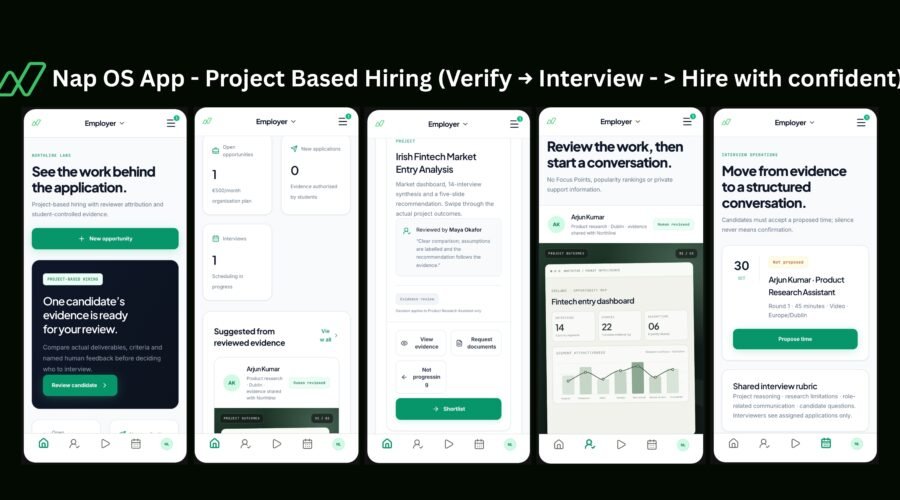
An inside look at the Nap OS employer experience: candidate-controlled project evidence, named human review and a structured route from first inspection to interview.
A CV can tell an employer where someone studied, which tools they list and what they say they can do.
But it cannot always answer the question behind the application:
What can this person actually produce—and how do they approach the work?
For students and job seekers, that question creates a familiar difficulty. They need an opportunity to demonstrate capability, yet employers often want evidence before offering the opportunity.
Nap OS is developing a project-based hiring experience designed to make that first conversation more informed.
The principle is simple: evidence before assumption.
Candidates share selected project outputs. Employers inspect the work, understand the criteria and read feedback attributed to a named Project Manager. They can then request documents, shortlist the candidate or propose an interview.
Not a guarantee of the right hire. A clearer foundation for deciding whom to meet.
Start with the work behind the application
The Nap OS employer interface opens with a direct invitation:
“See the work behind the application.”
That means looking beyond a skill label such as “research,” “analytics” or “communication.”
A candidate might share a market-entry analysis containing a dashboard, interview synthesis and a recommendation presentation. Another might share a campaign proposal or a product-research report.
The employer can inspect what the candidate produced rather than relying entirely on a description of it.
The questions become more specific:
- Is the reasoning understandable?
- Are the assumptions visible?
- Does the recommendation follow from the evidence?
- Can the candidate explain their contribution?
- What happened after feedback?
These questions do not remove the need for interviews. They give interviews a more useful starting point.
Verify: understand exactly what was reviewed
“Verified” should have a clear meaning.
In Nap OS, the proposed verification process centres on a named human reviewer assessing a defined piece of work against stated criteria.
A useful record identifies the project, deliverables, assessment criteria, reviewer, date and relevant feedback. It should also explain the project’s context.
Was it a practice scenario? A fictional-client exercise? An authorised external assignment?
Those distinctions matter.
A reviewed learning project is not automatically employment experience. It does not establish that the candidate worked for a company mentioned in the brief. Nor does one assessment verify every statement on a CV.
The objective is a precise, checkable account: this work was submitted, these elements were assessed, and this person reviewed them.
Credibility comes from that clarity—not from making the broadest possible claim.
Why named Project Managers matter
Nap OS’s initial reviewer proposition is centred on experienced professionals in Ireland, with matching dependent on domain expertise and availability.
Their role is to bring relevant professional judgement to the learning process.
A reviewer might recognise that a dashboard is visually attractive but supports an overstated conclusion. They might identify an unclear research question or ask the participant to distinguish observation from assumption.
That feedback creates an opportunity to improve.
For employers, the important information is not simply that a Project Manager was involved. It is what they reviewed and what they said.
Reviewer attribution gives the assessment an accountable source. Criterion-level comments help the employer understand its scope.
Ireland-based review can provide useful context for Ireland-focused preparation, but it should not be presented as universal validation for every profession or destination.
Revision makes the learning visible
A finished deliverable shows an outcome. A revision can reveal how the participant reached it.
Imagine an initial recommendation that overlooks an important limitation. The Project Manager identifies the issue, explains why it matters and asks for a revision.
The participant then changes the analysis and makes the limitation explicit.
Where the candidate chooses to share that history, an employer can see a concrete example of responding to feedback.
That is more informative than an unsupported claim of being “adaptable” or “open to learning.”
It still does not prove how someone will behave in every workplace. But it provides a specific example that the employer can explore in conversation.
The interview question becomes:
“What did you initially miss, and how did the feedback change your approach?”
Interview: turn evidence into better questions
Once a project appears relevant, the employer can move from inspection to a structured conversation.
The proposed Nap OS workflow connects evidence review with document requests and interview scheduling.
A recruiter might first inspect a project, then ask for a CV and a cover letter explaining interest in a particular role.
The candidate selects what to submit and receives a clear record of the request.
The employer can then propose an interview time, state the format and identify the discussion areas.
Confirmation should be explicit. A proposed time is not an accepted appointment, and silence should not be treated as agreement.
The result is a connected process: evidence, supporting information and conversation remain associated with the same application.
A short explanation can introduce a substantial project
Nap OS’s planned project-discovery experience can also include a concise candidate explanation.
In approximately sixty seconds, the participant can describe:
- The problem or brief.
- Their personal contribution.
- An important decision.
- What improved after feedback.
The explanation introduces the project; it does not replace the deliverable or review.
A narrated screen recording may be useful. A text or audio alternative should also be available so that camera performance and equipment do not become unnecessary barriers.
Employers should assess relevant reasoning, not appearance, accent or editing quality.
The strongest short presentation leaves the recruiter with a useful next question—not merely a favourable impression.
Hire with confidence—not certainty
After inspecting evidence and speaking with the candidate, the employer still needs to make its own decision.
Nap OS does not remove the need to assess role requirements, undertake appropriate checks or establish lawful employment arrangements.
“Hire with confidence” means approaching that decision with a better understanding of the evidence available.
It does not mean the platform guarantees performance or predicts the future.
The employer may conclude that the candidate is suitable, needs further discussion or does not match this particular opportunity.
The interface should preserve that context.
“Not progressing for this role” is a decision about an application—not a permanent judgement about a person’s capability or potential.
Candidate-controlled sharing
The employer experience depends on permission as well as access.
Candidates should understand which projects, deliverables and approved feedback they are sharing.
Private mentoring notes, personal support discussions and session recordings should not automatically appear in a recruiter’s workspace.
A person may choose to share one assessed project without exposing their entire learning history.
That separation is essential to the product’s purpose.
Learners need space to ask questions, make mistakes and seek help. Those activities should not become hidden negative hiring signals.
Nap OS’s employer interface expresses this boundary directly: no Focus Points, popularity rankings or private support information.
Professional evidence—not surveillance—should guide the conversation.
A clear employer subscription
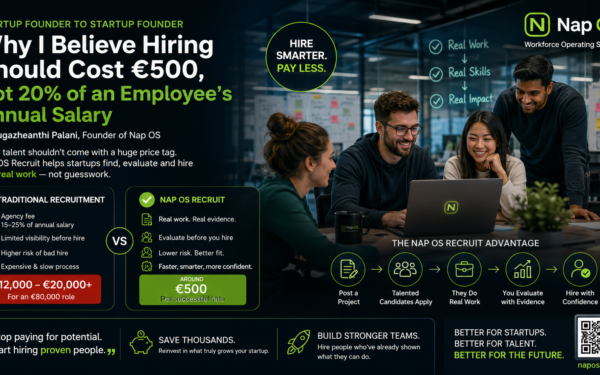
The proposed Nap OS Recruit organisation subscription is €500 per month.
Its purpose is to support an authorised hiring workflow: opportunities, shared evidence, applications, document requests, team review and interview coordination.
It is not a purchase of candidate data or unrestricted access to every participant.
The student programme remains separate: €999 for twelve months of project-based development, mentoring, assessment and career-readiness support.
Students should not face an additional charge to apply, submit requested documents or receive an interview invitation.
The distinction is straightforward: participants pay for learning; recruiters pay for their organisation’s hiring tools and authorised access.
Neither payment purchases an employment outcome.
Value for international students and job seekers
International candidates may be trying to explain experience from an unfamiliar education system, another market or an early stage of their career.
A well-presented project gives them something concrete to discuss.
Instead of saying only, “I can analyse information,” they can show an output, explain its limitations and describe the review process.
The same approach can support career changers and graduates who have relevant knowledge but limited conventional work history.
It does not make previous qualifications or experience irrelevant.
It adds another source of information alongside them.
A candidate’s strongest contribution may be the ability to explain what they did honestly—including what remains outside the project’s scope.
The next test is practical
The employer screens show the intended direction: inspect the work, understand the review and start a structured conversation.
The commercial and operational test comes through real use.
Do employers find relevant evidence? Do candidates understand their sharing choices? Do interviews become more focused? Do reviewers provide useful assessments? Do recruiter organisations choose to renew?
Those questions matter more than views, swipes or attractive dashboards.
Nap OS’s opportunity is to build a dependable connection between learning and hiring without pretending they are the same activity.
For employers, the invitation is simple:
Before deciding whom to interview, meet the work.
For students and job seekers, the message is equally clear:
You should be able to explain your capability with more than a list of claims.
Verify the evidence. Interview with purpose. Hire with a clearer understanding.