10 min read
What is in this invitation
- The invitation, in one paragraph
- Who we are inviting — by organisation type
- Where — corridors we can serve today, and corridors we will build with you
- The Catch-22, and what a foreign-national Project Manager actually does about it
- What Enterprise Ireland is selecting for, and how narrow the gate is
- How to verify us before you talk to us
- What we will not claim
- Six ways to partner
- The pilot, and how we would price it
1. The invitation, in one paragraph
Nap OS runs a twelve-month International Work Experience Program: six months of assessed project work before a student leaves home, six months after they land. Every brief is read and judged by a named Project Manager with at least five years in that field — in most cases somebody who made the same move themselves. We are inviting organisations that already hold the student relationship before departure — agencies, academies, schools, colleges, universities and training companies — to run that first six months with us, under terms we agree in advance and that you can leave if we fail your cohort. We are not asking you to resell a product. We are asking you to use the dead months you are already managing.
2. Who we are inviting — by organisation type
The common factor is simple: you are in contact with a student during the window between an offer and a flight. That window is the asset. These are the organisation types that hold it.
Overseas education consultancies and study-abroad agencies. You counsel the family, handle the application and the visa file, and then lose contact at the airport. The six months you already spend waiting on paperwork is the most valuable and least used period in the whole journey.
Test-prep and coaching institutes — IELTS, PTE, Duolingo English Test, GMAT, GRE. Your students are already in a disciplined study habit, already paying for preparation, and already understand that a test score is a gate rather than an outcome. Nap OS sits beside the score, not against it: the score proves language, the record proves work.
International language schools and English language teaching providers, both in source countries and in destination cities. Students in a pre-sessional or general English course have structured weeks and unstructured afternoons.
International schools — IB, Cambridge, A-Level and American curriculum — specifically Grade 11 and 12, and their university counselling offices. A student with a reviewed project portfolio is a stronger university applicant before they are a stronger job applicant.
Universities, colleges and their international offices, careers services and alumni teams, on both ends of the corridor: the institution recruiting international students, and the institution sending them.
Pathway and foundation providers running pre-university and pre-master’s programmes.
Graduate training and finishing-school companies — campus-to-corporate trainers, soft-skills and employability providers, final-year readiness programmes.
Placement and campus-recruitment training companies, including training and placement cells inside engineering and management colleges, and the third-party trainers they contract.
IT and professional training academies and bootcamps — data, software, cloud, analytics, digital marketing, finance. Your graduates can build; what they lack is an assessed record in the language and conventions of the market they are moving to.
Employer-side early-careers and graduate programmes in destination markets, as reviewers and as the eventual readers of the record.
Diaspora professional associations and alumni networks in destination countries — the natural supply of Project Managers who have made the move themselves.
3. Where — corridors we can serve today, and corridors we will build with you
A corridor has two ends. The student leaves from one; the reviewer must know the other. We will tell you plainly which ends we can staff.
Source markets we are built for today. India — with the deepest interest in Kerala, Tamil Nadu, Telangana, Andhra Pradesh, Karnataka, Maharashtra, Gujarat, Punjab and Delhi NCR. Nigeria, Ghana and Kenya. Vietnam and the Philippines. Nepal, Sri Lanka, Bangladesh and Pakistan. Brazil, Colombia and Mexico. Turkey, Kazakhstan and Uzbekistan. Gulf-resident expatriate families in the UAE, Qatar, Oman and Saudi Arabia, whose children apply as international students. Within the EU, Italy, Spain, Poland and Romania — no visa problem, the same Catch-22.
Destination markets. Our reviewer bench is strongest in Ireland today, and we would rather say so than imply a global network we do not have. We can place reviewers in the United Kingdom. Canada, Australia, New Zealand, Germany, the Netherlands, France, Poland, Spain, the United States, the UAE and Singapore are corridors we build on demand, with a named partner and a defined cohort — not before.
That is the honest position and it is also an invitation: if your organisation sits in a destination market, the most valuable thing you can bring us is reviewers, not students. Alumni and industry contacts who arrived as foreign nationals in that country and got through it are exactly the people we pay by the hour.
4. The Catch-22, and what a foreign-national Project Manager actually does about it
Your student lands with good grades, a degree nobody locally has heard of, and no work anyone in that country can check. Employers ask for local experience. Local experience requires an employer. That is the trap, and it is not solved by another certificate.
Three things make it worse, and they happen in a bad order. Rent starts before the career does, so the job that is available — retail, delivery, a warehouse — takes the evenings. Internship and graduate recruitment windows open in the first months of a course, not at the end of it. And the window after graduation is narrowing: the UK’s post-study Graduate route drops from twenty-four months to eighteen for applications from 1 January 2027.
What we put against it is not content. It is a named human being who has made the same move.
A Project Manager on our bench is a working professional with five or more years in the field, reviewing the work of a student heading for the market that professional lives in. They do the thing no model and no course does: tell a student that they answered the question that was asked instead of the one that was meant, or that the way they framed a recommendation reads badly to a hiring manager in that country. Criteria are published before the student begins, so nobody grades to fit what happened to be produced. Reviewers are paid by the hour rather than per submission, because paying per submission rewards speed and the thing being bought is somebody reading the work properly.
The student finishes with a record that states what they did, what it was judged against, who reviewed it and when — with a code an employer can follow. It belongs to them permanently, whether they remain a member or not. And it holds even if they never move: nothing in the programme depends on anyone being granted anything.
5. What Enterprise Ireland is selecting for, and how narrow the gate is
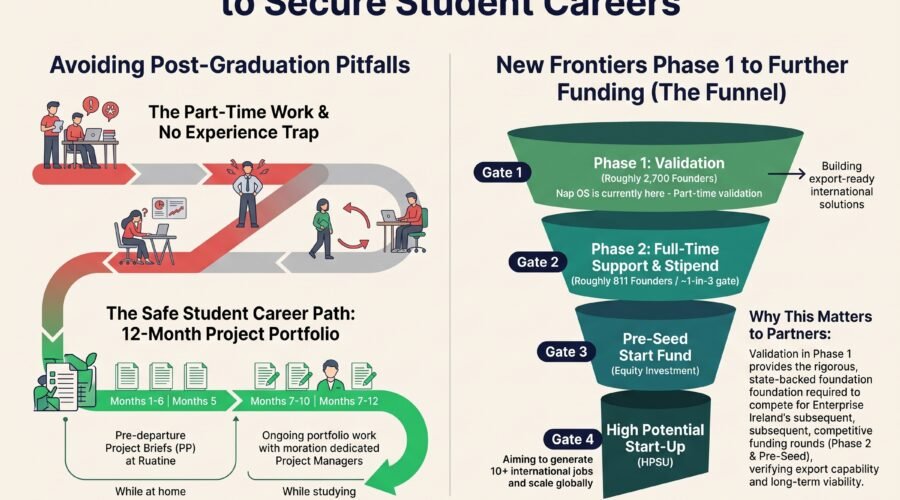
In October 2026 Napblog Limited was accepted onto New Frontiers Phase 1 at Media Cube IADT and NovaUCD. New Frontiers is Enterprise Ireland’s national entrepreneur development programme, running since 2012 and now delivered inside the Startup Ireland framework — a cross-government initiative backing 10,000 entrepreneurs and 1,000 new startups between 2026 and 2030, with €150m of direct early-stage funding.
What should interest a partner is not the acceptance but the criterion. Enterprise Ireland’s mandate is narrow: jobs and exports. Not good ideas, not domestic revenue. Companies that sell outside Ireland.
Look at the funnel. Over 2026–2030 New Frontiers will run 122 Phase 1 programmes for roughly 2,700 participants, and 62 Phase 2 programmes for roughly 811 founders — the state’s own published numbers, so Phase 1 to Phase 2 is about a one-in-three gate, decided competitively. Beyond it, Phase 2 carries a €17,500 stipend inside a package worth around €40,000; the Pre-Seed Start Fund takes state equity in companies judged high-potential; and the designation at the top, High Potential Start-Up, means a company assessed as able to sell an innovative product internationally and create ten or more jobs within three years.
That is the same question you are asking: can this Dublin company actually serve students in Kochi or Lagos, and will it exist in three years.
We are at the first gate. Phase 1 carries no funding, no equity and no endorsement of our product. Phase 2 is a separate competitive decision we have applied for and have not received, and two in three people in the room with me next month will not get it either. If we called ourselves “Enterprise Ireland-backed” we would be claiming state money we do not have — and we would have failed the test in the next section.
6. How to verify us before you talk to us
CRO 812006 — Napblog Limited on Ireland’s Companies Registration Office register, free to search at core.cro.ie: directors, filings, and the registered address at 77 Camden Street Lower, Saint Kevin’s, Dublin 2, D02 XE80.
EA 5651 — an Irish employment agency licence under the Employment Agency Act 1971. The Department publishes the register; check the name matches.
That second number carries a prohibition with it: we may not charge a jobseeker a fee for finding them work. It is the condition of the licence, not a marketing stance. If an overseas provider has offered your families guaranteed placement for a fee, ask which regulator licenses them and what that licence permits.
Then ask for a live record and read it closely — it is the only artefact, and everything else on our website is a claim.
Where we are today: 200 active members, 600 project briefs generated, 28 alumni now working at 24 employers. Small numbers, not dressed up, and checkable.
7. What we will not claim
Not a job. Legally prohibited from charging a jobseeker to find them work. Employment is not guaranteed.
Not a visa. No third party improves an immigration decision. Anyone telling your families otherwise is selling something.
Not a qualification. Not accredited, no ECTS, no NFQ level. We do not sell a certificate at all — so there is no premium tier to upgrade to, and nothing to sell a family a second time when an application goes quiet.
Not insurance. Nothing pays out if things go wrong. It is a programme of work.
These are on our homepage, above the pricing, because a partner who has to explain our small print to a family after the sale will not recommend us twice.
8. Six ways to partner
Referral. You introduce, we deliver and support, you take an agreed share. Lightest commitment, fastest to start.
Bundled pre-departure. Nap OS becomes the sixth month of your own package, sold as yours, priced inside your fee.
White-label cohort. Your brand on the programme, our briefs, criteria and reviewers behind it, with the record issued by Napblog Limited under EA 5651 so it stays verifiable.
Campus cohort. You host sessions on your own premises and supply the room and the cohort; we supply the briefs and the reviewers. This is the model under discussion with Faith Infotech Academy at Technopark, Thiruvananthapuram, for a 2027 pilot.
Institutional seats. A university, college or school buys a block of seats for an intake, with reporting back to the international office or careers service.
Reviewer supply. You bring Project Managers from your alumni or industry network in a destination market; we assess, calibrate, train and pay them by the hour. This is how a new corridor opens.
9. The pilot, and how we would price it
Start with one cohort, not a contract. Twenty to thirty students, the full twelve months, with the first six beginning while they are still with you, before departure. Agreed in advance: who recruits, who supports, who holds the student relationship, and what counts as success. Our proposal for the last one — completion rate, written feedback delivered inside seven days, and how many students arrive holding at least four reviewed projects.
Pricing is €999 for the twelve months paid once, or €49.99 a month rolling. The €999 plan includes ten fifteen-minute one-to-one sessions a month; the monthly plan, three.
One thing to understand about the commercials. Our cost is human hours, not software, so it does not fall as volume rises. A channel discount deep enough to squeeze the reviewer rate does not give your families a cheaper product — it gives them a worse one, because the only thing that can give is the care taken reading the work. We will show you the per-student reviewer cost in the conversation, and any structure that survives it is one we can both hold for three years rather than one.
And a termination clause that favours you. You are lending us your name with families you have known for years. If we fail your cohort, you should be able to walk away without argument.
To start a conversation, tell us three things: the corridor (where your students leave from and where they are going), the cohort size and intake month, and which of the six models fits how you already work.
Pugazheanthi Palani · Founder & CEO, Napblog Limited (Nap OS) palani@napblog.com · +353 89 453 0418 · napblog.com
Napblog Limited, trading as Nap OS. 77 Camden Street Lower, Saint Kevin’s, Dublin 2, D02 XE80, Ireland. Company No. 812006 · Licensed Employment Agency EA 5651 · EdTech Ireland Industry Partner Member · Accepted onto New Frontiers Phase 1 at IADT Media Cube / NovaUCD, November 2026. Fees cover project briefs, Project Manager review and career support — not recruitment or job placement. Employment is not guaranteed. Nap OS is not accredited and is not a qualification. Figures: Nap OS platform data, October 2026. New Frontiers and Startup Ireland figures: Startup Ireland Roadmap — Backing the Next Wave of Irish Startups, Enterprise Ireland, 2026. UK Graduate route duration: gov.uk, Statement of Changes HC 1333, 14 October 2025.