7 min read
Let me get the most important sentence out of the way first, because everything after it depends on being trusted.
Nap OS does not issue micro-credentials. In Ireland that word has a precise, protected meaning, and what we produce is not one. We say so in our own awards submissions, we say so to universities, and we will keep saying it, because the moment we blur that line we become one more company selling a badge — and badges are exactly what the people we serve already have too many of.
What we are building is the other half. Here is what I mean.
What Ireland actually built
Since 2020, the Irish Universities Association has run MicroCreds, a €14.3 million project funded under the Human Capital Initiative from the National Training Fund. Eight universities now take part — UCD, UCC, University of Limerick, Trinity, DCU, University of Galway and Maynooth, joined by TU Dublin in early 2025.
An Irish micro-credential from that system is a specific object. It is credit-bearing, quality-assured and accredited by the awarding university. It is aligned to levels 6 to 9 of the National Framework of Qualifications. It carries between 1 and 30 ECTS credits, where one ECTS represents 25 hours of learning. Some stack toward a larger award on a predefined pathway.
This sits inside a European structure. The Council of the European Union adopted its Recommendation on a European approach to micro-credentials on 16 June 2022, and the Commission’s own description is admirably plain: micro-credentials certify the learning outcomes of short-term learning experiences.
That is real infrastructure, built properly, by people who know what quality assurance costs. I am not about to pretend otherwise in order to sell something.
The sentence a micro-credential cannot write
Read that Commission definition again, carefully. A micro-credential certifies learning outcomes. It is a statement about what you were taught and how you were assessed on it.
It is an excellent statement. It is also not the statement an employer is trying to make when they are deciding whether to hire a graduate.
The sentence they want is different: this person took a brief that was not fully specified, made the judgement calls inside it, produced something finished by a date they did not choose, and a person who does this work for a living looked at it and said it was good.
No amount of accreditation produces that sentence, because accreditation is not what it measures. And the evidence that employers want it is not my opinion — the UL Careers Early Careers Employer Survey 2026, covering 269 employers, found that completing a work placement ranks as the second most important factor employers use to assess an application, behind only degree discipline. Ahead of grades.
Which leaves a strange gap. The thing employers rank second has no framework, no standard and no portable record. It exists only if you were lucky enough to get a placement.
What the Irish Work Experience Program actually issues
So here is our object, described as precisely as I described theirs.
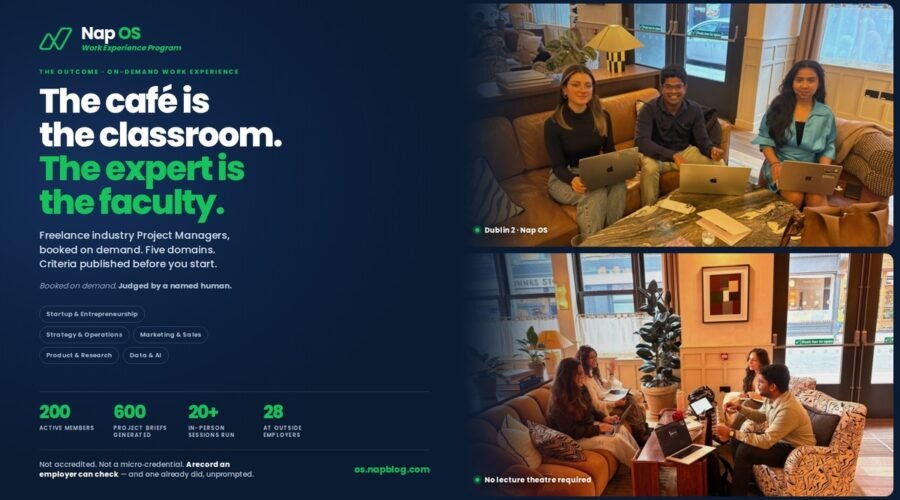
A member picks a project brief in one of five domains: Startup and Entrepreneurship, Strategy and Operations, Marketing and Sales, Product and Research, or Data and AI. The brief runs ten tasks over a fortnight. Each task carries its deliverable and the criteria it will be judged against, published before the member begins — not written afterwards to fit whatever they happened to produce.
They build. They submit. A named Project Manager with at least five years in that field assesses the submission against those published criteria and returns written feedback inside seven days. On completion, the member gets a verified record stating which brief they did, what they produced and what it was judged against, carrying a code an employer can check.
Now the disclaimers, in the same breath, because they are part of the product and not a footnote to it. It is not accredited. It carries no NFQ level. It carries no ECTS credits. It is not a qualification.
There is an interesting coincidence of scale worth noticing, though. At 25 hours per ECTS, a fortnight of structured project work sits roughly where a one-to-two-credit unit would sit. Similar size; entirely different kind. One certifies that you learned. The other evidences that you did, and names the person who checked.
What “hybrid” should actually mean
Most of the time “hybrid education” means online plus campus. That is a delivery detail, and it stopped being interesting around 2021.
The hybrid that matters is institution plus industry, and it is structural rather than logistical.
The institution owns what it is uniquely good at: the curriculum, the accreditation, the NFQ level, the academic relationship, the quality assurance, the credit that transfers. Nobody else can issue that and nobody should try.
Industry owns the other side: the brief that comes from a real problem, the judgement call that has no answer key, the person with five years of scar tissue who can tell you why your work is not good enough yet, and the record of what you actually produced.
A learner should be able to hold both at once. Today they mostly cannot, and the reason is not philosophical — it is that the second half was never built as infrastructure. It was left to whoever could get an internship.
Three of the eight MicroCreds universities are already in conversation with us. That is not a coincidence and it is not a competitive accident. We are not trying to be the ninth. We are trying to be the half that was missing.
Why live learning from a Project Manager is the irreducible part
Here is the thing that has changed under all of this, and it is why I think the human hour is now the scarce resource rather than the content.
AI will do the task. It will draft, structure, summarise, analyse and produce a competent first seventy per cent of almost anything, and it will do it in seconds. What it will not do is tell you that your judgement was wrong. It will not say you answered the question they asked instead of the one they meant. It will not know which part of your work would embarrass you in front of a client.
That is what the live sessions are for, and only that. Two fifteen-minute one-to-one sessions a month, plus written feedback within seven days — and the sessions exist for learning and feedback only.
Everything a system should do, the Nap OS app does: finding and picking briefs, tracking progress across the ten tasks, holding submissions, carrying the criteria, and letting a member review every aspect of their own work live and online. We deliberately do not spend a human’s fifteen minutes on anything software can do. The fifteen minutes is for the thing software cannot: a person who knows the field, looking at your work, and being straight with you about it.
We have run more than twenty in-person work experience sessions on top of that, because some feedback lands better in a room.
Is it an invention?
Honestly — the components are not.
Apprenticeship is thousands of years old. Work placement exists. Portfolios exist. Reviewed practice is how every craft has ever been taught. Anyone who tells you they invented learning by doing is selling something.
What I have not seen combined before is this: open entry with no CV screen and no interview, so the circle that keeps people out is broken at the door; criteria published before you start, so the judgement cannot be constructed afterwards; a named human reviewer paid by the hour, so careful review is rewarded rather than penalised; and a record deliberately narrow enough to survive verification, issued by a licensed employment agency that neither sells nor promises placement.
That last clause is the strange one, and it is the one I would defend. Napblog Limited holds Licensed Employment Agency licence EA 5651. We are legally forbidden from charging a jobseeker to find them work, which means the only thing we can sell is the practice and the review — and that constraint is why the record stays narrow enough to be true.
Earlier this month an employer we had never met contacted us to verify one of those records. They had no relationship with us. They found us, decided the thing was worth checking, and checked. It held up precisely because it claims so little.
Where the claim stops
Two hundred active members. Six hundred project briefs generated. Twenty-plus in-person sessions. Twenty-eight people who built this programme while using it, now working at twenty-four companies including Accenture, Amazon, ServiceNow, ESB Networks and Uisce Éireann.
That is not an ecosystem. That is a working second half at small scale, sitting beside a first half that took eight universities, six years and €14.3 million to build — and whose own project window closes this year, which makes the question of what comes next live right now rather than theoretical.
I would rather state the position at that size and be believed than inflate it and be checked.
Start free: os.napblog.com
Pugazheanthi Palani is Founder and CEO of Napblog Limited, trading as Nap OS, a licensed employment agency (EA 5651) at 77 Camden Street Lower, Dublin 2, and an EdTech Ireland Network Member. Nap OS records are not accredited awards and carry no NFQ level or ECTS credit. Fees cover project briefs, Project Manager review and career support — not recruitment or job placement — and employment is not guaranteed. Sources: Irish Universities Association MicroCreds project; European Commission, micro-credentials; Council of the European Union Recommendation of 16 June 2022; UL Careers Early Careers Employer Survey 2026 (269 employers).