7 min read
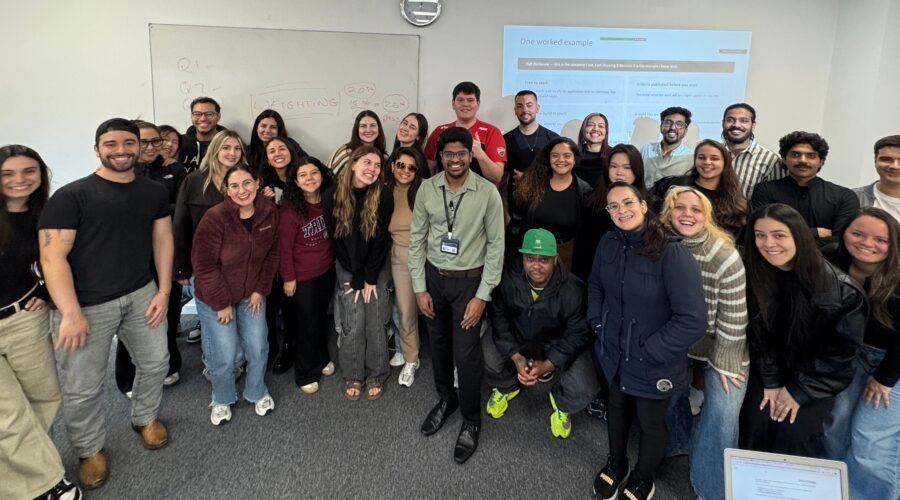
Room 204, Independent College, Foley Street. Half eleven on a Wednesday morning, which is not a time anyone chooses to think about their career. The room filled anyway.
I had forty minutes and five sections. The last slide on the screen when the photograph was taken is the one headed One worked example, and the first line on it reads: “Full disclosure — this is the company I run. I am showing it because it is the example I know best.” I wrote that line because I had promised the College the session would be educational rather than promotional, and because a room of students can smell a pitch from the back row.
What I want to write about is not what I said. It is what they were curious about — because it was not quite what I had prepared for, and the gap is worth recording.
The circle landed before I finished saying it
The session opens with three statements that are each individually true and jointly a trap.
Employers want judgement. Judgement comes from experience. Experience requires a job.
I had built that opening carefully, expecting to have to argue for it. I did not. The recognition in the room arrived about halfway through the second line. Everyone there had already met this circle personally; what they had not had was a name for it or anyone willing to say out loud that it is structural rather than a personal failing.
That is worth noting for anyone who teaches or hires. Students are not confused about the problem. They have diagnosed it perfectly well on their own. What they lack is permission to stop treating it as evidence that something is wrong with them.
What AI has taken, and the honesty it bought
The second section is the one I was most nervous about, because the honest version is bleak. The tasks that made up a graduate job five years ago — first-draft research, summarising, formatting, first-pass code, routine analysis, the competent first seventy per cent of almost anything — are substantially automated. Nearly half of Irish recruiters cut graduate and entry-level postings this year.
I had debated softening it. I did not, and I would make the same call again.
What I underestimated is how much credibility the bad news buys. The room leaned in after the uncomfortable slide, not before. I think students have been told so many encouraging things by so many people with something to sell that an adult being straight with them registers as unusual enough to be interesting.
The part that is not bleak sits in the right-hand column: knowing which question is worth asking, noticing when the output is wrong, deciding what to do about it, standing over the decision when challenged, and caring whether it is actually right. None of that moved. All of it is harder to prove on a CV than a list of software you have used.
The curiosity was almost entirely about one thing
Here is where the session went somewhere I had not fully planned for.
I had allocated eight minutes to using AI without hollowing out your own judgement, and ten to evidence. I expected the AI section to generate the questions. It did not. The questions clustered, insistently, around a narrower and more practical worry: if everyone can produce competent work now, what exactly am I supposed to show?
That is a better question than the one I had prepared to answer, and it is the whole business in one sentence.
The number I put on the screen for it comes from the UL Careers Early Careers Employer Survey 2026, which covered 269 employers: completing a work placement ranks as the second most important factor employers use to assess an application, behind only degree discipline. Ahead of grades. Ahead of everything in the personal statement.
Which is awkward, because the placement is precisely the thing the circle in section one makes hard to get. Employers rank second the very thing the market is supplying less of.
The four-part test
So the forty minutes narrow to a single practical definition, and it is the part I would ask anyone who was in that room to remember.
A piece of work is assessable — meaning an employer can do something with it — when it has four things.
A brief. Someone else’s problem, with a deadline you did not set. Not a project you designed to show yourself in a good light.
Criteria agreed in advance. Written down before you start, so the judgement cannot be constructed afterwards to fit whatever you happened to produce.
A finished deliverable. Something a person can open and inspect. Not a description of something you once did.
An independent judge. A named person with standing in the field who assessed it against those criteria and will confirm they did.
Remove any one of the four and it reverts to being a claim about yourself. That is the test, and it applies to a Nap OS project brief exactly as it applies to a college assignment, a hackathon, a volunteering project or a part-time job. Most college work has three of the four and is missing the independent judge. Most self-directed projects are missing the criteria.
What “AI-workplace-ready” actually means, since the phrase is everywhere
I am wary of the phrase because it has been attached to a great many courses that teach people to operate a tool.
Being ready for an AI-changed workplace is not knowing the tool. Everyone will know the tool within a year; that is what tools do. It is being able to show that you can take a brief, make the judgement calls inside it, produce something finished, and have a person who knows the field confirm that you did.
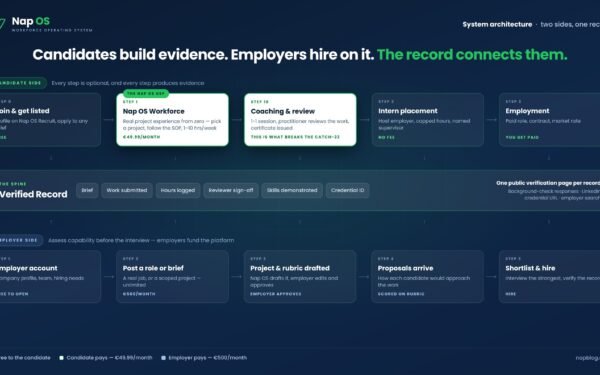
That is what the Nap OS Work Experience Program produces: a project brief with criteria published before you begin, work tracked in the app, review by a project manager with at least five years in your field, and a reference that states what you completed and what it was judged against. Not a character reference, not an endorsement, and not a job — we are a licensed employment agency and we do not sell recruitment or placement. A factual confirmation that can be checked.
The reason I believe the narrow version is the valuable one: earlier this month ten employers and background-verification companies contacted us unprompted to verify work a member had completed. Nobody asked them to. That is the only evidence I have that any of this works, and it is worth more to me than anything I could claim from a stage.
The two weeks, and why I end on it
The last five minutes are a plan a student can start the same afternoon with no permission, no money and no employer.
Days one and two: pick one real problem that belongs to someone else. Days three and four: write down the three or four criteria it will be judged on, and date it. Days five to eleven: do the work, using AI, writing your own first sentence every time. Day twelve: send it to one person qualified to judge it and ask for the hardest version of their feedback. Days thirteen and fourteen: write two hundred words on what you decided and why — not what you made, what you chose.
In a fortnight that produces one assessable piece of work. Most graduates applying this season will have none.
Thank you
To Shivam Singh, Student Experience Executive, who proposed the session, arranged it inside forty-eight hours of confirming the date and asked all the right logistical questions before I thought to. And to Karthik Jayaram, Marketing Executive, who got it in front of the students it was for. A guest speaker gets the easy half of this; the people who fill a room at half eleven on a Wednesday do the rest.
Thank you also to the Nap OS team. Very little of what I said in Room 204 was invented by me. The briefs, the review format and the evidence model were built by interns and coworkers who used the system while constructing it, and several of them were graduates standing where that audience is standing not long ago.
What I would say to the room, now that it has gone
You do not control whether someone gives you a chance. You control whether there is something to look at when they do.
Nothing in that session required Nap OS. The four-part test works on anything. If you take the criteria-before-you-start habit and nothing else from the forty minutes, you will be ahead of most people applying alongside you — and you will have got that for free from a Wednesday morning.
If you want the other part, the named person in your field who will tell you the truth about what you built and put their name to it, that is what we do and what we charge for. There was nothing to buy in that room and there still isn’t.
Start free: os.napblog.com
Pugazheanthi Palani is Founder and CEO of Napblog Limited, trading as Nap OS, a licensed employment agency (EA 5651) at 77 Camden Street Lower, Dublin 2. Fees cover project briefs, Project Manager review and career support — not recruitment or job placement, and employment is not guaranteed. Figures: UL Careers Early Careers Employer Survey 2026 (269 employers); IrishJobs Hiring Trends, May 2026 (500 HR professionals).