9 min read
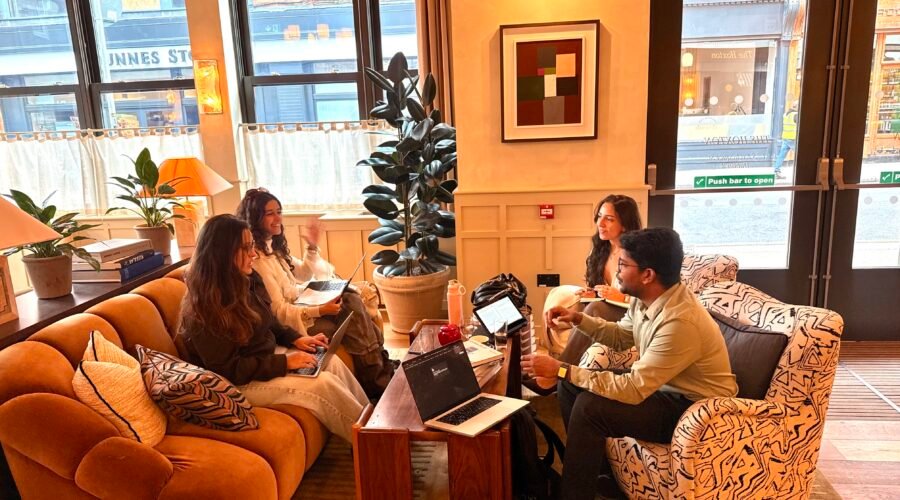
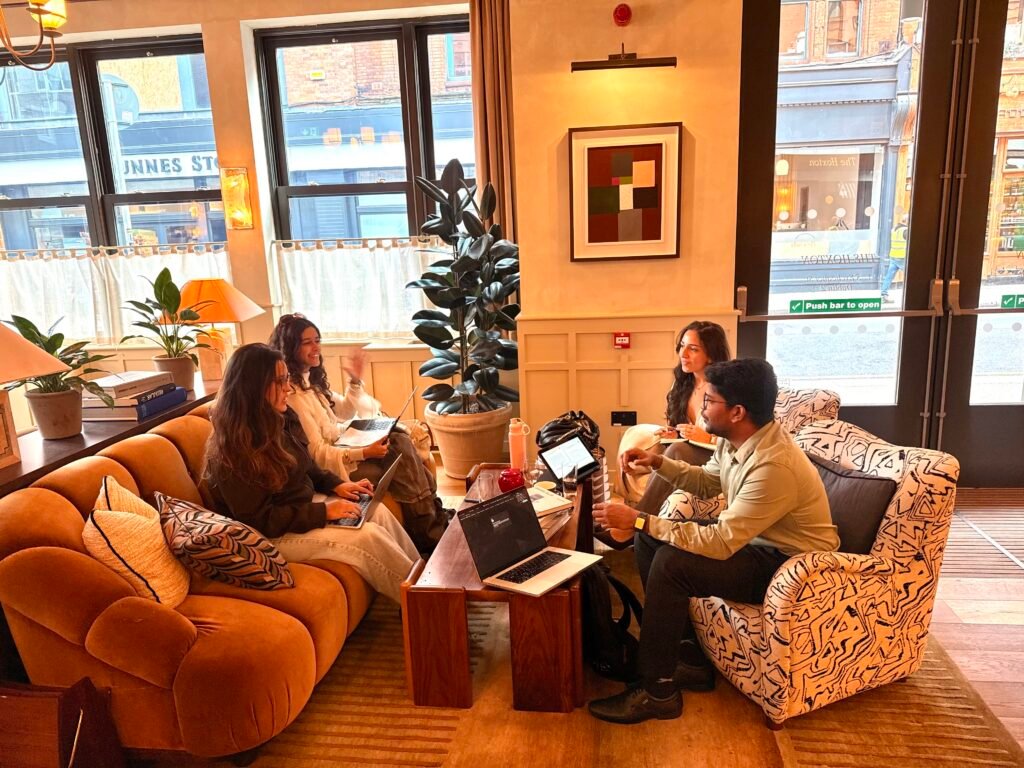
There is a photograph I keep coming back to. A Tuesday afternoon in the lobby of The Hoxton on Stephen Street Lower, eight minutes’ walk from our office. Four people, four laptops, a coffee table, an orange velvet sofa. Dunnes visible through the window.
One of them is a project manager. The other three are members working through live briefs. If you walked past you would assume they were friends who had brought their work with them, which is roughly accurate and is the entire point.
That is the Nap OS Work Experience Program. No application. Nobody waited six weeks to hear back. Nobody sat alone at the end of a row of desks being the youngest person in the building. And nobody sat facing forward for ninety minutes.
Take the furniture away
Strip work experience down and it is three parts. Someone gives you a real problem. You attempt it and produce something. Someone who knows more than you tells you honestly where it fell short.
Everything else — the building, the lanyard, the six months, the rejection letters that preceded the one acceptance — is delivery mechanism. It accumulated because for most of the last century there was no way to put a learner beside a practitioner except to hold them in one building for a long time.
That mechanism fails in three familiar ways. The wait: you apply in November for something starting in June, and the person who applied no longer exists by the time it begins. The isolation: one young person in a room of experienced ones, not asking the obvious question because everyone else knows the answer and you are being assessed. The latency: you learn whether the work was any good long after you have forgotten what you were thinking.
The lecture has the same problem
The placement is only half of it. The other half is the room most students spend the week in: ninety minutes, one person at the front, sixty people facing forward. A lecture is a broadcast, calibrated to a student who does not exist — the average of sixty people, moving too fast for a third of the room and too slow for another third.
The deeper problem is not boredom. It is that nothing in a lecture tells you whether you understood it. You nod along, the logic seems to follow, you write it down, and you find out weeks later under exam conditions, far too late to ask. And you will not ask in the room — nobody raises a hand in front of fifty-nine people when the cost of looking slow is public and the benefit is private.
Now put the same learning in a hotel lobby. One project manager, your actual work on the table, fifteen minutes. You cannot nod along, because you are the only one there. They cannot generalise, because they are looking at the specific thing you made. The question you would never raise in a lecture hall is the obvious thing to say across a coffee table.
What €49.99 a month buys
The briefs are free. A hundred project domains, ten briefs in each, ten tasks across a fortnight, every task carrying its deliverable and the criteria it will be judged against before you begin. Read all of it, start any of it, pay nothing. What you build is yours permanently either way.
The Work Experience Program is the €49.99. Monthly, pausable for exams, restartable afterwards. You make three choices in the app, and the app carries everything that follows.
You choose the domain. Not the one that was available — the one you actually want experience in. At our two careers fairs this month, data and AI was ticked more than twice as often as anything else, which tells you how badly the old allocation system served people.
You choose the project manager’s expertise. You are not assigned whoever has capacity. You browse and pick someone with at least five years in the specific field you are trying to enter, and that person reviews your work and signs your record.
You choose the location. Online if that suits. A café, a library, a hotel lobby in Dublin 2 if it does not. The session goes where you are rather than the other way round.
The app does everything a system can do
This is the part people miss when they picture a coffee shop, so let me be plain about it. The sofa is not the product. The Nap OS app is where the work actually lives.
The finder is where you pick: filter briefs by domain and skill, browse project managers by field and years of experience, choose the format and place that suits you, and see what is available before you commit to any of it. You can review every aspect — the brief, the tasks, the criteria, the reviewer’s background — before you start, not after.
Then the app tracks it. Ten tasks across a fortnight, each with its deliverable. What you submitted and when. The criteria each piece was judged against, published before you began. The written feedback, inside seven days. What you completed, what you did not, and what the reviewer confirmed. That tracked history is what the reference is generated from — not somebody’s recollection of a nice conversation in a lobby.
So the division of labour is strict. Everything that can be recorded, filtered, timestamped or audited happens in the app, because software is better at all of it than a person with a notebook. The human time is reserved for the one thing software cannot do.
Choosing your own reviewer, and the trap in it
In every other version of this, the assessor is an accident. You got the manager you got. If they were generous you were lucky; if not, you lost six months and learned to make coffee. Letting the learner choose inverts something fixed for a century, and it is the change I am most confident about.
The trap is that people will choose the nice one. Given a free choice between a reviewer known for being encouraging and one known for being exacting, a nervous twenty-two-year-old picks encouraging almost every time — and that instinct, followed consistently, produces a system that feels wonderful and certifies nothing.
So the finder sorts by expertise and availability, not by leniency. The criteria are published before the work starts and the reviewer judges against those, not against their mood. A reviewer who waves work through is not being kind — they are devaluing the only asset this company owns, and a record signed by someone who skimmed it is worse than no record at all. It is a lie with a logo on it.
One honest caveat: choice requires supply. We are recruiting toward a thousand freelance project managers precisely because “pick your reviewer’s expertise” is an empty promise if there are four of them. If your field is thin this month, I would rather tell you than match you with someone who does not know it.
Friends make it work, and friends are the second trap
The thing I did not design is that people do this together. They bring someone from their course, work in a café, argue about an approach. One of them explains something out loud and discovers halfway through the sentence that they do not actually understand it — the most reliable learning event there is. The discomfort of not asking the obvious question disappears when the person beside you is equally unsure.
And the second trap. A group of peers is an excellent machine for confirming one another’s mistakes. Four people who like each other, all think the approach is sound and all want the afternoon to go well will produce four versions of the same wrong answer and feel good about it. Everything that makes working with friends pleasant also makes it uncritical.
Which is why there is a fourth person in that photograph.
Fifteen minutes of a named human
Two fifteen-minute one-to-one sessions a month, wherever you chose to have them.
The sessions are for learning and feedback. Nothing else happens in them. You do not pick your brief in a session, you do not submit work in one, nothing is graded in one, and no record is created by one. All of that is in the app, where it can be checked. The session exists so that a person who has spent five years in your field can look at the specific thing you made and tell you what is wrong with it.
Fifteen minutes sounds like nothing. I think it is the most efficient unit of instruction in the system, for two uncomfortable reasons.
A manager in a real job does not give you fifteen uninterrupted minutes of undivided attention twice a month. They give you three minutes between meetings, half their mind elsewhere, and a vague “yeah, looks fine.” The placement wins on duration and loses badly on density.
And a lecturer, however good, is giving ninety minutes to sixty people — ninety seconds each. Fifteen minutes one-to-one on work you actually made is ten times that, spent on you rather than on the average of the room.
Duration is the wrong measure. What matters is how many of those minutes were about your specific mistake.
The reference, and exactly what it is
Napblog Limited trades as Nap OS and holds Licensed Employment Agency licence EA 5651, which makes this paragraph a legal statement as much as an honest one.
The reference a project manager provides is a factual confirmation of work completed and reviewed: which brief you did, what you produced, the criteria it was judged against, and that a named person assessed it. Not a character reference, not a personal endorsement, not a job offer. We sell project briefs, Project Manager review and career support — not recruitment or job placement — and we do not guarantee employment.
That narrowness is only possible because of the app. Every line of it comes from something tracked: a dated submission, a criterion published before the work began, a reviewer’s written response. Nothing in it rests on anybody’s memory of an afternoon.
And a factual claim an employer can check is worth more than a warm paragraph they cannot. Earlier this month, ten employers and background-verification companies contacted us unprompted to verify work a member had done. Nobody asked them to. It is the only real evidence I have that any of this works.
Where the claim stops
The UL Careers Early Careers Employer Survey 2026, covering 269 employers, ranks completing a work placement as the second most important factor in assessing an application, behind only degree discipline. Ahead of grades. In the same year, nearly half of Irish recruiters cut graduate and entry-level roles. Employers rank second the very thing they are supplying less of — and that gap does not close by companies creating more placements. It closes by the evidence being produced elsewhere and being credible enough to accept.
And here is where I stop. Of the 124 people who signed up at our two careers fairs this month, five took a paid plan. Five. The format is clearly wanted; the model has not yet proved it is a business. Anyone telling you a new format is the future without showing you their conversion rate is showing you the flattering half.
I think the format is right. I do not yet know whether we are.
Open a brief. It costs nothing. Bring one person you like working with, find a room with good coffee and unreasonable sofas, and work for two hours.
If at the end of it you want someone who is not your friend — someone with five years in your field — to tell you the truth about what you built and put their name to it, that is the Work Experience Program.
Start free: os.napblog.com
Pugazheanthi Palani is Founder and CEO of Napblog Limited, trading as Nap OS, a licensed employment agency (EA 5651) at 77 Camden Street Lower, Dublin 2. Fees cover project briefs, Project Manager review and career support — not recruitment or job placement. Employment is not guaranteed. Employer figures: UL Careers Early Careers Employer Survey 2026; IrishJobs Hiring Trends, May 2026.