7 min read
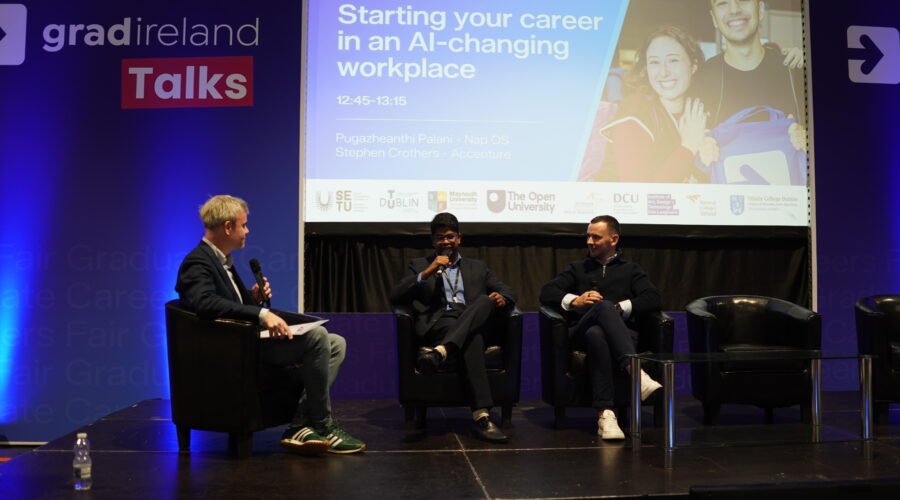
On 6 October I sat on the Main Stage at the gradireland Graduate Careers Fair in the RDS, microphone in hand, talking to a room of graduates about how to start a career in a workplace that AI is rearranging underneath them.
Six years ago I was a graduate student in Dublin with a Master’s from Griffith College, an engineering degree from Chennai, and no Irish work experience. I went to fairs like that one. I queued at stands like the ones I stood beside on Monday. I collected branded pens and left with the quiet feeling that everyone in the room already knew something I did not.
So when gradireland asked whether I would speak on a panel, I said yes before I had finished reading the email. Not because I had something clever to say. Because I remembered exactly what that chair feels like, and I knew what I would have wanted somebody on that stage to tell me.
I am thankful to gradireland for the invitation, and genuinely a little stunned by the distance between those two chairs.
The panel
12:45–13:15 — Starting Your Career in an AI-Changing Workplace.
I shared the stage with Stephen Crothers of Accenture — two people looking at the same problem from opposite ends. Accenture hires graduates at scale into a business AI is reshaping in real time. Nap OS works with people in the months before anyone hires them at all.
The question underneath the session was the one every graduate in that room is actually asking, whether or not they say it out loud: if AI can do the entry-level work, what is left for me?
It is a fair question and it deserves a better answer than optimism.
Here is what I think is true. The tasks that made up a graduate job five years ago — pulling a report together, cleaning a dataset, drafting a first version — are precisely the tasks AI now does in seconds. Pretending otherwise helps nobody. What has not changed is the part that was never about the task: knowing which report is worth pulling, noticing the data is wrong before you build on it, understanding why the client asked the question they asked instead of the one they meant.
That is judgement. Judgement is not a skill you are taught. It is a residue left behind by having done the work, badly, a number of times, with somebody experienced telling you why.
Which is where the problem gets circular, and where it gets personal for me. Employers want judgement. Judgement comes from experience. Experience requires a job. The job requires judgement. Every graduate in that room was standing inside that circle, and AI has made it tighter, because the entry-level tasks that used to be the way in are the first ones to be automated.
If you love what you do, AI can’t take your job
I said that on the stage and I want to be precise about what I mean by it, because as a slogan it is easy to dismiss.
I do not mean enthusiasm is a force field. Loving your work will not stop a system automating a task you were doing. Plenty of people who loved their jobs have lost them.
What I mean is narrower and, I think, harder to argue with. If you love what you do, you do not stop at the task. You read around it. You ask why the process is shaped that way. You notice when the output looks wrong even though the numbers add up. You volunteer for the awkward piece nobody wants. You accumulate, almost without noticing, the exact thing that does not automate — context, taste, judgement about what matters.
Somebody doing the same job for the paycheque does the task and stops. When the task goes, there is nothing underneath it.
So the line is not really about passion. It is about depth. AI takes tasks. It has a much harder time taking the person who understands why the task existed. And the fastest way to become that person is to care enough to go past the brief you were given.
That is also, not coincidentally, the whole design of what we build.
The rest of the Main Stage
One of the better things about the day was that our panel was not the only one, and the five sessions together formed something more useful than any of them alone. Read the running order and you can see an entire career arc laid out in three hours:
12:00 — Resilience in the Job Market. Elizabeth Whittle of BDO and Matthew Ryan of Kerry on managing volumes of applications, handling rejection, and the long silences between stages. This one went first for a reason. Before anything else works, you have to still be standing.
12:45 — Starting Your Career in an AI-Changing Workplace. Stephen Crothers and myself.
13:30 — Culture Beyond the Careers Website. Terry Gleeson of Specialisterne Ireland and Donagh Powell of Accenture on how to tell whether you will actually fit somewhere — what to ask about management, feedback and belonging, using real examples instead of a values statement on a careers page. I would have found this session genuinely useful at twenty-four.
14:15 — Beyond the First Job. Hannah Furlong of Clear Strategy and Rebecca Keane of publicjobs on what development looks like at six months, one year and three years, and how promotions really happen.
15:00 — What Would I Actually Do All Day? Gargi Rajadnya, Thomas O’Dowd and Niamh Anderson of AIB, Ellie Galland of Irish Cement, Emma Lynch of Kerry and Agada Priscilla of BOFA, walking through a real working week.
That last one may be the most quietly radical session of the day. Nobody tells graduates what the work is actually like. We describe roles in the language of job specifications and then act surprised when people arrive with no idea what Tuesday afternoon involves.
I sat in on what I could and took notes like a student, which is roughly what I was. The generosity in that building — senior people giving an afternoon to strangers who can do nothing for them — is the part I keep thinking about.
What happened at our stand
The honest version, because a newsletter that only reports applause is not worth reading.
Ninety-seven graduates gave us their details that day, and over a hundred and twenty across the RDS and the NCI Part-Time Jobs Fair the following afternoon. A third of everyone who scanned our QR code completed the whole form on a phone in a noisy hall — far above what we expected.
The clearest signal in the data: Data and AI was ticked more than twice as often as any other area. Marketing, strategy, product and startup interest were all healthy and all a long way behind. The room is telling us where it is going.
Ninety-two per cent of people gave us a mobile number as well as an email. That is not a small thing. People do not hand over a phone number to a company they are unsure about.
We also got a number of things wrong, which I will write about separately rather than hide here. The follow-up email we had ready was warm, well-written and contained nothing to click. We fixed it. The lesson stands.
What we are offering, plainly
If you were at the fair, or if you are reading this and you are in the circle I described:
Every project brief on Nap OS is free to read and free to start. No CV, no application, no interview, no card. One hundred project domains, ten briefs in each, ten guided tasks over two weeks, roughly two hours a task. Every task tells you the deliverable, the criteria it will be judged against, and a suggested tool before you begin.
You choose a brief in the career you are aiming at, you build something real, and everything you make stays yours. That is free permanently, not for a trial period.
If you later want a project manager to review what you built and issue a verified record of it, that is the part we charge for — €49.99 a month, pause or cancel whenever you like.
To be exact, because we are a licensed employment agency and precision here matters: we sell project briefs, review and career support. We do not sell recruitment or job placement, and we do not guarantee employment.
What I can tell you is that twenty-eight people who worked through Nap OS briefs are now with outside employers — among them Accenture, Amazon, ServiceNow, ESB Networks, Uisce Éireann and Bosch Rexroth. One of them is a National College of Ireland graduate who is now a data analyst at Accenture. I was sitting beside Accenture on that stage. I did not mention it at the time, but I thought about it.
Start here: os.napblog.com
One last thing
To the graduate who stopped at our stand and said they had applied to ninety-four roles and heard back from three: you are not doing it wrong. The system is genuinely difficult right now and the silence is not a verdict on you.
Build something anyway. Pick one brief, finish it, and walk into the next room with evidence instead of a claim. It is the only part of this that is entirely within your control.
Six years ago somebody could have told me that. I am telling you.
Pugazheanthi Palani is Founder and CEO of Napblog Limited, trading as Nap OS, a licensed employment agency (EA 5651) based on Camden Street in Dublin. He spoke on the Main Stage at the gradireland Graduate Careers Fair, RDS, on 6 October 2026.
Questions? Reply to this email, or book thirty minutes: calendly.com/palani-napblog/30min