7 min read
The moment preparation met the market
A year of preparation reached its most important test at the gradireland Graduate Careers Fair 2026. For Nap OS, this was not simply another exhibition or a day of distributing promotional material. It was an opportunity to put the product, its language and its central promise directly in front of graduates and job seekers at scale.
The outcome was our clearest market signal so far. More than 100 people expressed interest in becoming early adopters. The team recorded over 1,000 positive conversations and responses, distributed approximately 3,000 Nap OS flyers and delivered the campaign through a coordinated twelve person crew. These figures represent internal event results rather than an independently audited study, but they give us something more valuable than online impressions: direct evidence that the problem resonates with the people experiencing it.
The event concluded a long period of preparation, but it also opened a more demanding phase. Interest must now become product use, completed projects and credible evidence. Commercial validation is a sequence connecting attention, activation, payment, retention and outcomes.
Why gradireland mattered to Nap OS
Nap OS was created around a simple employment problem. Many graduates are asked to show experience before an employer will give them the opportunity to gain it. A CV may list education, skills and ambition, but it often cannot show how someone approaches an open problem, makes decisions, responds to feedback or completes work to an agreed standard.
Nap OS is building an alternative evidence layer through R&D project briefs. Self-directed learners can begin independently. People seeking human support can pay for Project Manager review, verified evidence and, where earned, a professional reference based on completed work. The service does not promise employment or sell access to a job.
The gradireland fair brought Nap OS directly to an audience facing this challenge. Instead of relying on traffic, social engagement or assumptions, the team could explain the product face to face and observe which messages created understanding.
The strongest response came when we described Nap OS in practical terms: choose a relevant project brief, build the weekly tasks, receive human review, complete verification and show employers the resulting evidence. Graduates understood that this was different from another generic course, CV rewrite or motivational career service. The value was in doing relevant work and having that work reviewed.
A year of preparation behind one day of execution
The visible event lasted one day, but the operation behind it took months. The team refined broad employability support into a clearer project-based hiring proposition. We tested language around local experience, evidence, verification and Project Manager references. We built landing pages, forms, QR journeys, follow-up emails and measurement systems, supported by printed collateral designed for a busy exhibition hall.
The project catalogue was organised around five areas: Startup and Entrepreneurship, Strategy and Operations, Marketing and Sales, Product and Research, and Data and AI. Graduates could identify an entry point connected to the career they wanted rather than follow one generic pathway.
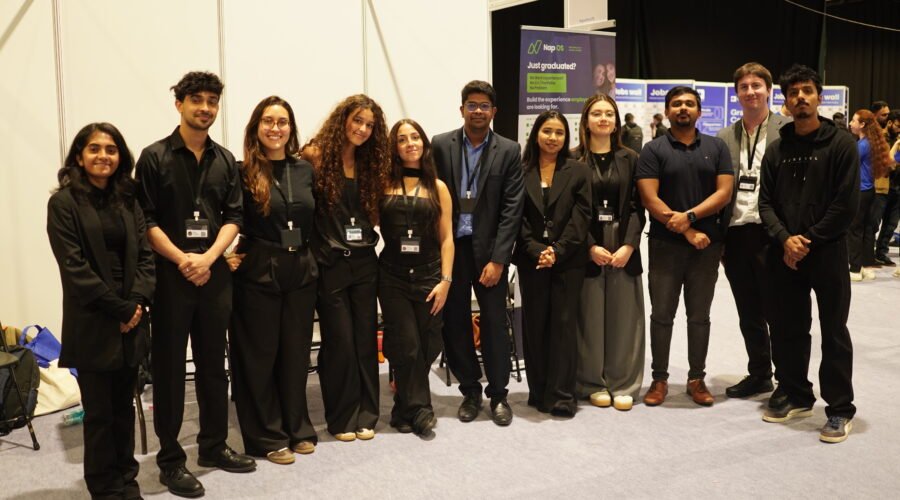
The operational plan was equally important. A twelve person crew meant the stand could remain active, welcome visitors, explain the model, support QR registration, distribute flyers and capture recurring questions without depending on one founder to manage every interaction. That preparation turned a potentially chaotic event into a coordinated field test.
What the numbers tell us
Three thousand distributed flyers show reach, but reach alone is not validation. More than 1,000 positive interactions show that the message attracted attention, but positive feedback is not the same as willingness to use or pay for a product. The most useful early signal is the group of more than 100 people who actively registered their interest as potential early adopters.
That group gives Nap OS a practical starting cohort. We can study which domains attract demand, how many registrants activate, which projects they begin, where they stop and how much support they need. We can also test whether self-directed use leads naturally into paid review and verification.
This is why the event represents strong early commercial validation rather than final proof of product market fit. It confirms that there is meaningful interest in the problem and the proposed solution. The next evidence must come from behaviour: activation, project completion, paid conversion, retention, referrals and employer acceptance of the resulting evidence.
That distinction matters. Startups weaken their credibility when they treat attention as revenue or registrations as long-term customers. Nap OS will treat the fair results as a promising baseline and measure what happens next with discipline.
The twelve people who made the campaign possible
The success belonged to the whole Nap OS team. Pugazheanthi Palani led as Founder and CEO of Napblog Limited. Anirudh Viswanath and Subramani Dandapani contributed as Data Project Managers. Balaji Shanmugam supported HR operations. Mridhula Vijayakumar represented the National College of Ireland student community, while Karthik Sumod contributed through the University College Dublin pilot thesis collaboration.
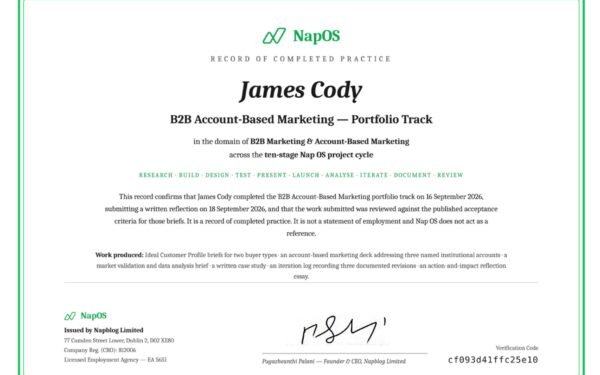
The campaign team included Namrata Ghoghari, Danielly Apodaca, Amanda Martins, Heloisa Moreira and Nefise Adiloglu. Their outreach, content and visitor engagement turned a proposition into a human conversation. James Cody participated as a Nap OS Incubate pilot candidate, connecting employability with entrepreneurship.
Each role mattered because commercial validation is not created by a founder speaking loudly about an idea. It is created when a team can explain the same value clearly, listen consistently, record evidence and help potential users take the next step. The event also demonstrated the operating principle behind Nap OS itself: people become more credible when they contribute to real work with defined responsibilities and visible outcomes.
What graduates helped us understand
The conversations reinforced that job seeking is personal. People were not asking only how to improve a document. They wanted to know how to build relevant experience, how to choose a project connected to a desired role, how feedback would work and whether an employer would recognise the evidence.
Visitors included international graduates facing the local experience barrier, career changers and students preparing for a first professional role. Their situations differed, but the underlying need was similar: a credible bridge between learning and employment.
The response also confirmed the importance of human review. AI can support research, drafting, analysis and productivity, but candidates still need accountable feedback on the quality of their decisions and outputs. A Project Manager can ask why a choice was made, identify gaps, require revision and verify what the participant actually contributed. That human judgement is central to the paid value of Nap OS.
Turning event interest into durable traction
The work after the fair is more important than the applause during it. The first priority is to follow up promptly with every registrant, confirm consent and segment people by career goal, experience level and preferred project domain. Each person should receive a simple route into Nap OS rather than a long sequence of promotional messages.
The second priority is activation. Early adopters need to select a brief, understand the expected output and complete the first task quickly. The team must track where participants become confused or disengaged and use those findings to improve onboarding, project instructions and support.
The third priority is value measurement. Nap OS should record project starts, weekly progress, completion, review requests, verification outcomes, paid conversions and referrals. Qualitative interviews should ask why participants chose Nap OS, which alternative they considered, what problem the project solved and whether the resulting evidence improved their confidence or employer conversations.
The employer side must also be tested. Project evidence becomes valuable when hiring managers understand it, trust the review and use it in decisions. The goal is not to eliminate the CV overnight, but to add a proof layer that reduces uncertainty.
Thank you and the beginning of the next phase
Nap OS is grateful to the gradireland team for providing the opportunity, platform and support to test this vision with Ireland’s graduate community. We are equally grateful to every graduate who stopped, asked a difficult question, challenged the proposition, completed a form or shared honest feedback.
The campaign showed that a small, committed team can execute a complex plan when responsibilities are clear and the mission is understood. It also showed that the demand for credible project experience is not theoretical. People want a practical way to move from learning to evidence and from evidence to stronger professional conversations.
A year of preparation has concluded successfully. The next phase is about proving repeatable value: helping early adopters begin, finish and verify relevant projects; learning what they will pay for; and demonstrating that employers recognise the evidence. The fair was a major milestone, but the real achievement will be what those first participants are able to build next.
That is how event interest will become durable workforce and hiring infrastructure.
The team is ready to make that transition measurable.
Napblog Limited | gradireland Graduate Careers Fair 2026