8 min read
Universities teach. Nap OS proves. Employers hire.
AI has changed how students and job seekers search for career advice.
Today, a student can open a general-purpose AI assistant and ask:
“How do I get a graduate job?”
“What skills do I need for data analytics?”
“Can you improve my CV?”
“What questions will I be asked in an interview?”
The answers can be useful.
But there is a fundamental limitation:
Generic AI can answer a career question. It does not necessarily build the workforce evidence required to answer an employer’s question.
That distinction is at the centre of the Nap OS AI Hiring Advisor.
Nap OS is building an AI Hiring Advisor specifically around project-based hiring, verified skills, workforce evidence and employer requirements.
The goal is not to create another chatbot that searches the internet and produces career advice.
The goal is to help a student move from:
“What should I do?”
to:
“What should I build?”
to:
“What can I prove?”
to:
“Which employer could value this evidence?”
That is a fundamentally different product proposition.
Generic AI Starts With Information. Nap OS Starts With the Hiring Problem.
A general AI assistant has access to an enormous universe of information.
Ask:
“How do I become a software engineer?”
It can discuss:
- programming languages
- university degrees
- coding bootcamps
- GitHub
- interview preparation
- CVs
- certifications
- job boards
- portfolio websites
- industry trends
All of this can be useful.
But a student still has to make the critical decisions:
Which skill should I develop first?
What project should I build?
How difficult should that project be?
How do I demonstrate the skill?
How can the work be verified?
How does the project relate to an actual employer requirement?
How do I turn the evidence into an opportunity?
This is where Nap OS is intentionally different.
The Internet Is Full of Information. Hiring Is About Evidence.
One of the biggest changes happening in recruitment is the movement toward skills-based hiring.
The OECD describes skills-first hiring as a shift toward demonstrated skills as a central basis for recruitment, with qualifications and experience becoming complementary rather than acting as the only signals.
That creates a new requirement for students.
It is no longer enough to know:
“Employers want Python.”
The more important question is:
“Can I demonstrate that I can use Python to solve a relevant problem?”
That means the workforce system needs to capture more than a list of skills.
It needs to capture:
Skill → Project → Output → Responsibility → Verification → Relevance
That is the model Nap OS is being designed around.
Why Generic AI Chat Is Not the Same as an AI Hiring Advisor
There is nothing inherently wrong with using general AI for career preparation.
It can be extremely useful.
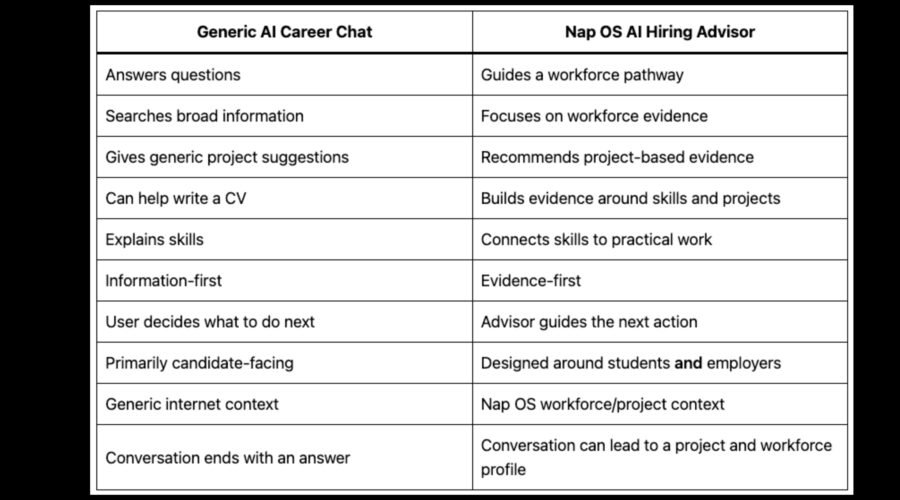
But there is a difference between AI that provides information and AI designed around a workforce operating system.
| Generic AI Career Chat | Nap OS AI Hiring Advisor |
|---|---|
| Answers questions | Guides a workforce pathway |
| Searches broad information | Focuses on workforce evidence |
| Gives generic project suggestions | Recommends project-based evidence |
| Can help write a CV | Builds evidence around skills and projects |
| Explains skills | Connects skills to practical work |
| Information-first | Evidence-first |
| User decides what to do next | Advisor guides the next action |
| Primarily candidate-facing | Designed around students and employers |
| Generic internet context | Nap OS workforce/project context |
| Conversation ends with an answer | Conversation can lead to a project and workforce profile |
This distinction is central to the Nap OS product strategy.
The AI Hiring Advisor Is Designed Around the Employer’s Question
The candidate asks:
“How can I get hired?”
The employer asks:
“Can this person do the work?”
Those are not the same question.
A generic career chatbot is naturally optimised around the first.
Nap OS wants to build a system that connects both.
Imagine a student says:
“I want to become a marketing analyst.”
A generic AI might recommend learning:
- Excel
- SQL
- Google Analytics
- market research
- statistics
- presentation skills
Useful.
But the Nap OS AI Hiring Advisor can take the next step:
What should you build?
Project: Irish E-commerce Customer Analytics
What should you demonstrate?
- data cleaning
- customer segmentation
- analytical reasoning
- dashboard creation
- business recommendations
- communication
What should the final evidence contain?
- project brief
- methodology
- dataset
- analysis
- dashboard
- recommendations
- presentation
- reviewer feedback
Now the student has moved from career information to workforce evidence.
Nap OS Is Not Trying to Predict the Employer. It Is Trying to Make the Candidate More Legible to the Employer.
This distinction matters.
Nap OS should not claim:
“Our AI knows exactly what every employer will decide.”
Hiring decisions remain human and organisation-specific.
In fact, current research reinforces the importance of human involvement. A 2025 survey of hiring managers found that 93% emphasised the importance of human involvement in hiring, even while AI adoption was widespread.
The Nap OS opportunity is therefore different.
It is to make the evidence that reaches the human decision-maker better structured, more relevant and easier to understand.
Instead of forcing a recruiter to interpret:
“Strong analytical skills.”
Nap OS can aim to present:
Analytics — demonstrated through three projects — SQL, Python and dashboard development — verified outputs — employer feedback — project responsibility.
The employer still decides.
But the candidate has provided a much stronger basis for that decision.
Generic AI Can Scrape the Internet. Nap OS Needs to Understand the Workforce Evidence Layer.
This is perhaps the most important distinction.
A generic AI can retrieve information about:
“What skills are required for a data analyst?”
But Nap OS is building around a more structured question:
“What evidence should a student create to demonstrate those skills to an employer?”
That requires a different architecture.
Nap OS can organise information around:
1. Roles
What type of work does the student want?
2. Skills
What capabilities are relevant?
3. Projects
What practical work could demonstrate those capabilities?
4. Deliverables
What should the student actually produce?
5. Verification
Who or what can validate the work?
6. Evidence
How can the work be presented?
7. Employer relevance
Which types of organisations or roles could value that evidence?
This is why Nap OS describes the concept as an AI-guided workforce pathway, rather than simply an AI career chatbot.
Project-Based Hiring Gives the AI Something Concrete to Work With
A generic AI conversation can disappear when the chat ends.
A project produces an artefact.
For example:
Project: Customer Segmentation Analysis
Duration: 20 hours
Skills: SQL, Excel, Python, data analysis
Output: Dashboard + report + presentation
Responsibility: Independent delivery
Verification: Reviewer assessment
Evidence: Portfolio record
Now the AI has something concrete to help the student develop further.
The next question becomes:
“What project should I build next?”
The adviser could identify a progression:
Foundation Project
↓
Applied Project
↓
Advanced Project
↓
Employer-Relevant Project
The student’s experience begins to stack.
That is one of the key ideas behind Nap OS.
Project Stacking Can Change the Student Journey
Consider a student who wants to enter cybersecurity.
Instead of waiting for an employer to give them their first opportunity, their Nap OS journey could potentially look like:
Project 1 — Foundation
Network security assessment.
Project 2 — Applied
Vulnerability analysis.
Project 3 — Advanced
Security monitoring dashboard.
Project 4 — Employer Challenge
Real-world security scenario.
Each project creates another piece of evidence.
The student is gradually transforming:
interest
into
skill
into
experience
into
evidence
into
employer visibility.
This is the problem Nap OS wants its AI Hiring Advisor to help solve.
The AI Hiring Advisor Is Also Designed for the “I Don’t Know What to Do Next” Problem
This may be one of the most important use cases.
Students often don’t lack ambition.
They lack a next action.
They may say:
“I want a job in technology.”
But that is too broad.
The adviser can progressively narrow the problem:
What interests you?
↓
Which roles fit?
↓
What skills are relevant?
↓
Which skills do you already demonstrate?
↓
Which skills need evidence?
↓
What project could demonstrate them?
↓
What should you build?
↓
How can it be verified?
↓
How does it appear in your Workforce profile?
That is much closer to an intelligent workforce navigation system than a conventional chatbot.
Why Employers May Care About This Difference
Employers are already dealing with a paradox.
AI makes it easier for candidates to create applications at scale, while employers simultaneously receive large volumes of applications.
LinkedIn reported in 2025 that 73% of HR professionals surveyed said fewer than half of applications they received met all the criteria listed in the job description.
Meanwhile, AI is already being used in recruitment. SHRM reported that 51% of organisations surveyed were using AI to support recruiting, including resume screening, candidate searches and applicant communication.
The result is an emerging problem:
More information does not necessarily mean better hiring.
Employers need better signals.
That is why demonstrated project evidence becomes interesting.
The question shifts from:
“How many applications can AI generate?”
to:
“How efficiently can employers identify people who can actually do the work?”
Nap OS Wants to Move From Application Volume to Evidence Quality
This is the philosophical difference.
The traditional recruitment funnel often looks like:
CV → Application → Screening → Interview → Hiring
Nap OS is building toward:
Goal → Project → Skill → Verification → Evidence → Employer Opportunity
The two systems can ultimately connect.
A student can still apply for a job.
But they are no longer dependent exclusively on a document describing what they claim to be capable of doing.
They can bring evidence.
The Nap OS AI Hiring Advisor Is Not a Job-Guarantee Machine
This is important to state clearly.
Nap OS should not promise:
“Complete this project and you will get hired.”
That would undermine the credibility of the system.
Instead:
Build stronger evidence.
Make your capabilities easier to understand.
Connect evidence to relevant opportunities.
Let employers make the hiring decision.
The value is therefore not an artificial promise of employment.
It is the creation of a better bridge between capability and opportunity.
What Makes Nap OS Different?
The strongest differentiation is not:
“Nap OS has AI.”
Many products have AI.
The stronger proposition is:
“Nap OS is building AI specifically around project-based hiring and workforce evidence.”
That means the AI has a defined purpose.
It is designed to help students:
Learn
→ Choose
→ Build
→ Verify
→ Prove
→ Hire
And it is designed to help employers move in the opposite direction:
Need
→ Skill
→ Evidence
→ Project
→ Candidate
→ Decision
The AI becomes the bridge.
The Future: An AI Career Chatbot Is Not Enough
The next generation of career technology should not simply answer:
“What jobs are available?”
It should increasingly help answer:
“What can I demonstrate?”
And then:
“What should I build next?”
And eventually:
“Which employers have a relevant need for the evidence I have created?”
That is the larger Nap OS vision.
The company is building toward an AI Hiring Advisor that does not treat the internet as the product.
The workforce evidence is the product.
The project is the unit of experience.
The verified skill is the signal.
The Workforce profile is the structured representation.
The employer is the decision-maker.
And AI is the guide connecting these components.
From Generic Answers to Genuine Workforce Evidence
Students do not need another system that simply tells them:
“Build your skills.”
They need help answering:
Which skills?
For which role?
Through which project?
What should I produce?
How can I prove it?
Who might value it?
That is why Nap OS is dedicating its AI Hiring Advisor to project-based hiring.
Generic AI can help you talk about your career.
Nap OS wants to help you build the evidence behind it.
Because ultimately, the most powerful answer to an employer’s question—
“What can you do?”
—is not another AI-generated paragraph.
It is:
“Here is what I built.”
Universities teach. Nap OS proves. Employers hire.
Learn → Build → Verify → Prove → Hire.