9 min read
The transition from education to employment is not a single moment.
For an 18-year-old student, “career” may still mean choosing a subject, discovering industries and understanding what employers actually do.
For a 22-year-old final-year student, the same word can mean internships, graduate programmes, CVs, interviews and the first full-time job.
For a 25-year-old international graduate, it may mean something different again: How do I prove that my previous experience is relevant to the Irish labour market?
And for someone aged 28–30 who has already accumulated several years of education or employment experience, the question may become:
How do I demonstrate that my existing skills can transfer into a better opportunity in Ireland?
Nap OS sees these not as completely different problems, but as different stages of the same workforce journey:
Education → Experience → Evidence → Opportunity → Employment
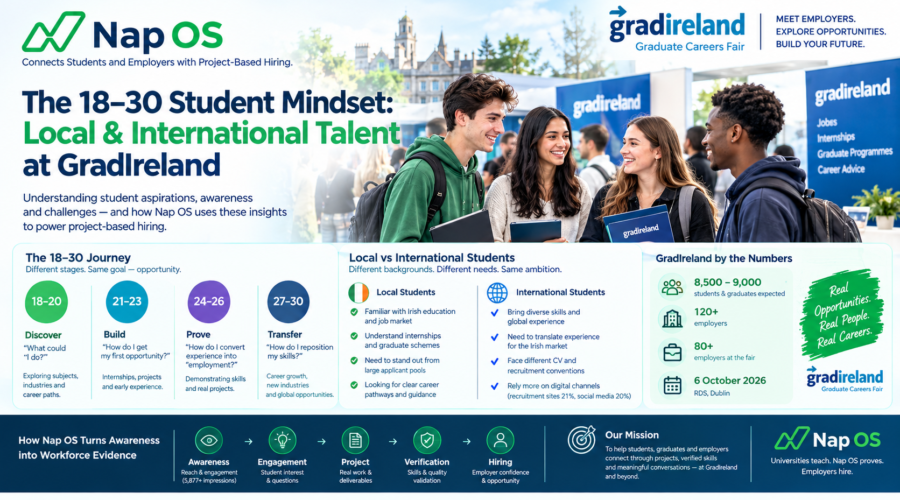
This is why the upcoming gradireland Graduate Careers Fair at the RDS Dublin on 6 October 2026 is particularly interesting from the Nap OS perspective. The event is open to job seekers ranging from first-year students through postgraduate students and graduates, and the official event information says attendees can meet 80+ employers recruiting for hundreds of graduate jobs and internships.
The exhibitor-facing information indicates an even larger expected ecosystem, with 120+ employers and approximately 8,500–9,000 students and graduates expected.
For Nap OS, that is not simply an employment event.
It is a workforce-signal environment.
1. The 18–30 age range is not one audience
One of the biggest mistakes in graduate recruitment is treating “students” as a single category.
Nap OS uses a more granular mindset model.
| Age | Typical career question | Evidence maturity |
|---|---|---|
| 18–20 | “What could I do?” | Early |
| 21–23 | “How do I get my first opportunity?” | Developing |
| 24–26 | “How do I convert experience into employment?” | Intermediate |
| 27–30 | “How do I reposition my skills?” | Advanced |
These are Nap OS analytical segments, not claims that every person in an age group thinks identically.
The important point is that the employment problem changes as experience increases.
An 18-year-old may have potential but limited evidence.
A 22-year-old may have education plus projects.
A 25-year-old may have international or local employment experience.
A 30-year-old may have substantial experience but poor translation of that experience into the next labour market.
Project-based hiring can operate across all four.
2. The local student mindset
For a local Irish student, the career journey may begin with relatively high familiarity with the domestic education and employment environment.
They may understand:
- Irish universities;
- local employers;
- internships;
- graduate programmes;
- recruitment cycles;
- Irish CV conventions;
- networking;
- career fairs.
But familiarity does not automatically equal employability.
The student may still ask:
“I have a degree, but what makes me different from the other 500 applicants?”
This is where project-based evidence becomes important.
Instead of simply saying:
Business student
the candidate could demonstrate:
Business student → market research project → 30 customer interviews → analysis → commercial recommendation → employer validation
The second representation creates a much stronger employment narrative.
3. The international student mindset is different
International students can face an additional translation problem.
They may have:
- education from another country;
- previous professional experience;
- different CV conventions;
- international qualifications;
- different professional terminology;
- limited Irish work experience;
- uncertainty about employer expectations.
The challenge is not necessarily a lack of capability.
It can be a lack of locally interpretable evidence.
The latest HEA Graduate Outcomes data provides an important indication of the scale of this population.
For the 2024 graduate cohort, 14,179 graduates were internationally domiciled. Their employment rate nine months after graduation was 76.6%, compared with the broader graduate population’s strong employment outcomes.
The HEA data also shows an important difference in how internationally domiciled graduates find employment: recruitment sites accounted for 21%, while social media/professional networking sites accounted for 20%.
This is highly relevant to Nap OS.
The international graduate is already using digital channels to enter the employment system.
The next question becomes:
What evidence are they presenting through those channels?
4. Awareness is the real starting point
Nap OS thinks about student awareness in five levels.
Level 1 — Career awareness
“I need a job eventually.”
At this level, the student may not yet understand what employers actually evaluate.
Level 2 — Opportunity awareness
“I need internships, graduate schemes or projects.”
The student begins looking for opportunities.
Level 3 — Evidence awareness
“I need to demonstrate what I can do.”
This is a major transition.
Level 4 — Verification awareness
“I need someone credible to validate what I have done.”
Now a project becomes more valuable.
Level 5 — Hiring awareness
“My evidence should help an employer make a decision.”
This is where project-based hiring becomes a recruitment mechanism rather than simply a learning activity.
Nap OS’s objective is to help students move from:
“I need experience”
to:
“I can create evidence of capability.”
5. The biggest psychological gap: “I don’t have enough experience”
The traditional Catch-22 is simple:
You need experience to get a job, but you need a job to get experience.
For younger students, this can create hesitation.
They may believe:
- “I don’t have enough to put on my CV.”
- “Other candidates have internships.”
- “I have no professional experience.”
- “Employers will not take me seriously.”
Nap OS changes the unit of thinking.
Instead of asking:
“Do you have experience?”
we ask:
“What can you demonstrate?”
A 19-year-old may not have two years of employment experience.
But they may have completed:
- a data project;
- a software prototype;
- a marketing campaign;
- a research study;
- a business plan;
- a design portfolio;
- a community project.
The project becomes the bridge.
6. The project becomes the common language
This is particularly powerful when local and international students are placed in the same employment ecosystem.
Consider two candidates.
Candidate A
Irish undergraduate
Business degree
Internship experience
Candidate B
International postgraduate
Previous business experience overseas
No Irish employment experience
A conventional recruitment system may immediately favour Candidate A because the evidence is easier to interpret locally.
But project-based hiring can create a common evaluation layer.
Both candidates can be assessed on:
Problem → Task → Skills → Deliverable → Quality → Verification → Outcome
Now the employer has comparable evidence.
This does not eliminate differences in experience.
It makes those differences more visible and structured.
7. Why GradIreland matters to the Nap OS model
The GradIreland ecosystem is particularly interesting because it brings together students, graduates, employers and career information in one environment.
The 2026 Graduate Careers Fair is designed for students and job seekers from first year through postgraduate level, not only final-year graduates.
That matters.
A first-year student and a postgraduate international student may walk through the same exhibition hall, but their information requirements are radically different.
Nap OS therefore sees the event as a potential career-awareness funnel.
18–20
Discover
“What careers exist?”
21–23
Build
“What projects can I undertake?”
24–26
Prove
“How do I demonstrate my capability?”
27–30
Transfer
“How do I convert existing skills into my next opportunity?”
The same infrastructure can support each stage.
8. The Nap OS project-based hiring equation
Nap OS can conceptualise candidate evidence using a simple structure:
Candidate Evidence Score
CES = Skills × Project Evidence × Verification × Relevance
This is not a universal industry-standard formula.
It is a Nap OS analytical framework for explaining how evidence quality can improve.
For example:
Skills = 8/10
Project Evidence = 9/10
Verification = 8/10
Job Relevance = 9/10
The candidate has a substantially stronger evidence profile than someone whose only signal is:
“I am proficient in data analytics.”
The objective is not to reduce people to a number.
The objective is to make the evidence behind the number visible.
9. What employers need to see
Employers do not necessarily need another 500 CVs.
They need better signals.
A project-based hiring record could include:
Project ID: NAP-2026-00125
Candidate: Verified Workforce Member
Project: E-commerce Analytics Dashboard
Duration: 25 hours
Skills: Python, SQL, Excel, Data Visualisation
Deliverables: Dashboard + Report + Presentation
Reviewer: Employer/project mentor
Completion: 100%
Skills verified: 8/9
Employer rating: 4.6/5
Portfolio evidence: Yes
This changes the hiring conversation.
Instead of:
“Tell me about yourself.”
the employer can ask:
“Walk me through the project.”
That is a fundamentally different interview.
10. Ireland already has evidence that work experience matters
The HEA’s Graduate Outcomes data provides an especially interesting signal for Nap OS.
For the 2024 graduate cohort, 61.6% of graduates completed internships.
The same data shows that one of the most common sources of employment was already having worked at the organisation, including through work experience, accounting for 21.1%. Recruitment sites accounted for 20.7%, and personal contacts for 20.6%.
This is important.
It suggests that the transition:
experience → employer relationship → employment
is already a major pathway.
Nap OS asks:
Can project-based work expand that pathway to students who have not yet secured traditional internships?
That is the opportunity.
11. Skills mismatch makes the problem bigger
Ireland’s skills challenge is not simply about the number of graduates.
The OECD has identified skills mismatch and changing skills demand as structural issues in Ireland, including shortages in areas such as digital skills, software, coding, data analytics, STEM and management skills.
The OECD’s 2026 skills-first analysis goes further, arguing that labour markets are increasingly moving toward a model where skills information complements traditional credentials, because degrees alone do not always capture the full range of capabilities individuals possess.
This is exactly where Nap OS positions project-based hiring.
Education tells employers what someone studied.
Projects can show employers what someone can do.
12. From GradIreland awareness to Nap OS evidence
The Nap OS objective is therefore not to compete with the existing graduate ecosystem.
It is to add another layer.
GradIreland can create awareness:
Students ↔ Employers
Nap OS can create evidence:
Students → Projects → Verification → Employers
Together, the journey becomes:
Awareness → Engagement → Project → Evidence → Verification → Hiring
That is the workforce infrastructure opportunity.
13. The 18–30 opportunity in numbers
Nap OS sees the 18–30 population as a potential 12-year workforce development journey.
Rather than waiting until the final six months of university, imagine:
Age 18
1 project
Age 19
2 projects
Age 20
3 projects
Age 21
internship + projects
Age 22
verified graduate portfolio
Age 23–25
employer projects + professional experience
Age 26–30
advanced projects + career transitions
The individual is no longer building a CV once a year.
They are continuously building a career evidence graph.
Every project adds another node:
Skill → Project → Deliverable → Verification → Employer → Outcome
Over five years, 10 meaningful projects can potentially provide a much richer evidence base than 10 rewritten versions of the same CV.
14. The Nap OS POV
The future of graduate recruitment will not be won simply by having the largest database of CVs.
It will be won by improving the quality of the signal between capability and opportunity.
For the 18-year-old local student, Nap OS can help answer:
“What can I build now?”
For the 22-year-old graduate:
“How can I prove my capability?”
For the international graduate:
“How can I translate my experience into evidence an Irish employer understands?”
For the 27–30-year-old professional:
“How can I demonstrate transferable capability for my next role?”
And for the employer:
“What has this person actually demonstrated?”
That is the common language of project-based hiring.
Conclusion: From Student Awareness to Workforce Evidence
The GradIreland Graduate Careers Fair brings thousands of people into one employment ecosystem. The official exhibitor information estimates 8,500–9,000 students and graduates and 120+ employers, while the public event page describes 80+ employers and hundreds of graduate jobs and internships.
For Nap OS, those numbers represent more than footfall.
They represent thousands of individual career questions.
Some will be 18-year-olds asking:
“What should I do?”
Others will be 22-year-olds asking:
“How do I get hired?”
International graduates may be asking:
“How do I prove my experience here?”
And experienced early-career professionals may be asking:
“How do I make my skills transferable?”
Nap OS believes the answer should increasingly be:
Build something.
Demonstrate it.
Verify it.
Put it in your portfolio.
Let employers evaluate the evidence.
The career journey should move from:
CV → Application → Interview
toward:
Learning → Project → Evidence → Verification → Hiring.
That is the Nap OS understanding of the 18–30 student and early-career mindset.
And that is why project-based hiring is not simply another recruitment format.
It is a potential bridge between what people learn, what they can actually do, and what employers need next.
Universities teach. Nap OS proves. Employers hire.
From 18 to 30. From potential to proof. From projects to opportunity.