8 min read
The traditional hiring model asks students and graduates to prove that they can perform a job before they have been given the opportunity to perform the work.
A graduate may be asked for two years of experience to obtain an entry-level role. An international student may be asked for local experience before an employer will consider them. An employer, meanwhile, is expected to make a hiring decision using CVs, interviews, qualifications and increasingly AI-generated applications—often without seeing the candidate actually perform meaningful work.
Nap OS approaches the problem differently:
Universities teach. Nap OS proves. Employers hire.
Nap OS connects students and employers through project-based hiring, where employers can define real business projects, students can complete structured work, and the resulting evidence can become part of a verified career portfolio.
This model also raises an important question:
How should project-based work be priced?
There is no single global price list for project-based hiring. The more useful approach is to create a transparent pricing framework based on scope, complexity, skills, time, responsibility, quality and market conditions.
That distinction is important for both students and employers.
1. From CV-Based Hiring to Work-Based Evidence
The labour market is increasingly moving toward skills-based approaches.
The OECD describes a skills-first approach as one in which organisations identify the skills required for roles, adapt hiring processes to assess demonstrated skills and incorporate those skills into wider talent management.
The World Economic Forum’s Future of Jobs Report 2025 similarly identifies analytical thinking, resilience, flexibility, agility, leadership, creative thinking and technological literacy among important workforce skills. It also reports that employers expect 39% of workers’ existing skill sets to be transformed or become outdated by 2030.
This creates an opportunity for project-based hiring.
Instead of:
CV → Interview → Hiring decision
Nap OS can support:
Problem → Project → Work → Verification → Portfolio → Hiring decision
The difference is significant.
A CV tells an employer what a candidate claims they have done.
A verified project can demonstrate what the candidate actually produced.
2. What Is Project-Based Hiring?
Project-based hiring is the use of defined business assignments, projects or work packages to evaluate or engage talent based on demonstrated capability.
A project can be small:
- Market research
- Data analysis
- Competitor analysis
- UX research
- Social-media analysis
- Website testing
- Financial modelling
- Customer research
Or more complex:
- AI prototype development
- Software development
- Product research
- Business strategy
- Digital transformation
- Data engineering
- Market-entry analysis
The critical difference is that the employer defines an actual business outcome.
For example:
“Analyse 100 competitors across the Irish technology market and produce a 15-page market intelligence report.”
is considerably more useful than:
“We are looking for an analytical graduate.”
The first statement creates a measurable project.
The second creates an abstract hiring requirement.
3. The Global Pricing Problem
Project-based hiring cannot simply copy a traditional hourly salary.
Nor should it automatically copy freelance-market pricing.
A useful project-pricing model needs to account for at least six variables:
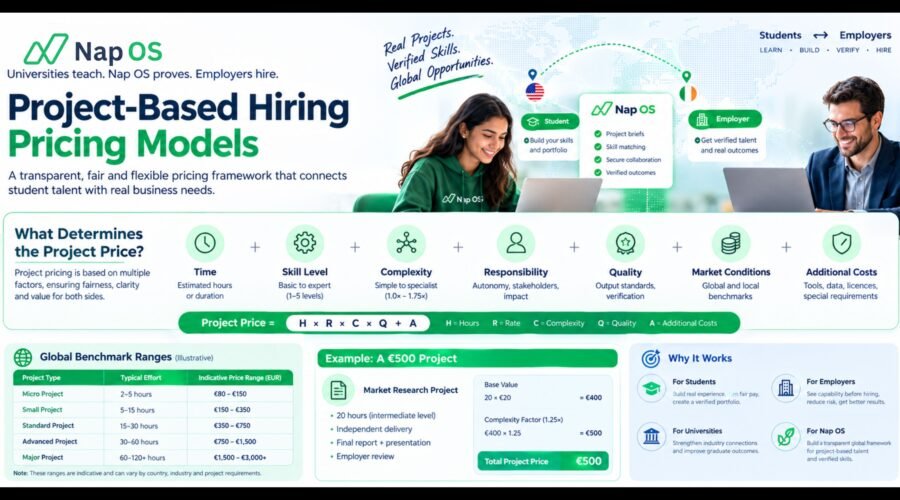
Project Price = Time × Skill × Complexity × Responsibility × Quality + Additional Costs
A simplified Nap OS pricing model could therefore use:
P = H × R × C × Q + A
Where:
- P = project price
- H = estimated hours
- R = benchmark hourly rate
- C = complexity multiplier
- Q = quality/responsibility factor
- A = additional approved costs
This gives students and employers a common technical language for discussing project value.
4. Time Is the First Pricing Variable
The simplest project benchmark is estimated effort.
For example:
| Project size | Estimated effort |
|---|---|
| Micro project | 2–5 hours |
| Small project | 5–15 hours |
| Standard project | 15–30 hours |
| Advanced project | 30–60 hours |
| Major project | 60–120+ hours |
These are Nap OS framework examples, not global legal standards.
Their purpose is to help students and employers understand the difference between a small assignment and a substantial piece of work.
A five-hour competitor scan should not be priced like a 100-hour software-development project.
Likewise, a student should not be expected to spend 40 hours on a project that an employer describes as a “small opportunity.”
Transparent scope protects both sides.
5. Skill Level Changes Project Value
Two projects requiring the same number of hours may have completely different market values.
Consider:
Project A
10 hours of basic data collection.
Project B
10 hours of Python-based data analysis involving cleaning, modelling and visualisation.
The time is identical.
The required capability is not.
A practical skills-level framework could therefore classify projects as:
| Level | Typical capability |
|---|---|
| L1 | Basic / supervised |
| L2 | Developing / guided |
| L3 | Independent |
| L4 | Advanced / specialist |
| L5 | Expert / strategic |
This creates a common language between universities, students and employers.
It also supports a major principle of skills-first hiring:
Pay and evaluate according to the work and responsibility—not simply the person’s student status.
6. Complexity Should Be Visible
A project involving one data source and a standard output is relatively simple.
A project involving:
- multiple datasets,
- external stakeholders,
- sensitive information,
- technical integration,
- regulatory requirements,
- customer interaction,
- or strategic recommendations
has significantly greater complexity.
Nap OS can therefore use complexity multipliers.
For example:
Basic = 1.0×
Intermediate = 1.25×
Advanced = 1.50×
Specialist = 1.75×
These are illustrative pricing coefficients, not internationally mandated rates.
The purpose is transparency.
If an employer asks for specialist technical work, the pricing model should make that complexity visible rather than hiding it behind a generic “student project” label.
7. Quality Must Also Be Measurable
Project-based hiring becomes much more powerful when the output can be evaluated.
Nap OS could structure project verification around metrics such as:
Delivery
Was the project completed?
0–100%
Quality
How closely did the output meet the agreed requirements?
0–100
Technical accuracy
How accurate and reliable was the work?
0–100
Employer satisfaction
How useful was the final deliverable?
1–5
Skill evidence
How many defined skills were demonstrated?
For example: 8/10
This converts an otherwise subjective student project into structured evidence.
8. A €500 Project Example
Imagine an employer creates a market-research project.
The agreed scope is:
- 20 hours
- intermediate research skills
- independent delivery
- one final report
- one presentation
- employer review
Suppose the agreed benchmark rate is:
€20/hour
Base value:
20 × €20 = €400
Add a 1.25 complexity factor:
€400 × 1.25 = €500
The project therefore has an illustrative value of:
€500
The important point is not the €500 itself.
The important point is that both parties can understand how the number was produced.
That is much more scalable than saying:
“What do you think this project is worth?”
9. Pricing Should Never Become a Race to the Bottom
This is where international standards around work and remuneration become important.
The International Labour Organization has highlighted that output-based or piece-rate systems need to be transparent and fair, taking account of the difficulty and quality of work. It also notes that in many jurisdictions such systems must not result in earnings below applicable minimum-wage protections.
The ILO’s 2026 Convention on decent work in the platform economy also addresses timely and full payment and, for workers in an employment relationship, protection against remuneration falling below applicable statutory or negotiated minimum wages.
Therefore, Nap OS should not position project-based hiring as “cheap student labour.”
The proposition is different:
Give students access to meaningful work, while giving employers access to verified emerging talent.
Where employment law, minimum-wage rules, tax requirements, immigration conditions or other regulations apply, those rules remain more important than any platform pricing model.
10. Learning Value and Commercial Value Are Different
A particularly important distinction is between:
Learning projects
and
Commercial projects.
A university learning project may primarily provide:
- experience,
- mentorship,
- assessment,
- academic credit,
- portfolio evidence.
A commercial employer project may create:
- market intelligence,
- software,
- customer research,
- operational improvements,
- financial analysis,
- marketing assets,
- product development.
These should not automatically have the same commercial pricing.
The EU’s 2024 proposal on improving traineeships emphasised learning objectives, fair pay, supervision, mentoring, appropriate working conditions and preventing regular jobs from being disguised as traineeships. It also recommended that traineeships generally not exceed six months unless objectively justified.
That provides an important design principle for Nap OS:
Project-based experience must create genuine learning and genuine value without disguising ordinary employment.
11. Nap OS Can Create a Global Project Pricing Language
This is where Nap OS can become more than a project marketplace.
It can potentially create a common language between:
Student → University → Employer → Mentor → Recruiter
A project could carry a structured specification such as:
Project ID: NAP-2026-00125
Discipline: Data Analytics
Level: L3
Estimated effort: 25 hours
Duration: 3 weeks
Skills: Python, SQL, Excel, Data Visualisation
Complexity: 1.25×
Deliverables: Dashboard + Report + Presentation
Employer rating: 4.6/5
Completion: 100%
Skills verified: 8/9
Portfolio evidence: Yes
Employer reference: Yes
Now the student has something considerably more valuable than:
“Completed an internship.”
They have a verifiable work record.
12. The Employer Gets More Than a CV
For employers, the value proposition is equally important.
Instead of screening:
500 CVs → 100 shortlisted → 20 interviews → 1 hire
an employer could potentially use:
100 students → 20 project participants → 10 verified outputs → 3 hiring candidates
The project becomes an extended assessment mechanism.
This can reduce information asymmetry.
The OECD identifies skills validation and employer trust in non-traditional credentials as important challenges for skills-first approaches.
Nap OS’s opportunity is therefore not simply to create more projects.
It is to make the evidence produced by those projects trustworthy.
13. A New Hiring Metric: Cost per Verified Skill
Traditional recruitment often measures:
Cost per hire
Nap OS can introduce another useful metric:
Cost per Verified Skill
For example:
Employer project cost:
€500
Verified skills:
8
Cost per verified skill:
€62.50
This does not mean every employer should literally price hiring this way.
It is a measurement framework.
Other useful metrics could include:
Cost per completed project
€500 ÷ 1 = €500
Cost per verified candidate
If 5 candidates complete the project:
€500 ÷ 5 = €100
Project-to-interview conversion
If 20 students participate and 4 receive interviews:
4 ÷ 20 × 100 = 20%
Project-to-hire conversion
If 20 participate and 2 are hired:
2 ÷ 20 × 100 = 10%
These metrics allow employers to evaluate project-based hiring as an actual workforce-development channel rather than simply an educational initiative.
14. The Nap OS Model
The emerging model can therefore be expressed simply:
Learn → Build → Verify → Prove → Hire
Learn
Students acquire academic and technical knowledge.
Build
Students apply that knowledge to employer-defined projects.
Verify
Mentors, universities and/or employers evaluate the work.
Prove
The completed project becomes structured evidence in the candidate’s portfolio.
Hire
Employers use demonstrated capability to make better-informed recruitment decisions.
This directly connects education with employment.
15. The Bigger Opportunity
The World Economic Forum reports that 63% of employers surveyed identify skills gaps as a major barrier to business transformation, while nearly 40% of required job skills are expected to change by 2030.
That means the future hiring system cannot rely exclusively on historical credentials.
Employers need better evidence.
Students need opportunities to generate that evidence.
Universities need stronger connections between learning and labour-market outcomes.
And technology can provide the infrastructure connecting all three.
That is the opportunity for Nap OS.
Nap OS: Turning Experience Into Evidence
The fundamental problem with the traditional graduate hiring system is not that students lack potential.
It is that potential is difficult to observe before employment.
Project-based hiring changes the unit of evaluation.
Instead of evaluating only the person, we evaluate:
Person + Project + Process + Output + Verification.
And pricing becomes part of that infrastructure.
A transparent project price should reflect:
Scope + Time + Skill + Complexity + Responsibility + Quality + Market Conditions + Legal Requirements.
There is no single global number that defines the correct price for every project.
There should not be.
The goal is a transparent global framework that allows students and employers to understand what they are exchanging.
For students, the result is an opportunity to build credible experience before securing a traditional job.
For employers, it is an opportunity to see capability before making a full-time hiring decision.
For universities, it creates a measurable bridge between education and employment.
And for Nap OS, it creates a new workforce infrastructure:
Universities teach. Nap OS proves. Employers hire.
Project by project. Skill by skill. Evidence by evidence.