9 min read
How institutional leaders, universities and regulatory stakeholders can help create a more transparent pathway from education to verified work experience
For many international students and graduates, the transition from education into employment can feel like a Catch-22.
Employers want experience before offering opportunities. Graduates need opportunities before they can build experience. International graduates may also need the right employment pathway, employer confidence and relevant evidence of capability before they can progress into longer-term employment.
Nap OS was created around this problem.
But solving a structural workforce problem cannot be achieved by technology alone.
It requires relationships.
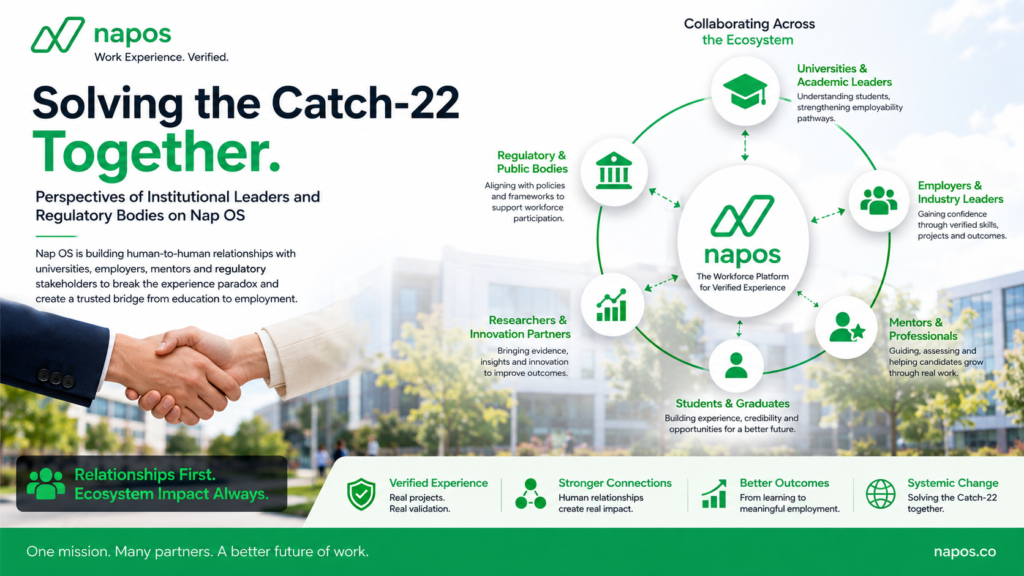
It requires universities, employers, graduates, mentors, researchers, policymakers and regulatory stakeholders to understand the problem from different perspectives and work towards practical solutions together.
That is why the journey of Nap OS has increasingly become one of relationship building with institutions and stakeholders, rather than simply building another technology platform.
The Catch-22 is bigger than a CV
A traditional CV tells an employer what someone says they have done.
It does not always demonstrate:
- what they actually worked on;
- who evaluated their work;
- what skills they demonstrated;
- what outcomes they achieved;
- whether an employer or institution can verify the experience;
- how recently those skills were demonstrated.
This becomes particularly challenging for international students and graduates attempting to establish themselves in a new labour market.
A graduate may have excellent academic qualifications and previous international experience, but still hear:
“Do you have Irish experience?”
If the answer is no, the candidate may struggle to obtain the first opportunity that would allow them to gain that experience.
This is the Catch-22 that Nap OS is attempting to address.
The fundamental idea is simple:
Give people opportunities to demonstrate capability, document meaningful work and build independently verifiable evidence of experience before asking employers to make a hiring decision.
Technology is only one part of the solution
Nap OS is being developed as a workforce platform that connects work experience, evidence, evaluation and employment.
However, the founder’s approach has increasingly been that the platform itself should not operate in isolation.
The people and institutions surrounding the workforce system matter just as much.
Universities understand students.
Employers understand hiring requirements.
Regulatory and public bodies understand labour-market frameworks.
Researchers understand workforce trends.
Mentors understand professional development.
And candidates understand the lived experience of trying to enter the labour market.
A meaningful solution needs to bring these perspectives together.
That is why Pugazheanthi Palani, Founder & CEO of Napblog Limited, has been deliberately building relationships across these different groups.
The objective is not to ask an institution to endorse Nap OS.
The objective is to listen, learn, test assumptions and understand what a credible solution would need to look like from each stakeholder’s perspective.
A relationship-first approach
One of the most important lessons from building Nap OS has been that institutional innovation rarely happens through a single meeting or a single product demonstration.
It happens through relationships developed over time.
A university leader may initially see Nap OS as an employability initiative.
An employer may see it as a talent-verification platform.
A regulatory stakeholder may see it through the lens of labour-market participation and workforce policy.
A student may simply see it as a way to obtain their first meaningful opportunity.
All of these perspectives can be valid simultaneously.
Nap OS therefore aims to create a common conversation:
How can we make the transition from education to verified work experience more transparent, trusted and accessible?
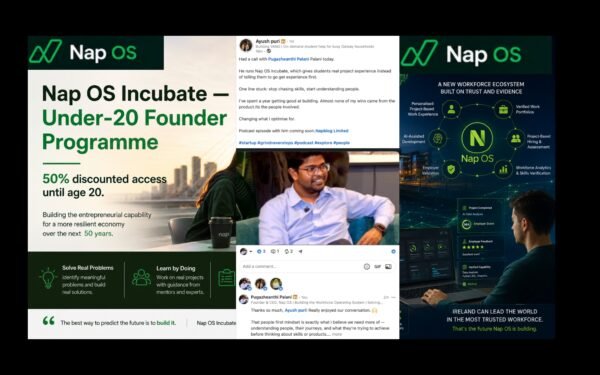
Sneak Peek: Conversations with institutional stakeholders
As Nap OS continues developing its institutional relationships, early conversations with university and innovation leaders have provided an important source of learning.
One example is the relationship being developed with University College Dublin (UCD) and the wider NovaUCD innovation ecosystem.
These conversations have been valuable not because they provide an automatic endorsement of Nap OS, but because institutional leaders can challenge assumptions that a founder might otherwise overlook.
The discussions have encouraged Nap OS to think more carefully about:
- how universities evaluate work experience;
- how employers assess candidates;
- how evidence of capability can be structured;
- how students can benefit without creating unnecessary institutional risk;
- how technology can complement existing university careers infrastructure;
- and how a workforce platform can develop credibility through independent relationships.
This is an important distinction.
Nap OS is not trying to replace universities, careers services or employers.
It is exploring how technology can connect the different parts of the existing ecosystem more effectively.
The role of institutional leaders
University leaders have a unique perspective on the Catch-22.
They see students complete degrees with significant academic knowledge, but they also see how difficult the transition into employment can be for some graduates.
The gap between:
“I have a qualification”
and
“I have demonstrated that I can perform this work in a professional environment”
can be significant.
Nap OS is interested in that gap.
The platform’s proposed model allows work experience to become more structured and evidence-based.
A project can generate evidence.
A mentor can provide an assessment.
An employer can validate contribution.
A university or educational institution can potentially recognise participation.
Over time, these different signals can contribute to a more complete picture of a candidate.
This is particularly relevant to international graduates, who may have skills but lack locally recognised evidence of professional experience.
The regulatory perspective matters too
The Catch-22 is not simply a recruitment problem.
For international graduates, employment can also intersect with immigration and employment-permit systems.
This makes engagement with regulatory and public-sector stakeholders particularly important.
Nap OS should not attempt to interpret or change regulation itself.
Instead, its role is to understand the environment in which candidates and employers operate.
That means building constructive relationships with relevant stakeholders and asking practical questions:
What evidence helps demonstrate genuine employment readiness?
How can work experience be documented transparently?
How can employers gain confidence in candidates without creating unnecessary barriers?
How can graduates understand the pathway from education to employment more clearly?
These conversations can help ensure that the technology is designed around the realities of the workforce system rather than assumptions made from inside a startup.
Human-to-human before platform-to-platform
Perhaps the most important principle behind this initiative is that technology should follow relationships, not replace them.
It is easy for a technology startup to approach institutions with a finished product and ask:
“Will you use this?”
Nap OS is taking a different approach.
The founder’s relationship-building initiative starts with:
“Can we understand the problem together?”
That creates a much healthier foundation for innovation.
Pugazheanthi’s outreach to universities, employers, innovation organisations and relevant public and regulatory stakeholders is therefore part of the product-development process itself.
Every conversation can reveal another requirement.
Every challenge can expose another assumption.
Every stakeholder can contribute another perspective.
And every relationship can potentially create a stronger foundation for the platform.
Why this matters for Nap OS
The Catch-22 cannot be solved by creating another job board.
Nor can it be solved simply by allowing graduates to upload another CV.
The deeper problem is the lack of trusted evidence connecting learning, work and employment.
Nap OS is exploring whether a workforce platform can help create that missing layer.
Imagine a graduate completing a project with an organisation.
Instead of simply writing:
“Marketing Intern — Company X”
on a CV, the candidate could potentially demonstrate:
- the project they contributed to;
- their responsibilities;
- the skills they applied;
- measurable outcomes;
- feedback from a mentor;
- validation from an organisation;
- and a record of the experience within their professional portfolio.
That creates a different type of employment signal.
It does not guarantee employment.
But it can potentially make the candidate’s capabilities easier to understand and verify.
Building trust before scaling
For Nap OS, institutional relationship building is therefore also a form of validation.
The platform needs to be challenged by the people who understand the workforce ecosystem.
Universities can challenge the educational model.
Employers can challenge the hiring model.
Candidates can challenge the user experience.
Regulatory stakeholders can challenge assumptions around employment and workforce policy.
Researchers can challenge the evidence.
This is healthy.
A startup solving a difficult social and economic problem should welcome scrutiny.
The goal is not to make everyone agree with Nap OS.
The goal is to make Nap OS better.
From founder relationships to ecosystem relationships
Pugazheanthi Palani’s role as founder is particularly important at this stage.
Before building a large institutional sales organisation, the founder can personally listen to stakeholders and understand their concerns.
This creates an opportunity for Nap OS to develop relationships at a human level.
A university leader is not simply an institutional contact.
An employer is not simply a potential customer.
A regulatory organisation is not simply a policy authority.
They are people with experience, expertise and perspectives that can help shape the solution.
This human-first approach is particularly important when attempting to solve a problem as complex as graduate employment.
The Three Stakeholder Questions
As Nap OS continues this journey, three questions remain central.
1. Can candidates demonstrate capability?
Not just qualifications, but meaningful evidence of work.
2. Can employers trust the evidence?
Not simply because Nap OS says it is valid, but because work has been evaluated or validated through credible participants in the ecosystem.
3. Can institutions understand and support the pathway?
Universities and relevant stakeholders need visibility into how students move from education into professional experience and employment.
If these three questions can be addressed together, the Catch-22 becomes more manageable.
A long-term relationship, not a short-term campaign
Nap OS is still building.
The platform will evolve.
The product will change.
The business model will evolve.
And the institutional relationships will develop over time.
That is intentional.
The ambition is not to announce that Nap OS has already solved Ireland’s graduate employment challenge.
It has not.
The ambition is to build the infrastructure, evidence and relationships required to make a meaningful contribution to solving it.
That means being transparent about what is working, what is not working and what is still being learned.
The Nap OS Perspective
The biggest takeaway from Nap OS’s engagement with institutional leaders and regulatory stakeholders is simple:
Complex workforce problems require ecosystem solutions.
Technology can provide the infrastructure.
But relationships provide trust.
Universities provide educational context.
Employers provide real-world validation.
Mentors provide human evaluation.
Candidates provide lived experience.
Researchers provide evidence.
Regulatory stakeholders provide the policy context.
And founders need to bring these perspectives together.
That is the direction Nap OS is taking.
Not building technology behind closed doors.
Not asking institutions to automatically endorse a startup.
But building relationships, listening to stakeholders and allowing those conversations to influence the product.
For Pugazheanthi Palani and the Nap OS team, the Catch-22 is therefore more than a product problem.
It is a systems problem.
And systems change begins with people talking to people.
Nap OS is building those relationships one conversation at a time.
A note from Nap OS
We are grateful to the university, innovation, employer and institutional leaders who have taken the time to engage with Nap OS, challenge our thinking and share their perspectives.
In particular, our engagement with the NovaUCD ecosystem and its leadership has reinforced the importance of listening carefully to experienced innovation leaders while developing the platform.
The purpose of sharing these perspectives publicly is not to imply institutional endorsement. It is to make the Nap OS development journey more transparent and demonstrate how stakeholder conversations are influencing the way we think about the problem.
The goal remains the same: help create a more transparent bridge between education, verified work experience and employment.