7 min read
Every transformative technology company begins by solving a problem that affects millions of people.
Google organised the world’s information.
Stripe simplified online payments.
Salesforce transformed customer relationship management.
LinkedIn digitised professional identity.
Nap OS is solving a different—but equally fundamental—problem.
How do we transform people into workforce-capable professionals, and how do employers hire with confidence?
This problem sits at the intersection of education, workforce development, recruitment, artificial intelligence and digital identity.
Individually, these industries are already worth hundreds of billions of dollars.
Combined, they represent one of the largest opportunities in the future of work.
For investors, understanding the size of this opportunity is critical.
Not because large markets guarantee success—but because transformative companies are usually built in markets large enough to sustain long-term growth.
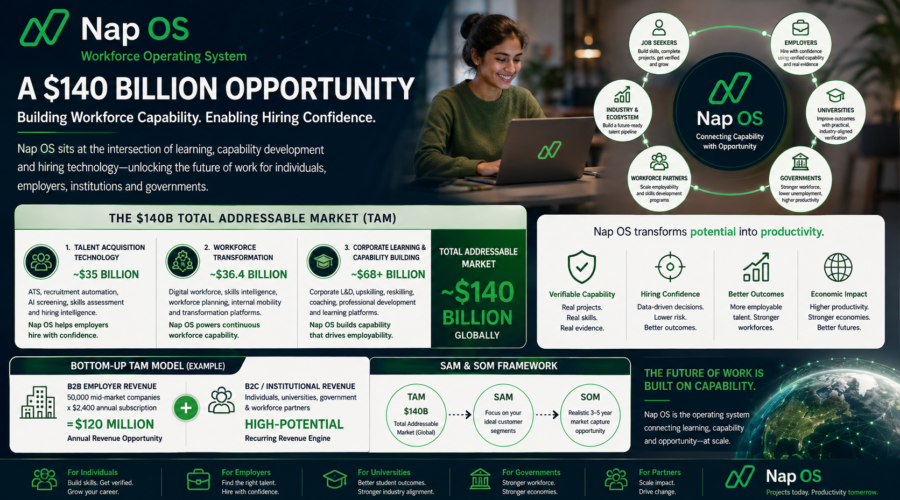
For Nap OS, that market is approximately $140 billion globally.
Why Market Size Matters
Investors often ask three questions before evaluating a startup.
- Is the problem real?
- Is the solution differentiated?
- Is the market large enough?
The first two determine whether customers care.
The third determines whether the business can become significant.
Even an exceptional product cannot become a billion-dollar company inside a million-dollar market.
Nap OS addresses a challenge affecting governments, universities, employers and hundreds of millions of job seekers worldwide.
Rather than creating another recruitment platform or learning management system, Nap OS operates across multiple workforce technology categories simultaneously.
This creates a much larger addressable opportunity.
Nap OS Is Not Just Another HR Platform
Traditional HR software solves isolated problems.
Applicant Tracking Systems manage recruitment.
Learning Management Systems deliver training.
Portfolio platforms showcase work.
Career services provide guidance.
Background verification companies validate employment.
Universities deliver education.
Recruitment agencies source candidates.
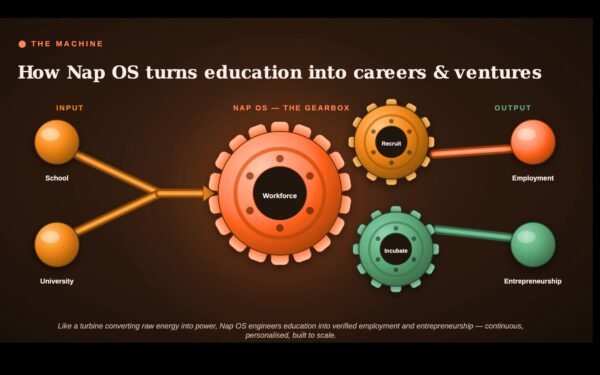
Nap OS combines these previously disconnected activities into one continuous workforce operating system.
Its purpose is simple.
Develop workforce capability before employment and provide employers with greater hiring confidence.
Because of this positioning, Nap OS participates across multiple technology markets simultaneously.
The Three Markets That Form Nap OS’s TAM
The approximately $140 billion Total Addressable Market is derived from three major technology sectors.
1. Talent Acquisition Technology (~$35 Billion)
Recruitment has evolved significantly over the past decade.
Organisations increasingly rely on technology to reduce hiring costs, improve candidate quality and automate recruitment.
This market includes:
- Applicant Tracking Systems (ATS)
- Candidate Relationship Management
- AI Recruitment
- Skills Assessment
- Recruitment Automation
- Hiring Analytics
Companies such as Greenhouse, Lever, Workday, SmartRecruiters and Ashby operate within this space.
Their primary objective is improving employer hiring decisions.
Nap OS contributes differently.
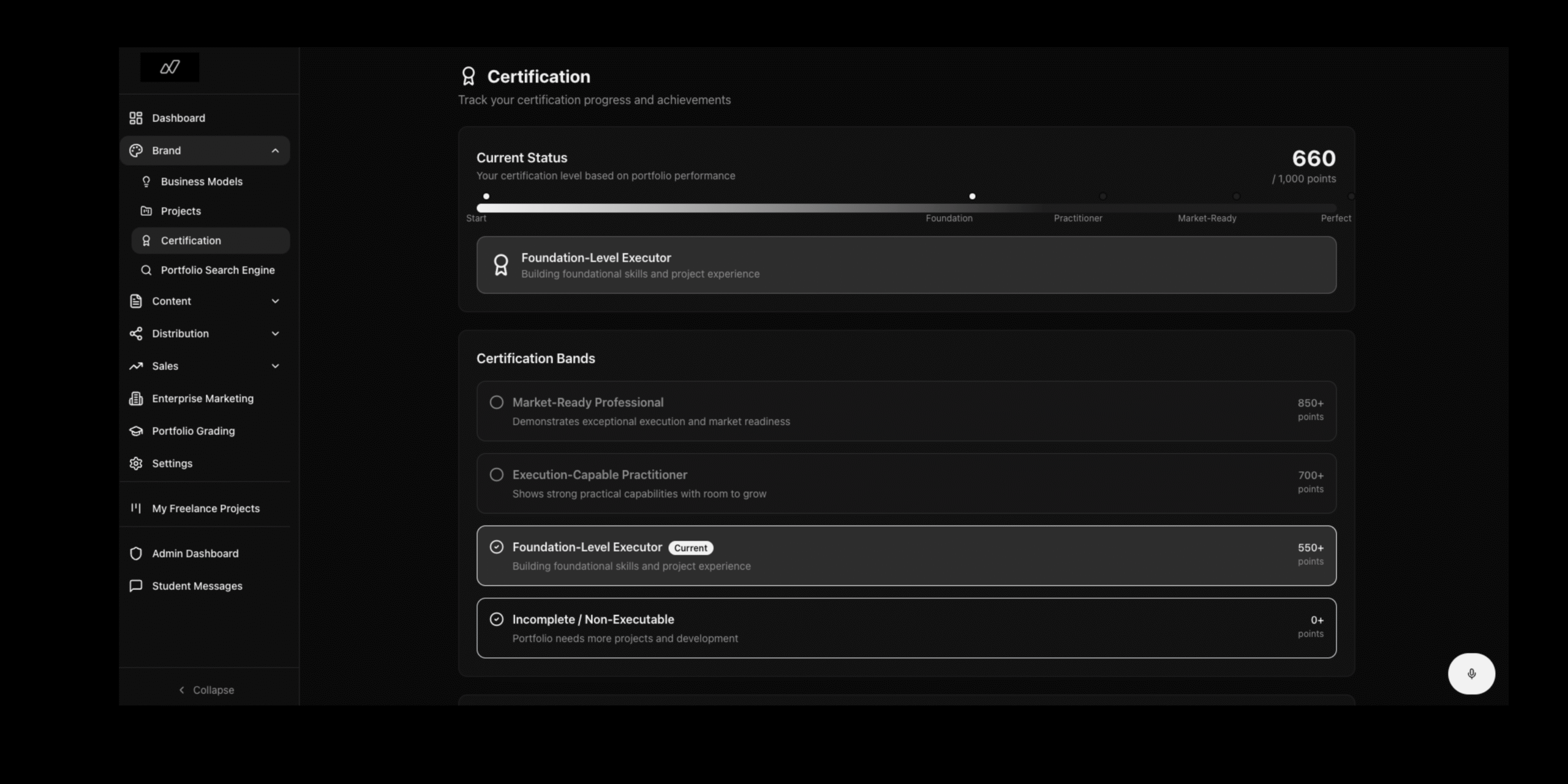
Rather than simply helping employers manage applications, Nap OS helps employers evaluate demonstrated capability through verified projects, portfolios, skill evidence and workforce readiness.
Instead of hiring based primarily on CVs and interviews, employers hire based on evidence.
This aligns directly with the evolution of AI-driven recruitment.
2. Workforce Transformation (~$36.4 Billion)
Across the world, organisations are investing heavily in workforce transformation.
Automation.
Artificial intelligence.
Digital transformation.
Changing workforce demographics.
Skills shortages.
Governments and organisations increasingly recognise that economic growth depends on workforce capability.
Workforce transformation includes:
- Skills intelligence
- Workforce planning
- Internal mobility
- Digital workforce platforms
- AI workforce management
- Capability mapping
Nap OS contributes by helping individuals continuously build workforce capability throughout their careers.
Instead of simply finding jobs, individuals develop measurable capabilities that remain valuable regardless of industry changes.
This transforms workforce development from a one-time event into a continuous process.
3. Corporate Learning & Capability Building (~$68 Billion+)
Corporate learning has shifted dramatically.
Organisations no longer invest solely in compliance training.
Today’s focus is continuous capability development.
Companies increasingly invest in:
- Digital learning
- AI coaching
- Skills platforms
- Professional development
- Career progression
- Workforce reskilling
The corporate learning market exceeds $68 billion globally.
Nap OS participates in this market differently.
Rather than delivering static online courses, it combines:
- personalised learning,
- mentoring,
- project-based work,
- skills verification,
- portfolio building,
- AI-guided development.
Learning becomes evidence.
Projects become employability.
Capability becomes measurable.
Combined Opportunity
These three markets create the strategic opportunity for Nap OS.
| Market | Estimated Size |
|---|---|
| Talent Acquisition Technology | ~$35 Billion |
| Workforce Transformation | ~$36.4 Billion |
| Corporate Learning & Capability Building | ~$68 Billion+ |
Combined Total Addressable Market: Approximately $140 Billion
This represents the global opportunity available to technologies transforming workforce capability and hiring.
Why Nap OS Is Different
Most companies compete inside one category.
Nap OS connects them.
Education produces knowledge.
Projects build capability.
AI personalises development.
Portfolios verify evidence.
Employers hire confidently.
Career progression becomes continuous.
This integrated model positions Nap OS as infrastructure rather than another standalone software product.
Bottom-Up TAM: A More Realistic Investor View
While top-down market statistics demonstrate scale, experienced investors often prefer bottom-up analysis.
Bottom-up TAM estimates revenue based on actual customers.
This provides a more realistic commercial opportunity.
Revenue Engine One: Employer Subscriptions
Nap OS enables employers to:
- assess workforce capability
- review verified portfolios
- reduce hiring risk
- discover talent faster
- improve recruitment confidence
Imagine targeting:
50,000 mid-sized organisations globally.
If each organisation subscribed for approximately $2,400 annually, the calculation becomes:
50,000 × $2,400 = $120 million annual revenue opportunity.
This represents only a small fraction of global employers.
Large enterprises.
Governments.
Recruitment firms.
SMEs.
Universities.
None of these are yet included.
Revenue Engine Two: Workforce Capability Membership
Nap OS also serves individuals.
Members use the platform to:
- build projects
- develop professional skills
- receive mentoring
- verify experience
- create AI-enhanced portfolios
- improve employability
Rather than paying for “work experience,” members invest in continuous workforce development.
The current membership model is:
€49.99 per month.
This creates recurring revenue while encouraging continuous professional development until employment and beyond.
Unlike traditional education, workforce capability continues throughout an individual’s career.
Institutional Customers
The platform also supports:
Universities.
Government agencies.
Employment services.
Workforce development organisations.
Corporate academies.
These organisations may sponsor workforce capability for thousands of individuals simultaneously.
This creates a B2B2C revenue model.
Instead of selling to one graduate, Nap OS can serve entire cohorts.
TAM vs SAM vs SOM
Investors expect founders to distinguish between market size and execution.
This is why three market definitions matter.
Total Addressable Market (TAM)
The total global opportunity.
Approximately:
$140 Billion
This includes every organisation and individual globally who could benefit from workforce capability and hiring technology.
Serviceable Addressable Market (SAM)
The specific market Nap OS initially targets.
For example:
- English-speaking countries
- Technology companies
- Professional services
- Graduate hiring
- Universities
- Workforce development agencies
This is significantly smaller than the TAM but highly focused.
Serviceable Obtainable Market (SOM)
The realistic market Nap OS can capture within the next three to five years.
Investors know startups do not capture entire markets overnight.
Instead, they look for disciplined execution.
The objective is not to dominate a $140 billion market immediately.
The objective is demonstrating repeatable growth within a clearly defined customer segment.
Why Governments Should Care
The opportunity extends beyond commercial software.
Governments invest billions annually in:
employment services,
graduate employability,
skills development,
workforce activation,
economic competitiveness.
Long-term unemployment remains one of the most expensive social challenges.
When individuals remain unemployed because they cannot demonstrate workplace capability, society loses productive talent while welfare expenditure increases.
If platforms like Nap OS can help people become workforce-ready faster, governments benefit through:
- reduced unemployment,
- increased tax revenue,
- higher workforce productivity,
- stronger innovation,
- greater economic competitiveness.
Workforce capability becomes national infrastructure.
Why Universities Should Care
Higher education has expanded dramatically.
Graduates increasingly compete against thousands of equally qualified candidates.
Degrees remain valuable.
But employers increasingly seek demonstrated capability.
Nap OS complements universities by extending learning into practical workforce readiness.
Students graduate not only with qualifications but with verified portfolios demonstrating how they apply their knowledge.
Why Employers Should Care
Recruitment remains expensive.
Poor hiring decisions cost organisations significant time and money.
Employers increasingly seek evidence rather than assumptions.
Nap OS provides:
- verified projects,
- capability evidence,
- structured portfolios,
- measurable workforce readiness.
Hiring becomes more informed.
Candidates become more prepared.
Everyone benefits.
A Long-Term Vision
The workforce of the future will increasingly value demonstrated capability over static credentials.
Artificial intelligence will automate many technical tasks.
Human capability will become increasingly important.
Employers will ask:
What has this person built?
How have they solved problems?
Can they collaborate?
Can they adapt?
Can they execute?
Nap OS exists to answer those questions through evidence rather than assumptions.
Conclusion
The future of work is changing.
Education is becoming more accessible.
Artificial intelligence is reshaping every profession.
Employers demand greater confidence in hiring.
Individuals need continuous workforce development rather than one-time education.
These trends are converging into one of the largest technology opportunities of the coming decades.
Nap OS sits precisely at that intersection.
By combining workforce capability development, AI-guided learning, verified portfolios and hiring confidence into a single operating system, Nap OS participates in an estimated $140 billion global market.
For investors, the opportunity is not simply another HR platform.
It is the emergence of a new workforce infrastructure.
A platform that helps people continuously build capability.
Helps employers hire with confidence.
Supports universities in improving graduate outcomes.
Enables governments to strengthen workforce participation.
And ultimately contributes to a more productive, skilled and resilient global workforce.
The market is already enormous.
The need is undeniable.
The opportunity is just beginning.