5 min read
The job market has a pain problem, and an entire industry has sprung up to sell aspirin for it. Type “unemployment” or “job search” into any search engine today and you’ll be met with a wall of tools promising instant relief: AI resume builders that rewrite your work history in seconds, portfolio “enhancers” that polish your LinkedIn profile, cover letter generators that spit out boilerplate enthusiasm on command. These tools are everywhere, and they are, by most measures, wildly popular. They are also, increasingly, part of the problem they claim to solve.
The Painkiller Economy
Painkillers work by masking symptoms, not curing the underlying condition. That’s exactly what most of today’s AI career tools do. A job seeker who is unemployed, underskilled, or simply competing in an oversaturated field doesn’t actually need a better-formatted PDF. They need a real match between what they can do and what employers actually need. But formatting a resume is easy to automate, and matching people to sustainable careers is hard, so naturally the market has flooded with tools that solve the easy problem and call it a day.
The result is what researchers and recruiters have started calling an “AI arms race” in hiring. Job seekers use AI to mass-produce applications. Employers, drowning in a flood of near-identical, keyword-stuffed resumes, respond by deploying their own AI filters to reject exactly those applications. Everyone ends up working harder to get exactly nowhere, and the underlying issue — a mismatch between people’s real capabilities and the roles available to them — goes untouched. Worse, because so many of these tools run on similar underlying models, they tend to homogenize the very candidates they’re meant to differentiate. Resumes start sounding the same. Portfolios start looking the same. The human story that actually convinces a hiring manager gets sanded away in the process.
There’s a second, sharper danger too. When an AI tool fabricates or exaggerates a claim on someone’s behalf — a suspiciously round statistic, a skill that was never really used in practice — it can look impressive on paper and fall apart in the first real interview. That’s not a shortcut to employment. That’s a trapdoor.
Why Painkillers Don’t Fix Unemployment
Unemployment isn’t one problem; it’s several problems wearing the same coat. Some of it is a skills mismatch, where the abilities job seekers have don’t line up with what employers are actually hiring for. Some of it is structural, where entire categories of work are shrinking or shifting faster than people can retrain. Some of it is simply about visibility and access, where qualified people never get in front of the right employer because the process filtering them is broken, not because they lack talent.
None of these are resume-formatting problems. Yet the dominant business model in this space treats them as if they were. It’s a lot easier to sell a subscription that promises a “polished, ATS-optimized resume in minutes” than it is to build something that actually closes a skills gap or connects a person to a role they’re genuinely suited for. The painkiller model is attractive precisely because it’s fast, cheap to build, and easy to market. It just doesn’t work for very long, because it never touches the actual source of the pain.
A Different Approach
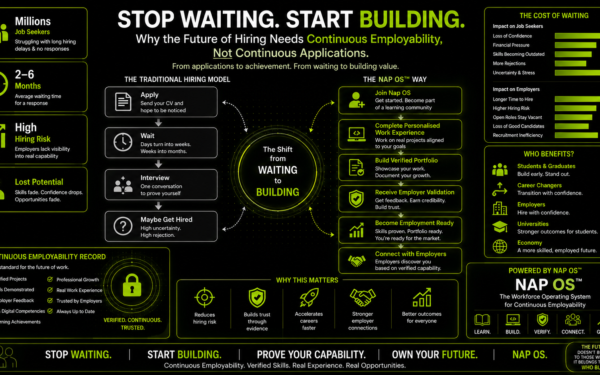
This is the gap Nap OS is built to close. Rather than treating the visible symptom — an unpolished resume, a generic cover letter — as the target, the goal is to address what’s underneath it: whether someone has the practical skills, real project experience, and clear evidence of capability that employers are actually screening for, and whether they can find their way to the roles where that capability is genuinely valued.
That distinction matters more than it might sound. A painkiller tool asks, “How do I make this person’s existing materials look better?” A real solution asks, “What does this person actually need to become a strong, credible candidate, and how do we get them there?” The first question can be answered by a language model in ten seconds. The second question requires structure: pathways for building demonstrable skills, mechanisms for showcasing real work rather than described work, and a way to connect people to opportunities that match where they actually stand, not just where their resume claims they stand.
It also means being honest about what technology can and can’t do. AI is genuinely useful as a research and brainstorming aid — helping someone understand what keywords and competencies a target role actually requires, for instance. It is much less useful, and arguably harmful, when it’s used as a replacement for the substance of a candidate’s experience. The tools that get this distinction right treat AI as a flashlight that helps a person see their own strengths more clearly. The tools that get it wrong treat AI as a costume that dresses up whatever is already there, real or not.
Standing Out Instead of Blending In
The job seekers who are actually succeeding right now aren’t the ones with the most AI-polished resumes. They’re the ones who can back up every line with something concrete: a specific project, a specific number, a specific outcome they can explain in detail under questioning. That kind of credibility can’t be manufactured by a generator. It has to be built, documented, and then communicated clearly — ideally with evidence an employer can actually look at, not just take on faith.
This is where the difference between a painkiller and a genuine fix becomes obvious in practice. A painkiller gives you a nicer-looking version of what you already had. A real fix helps you have more to show in the first place, and then helps you present it honestly and specifically enough that it survives contact with a real conversation. One treats the resume as the product. The other treats the person’s actual capability as the product, and the resume as just one way of describing it.
Rethinking What “Solving Unemployment” Means
None of this is to say that formatting, keywords, or presentation don’t matter — they do. But they are the last five percent of the problem, not the first ninety-five. An industry that spends all its energy on that last five percent, while ignoring the skills gaps, the structural shifts, and the access problems underneath, isn’t solving unemployment. It’s managing its symptoms just well enough to keep selling the next subscription.
Real progress on unemployment looks less like a slicker PDF and more like a clear, honest bridge between what a person can genuinely do and what an employer genuinely needs — built on real skills, real evidence, and real matching, not on a fresh coat of AI-generated polish. That’s a harder problem to solve, and a much less flashy one to market. But it’s the only version of “fixing unemployment” that actually holds up once the interview starts.
Mail to palani@napblog.com to start professional job hunting process.