6 min read
Most SaaS companies launch backwards. They build a product, hire a growth marketer, buy ads, and hope conversion rates cover the burn until product-market fit arrives. This works reasonably well for utility software — a better spreadsheet, a faster invoicing tool, a slicker Slack integration. It works far less well when the problem you’re solving is systemic: unemployment, broken hiring pipelines, or the absence of real pathways from education into meaningful work. These are trust problems as much as product problems, and trust cannot be bought in bulk through a CPM.
Nap OS, the operating system for employability and entrepreneurship built by Napblog Limited, is a useful case study precisely because it is tackling one of the largest and most stubborn structural failures in the modern economy: education that doesn’t map to job readiness, hiring that runs on CVs instead of capability, and entrepreneurship support that is inconsistent or nonexistent for most people who need it. A product addressing that scale of dysfunction cannot simply announce itself into existence with a paid campaign. It has to earn belief first.
Why paid-first launches fail on big, systemic problems
When a SaaS product solves a shallow problem, the buyer already understands the pain and is actively searching for a fix. Ads work because they intercept existing intent. Unemployment and hiring inefficiency don’t behave this way. Job seekers don’t wake up searching for “AI-native talent operating system.” Employers don’t type “capability-based hiring platform” into Google expecting a credible answer to exist. Universities and governments, who sit on the other side of this problem, are structurally slow-moving and skeptical of new entrants promising to fix workforce development. In every one of these audiences, the barrier isn’t awareness — it’s credibility. And credibility bought through impressions evaporates the moment the ad spend stops.
This is why an organic, value-first launch strategy isn’t just cheaper, it’s structurally necessary. You cannot advertise your way into being trusted by a system that has been failed repeatedly by consultants, edtech vendors, and HR software before you.
Lead with education, not the pitch
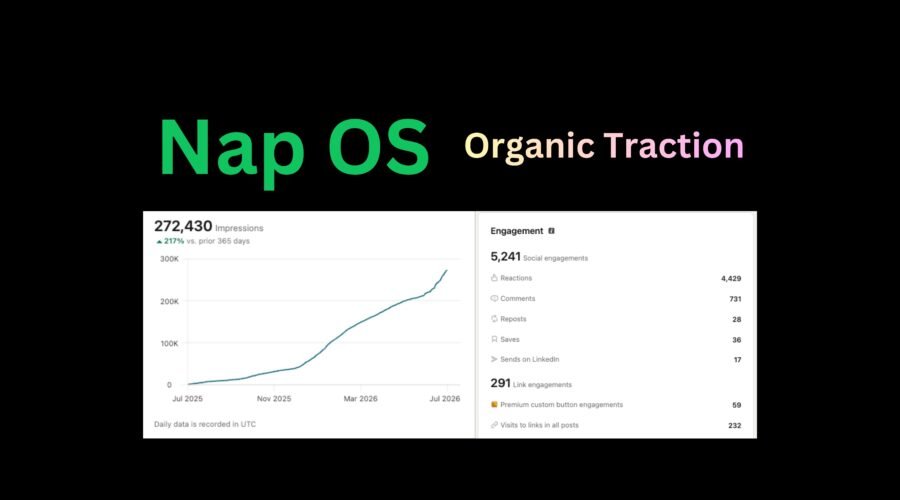
Nap OS’s growth data shows what this looks like in practice. Over roughly a year, its content reached 272,430 impressions, a 217% increase against the prior period, alongside 5,241 social engagements and meaningful downstream link engagement — all without a paid media budget behind it. That kind of curve doesn’t come from a single viral post; it comes from a compounding content engine. The company has been publishing a daily newsletter, with 210+ editions and 2,386 subscribers built up organically, and that newsletter is now the second-largest traffic source into the product itself.
The subject matter of that content is the real lesson here. Rather than writing about the product’s feature list, the content pillars center on the underlying dysfunction: why AI hasn’t actually solved the problem of hollow résumés and applicant-tracking-system gaming, why personalized work experience needs to exist at scale, and why the education-to-employment-to-entrepreneurship pipeline is broken in the first place. The company is teaching the market to see its own problem clearly before ever asking it to buy anything. That sequencing — diagnosis before prescription — is what separates organic trust-building from content marketing as a euphemism for disguised advertising.
Even more telling is where the traffic is actually coming from. The top organic landing pages driving new users aren’t about employability at all — they’re about homeschooling in Ireland, QQI course levels, and adjacent education-system topics that a founder audience might dismiss as “off-brand.” But this is exactly the point: real people searching for real answers about their circumstances are a far more durable audience-acquisition channel than paid targeting of job titles. Those readers arrive with a specific, unmet need, encounter a brand that clearly understands the broader system they’re operating in, and some meaningful share of them convert into product users. Google alone delivered roughly 2,000 new users this way, more than any other channel including the newsletter itself.
Prove the model before you promote it
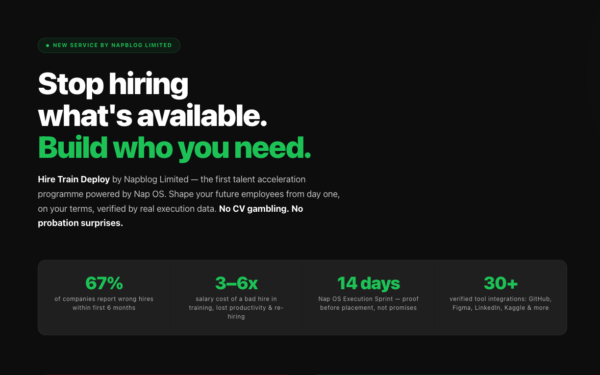
A launch built on trust also needs to show its work rather than assert it. Nap OS is explicit about being early — four paying users on a workforce subscription at €49.99 per month, two technology companies in active B2B conversations, and one live product already generating revenue. These are not impressive numbers in isolation, and that’s precisely why publishing them builds credibility rather than undermining it. A company willing to show unglamorous, real, small numbers signals that everything else it says is probably also true. Compare that to the instinct most startups have to inflate early traction with vanity metrics; it destroys the very trust an organic strategy is trying to build.
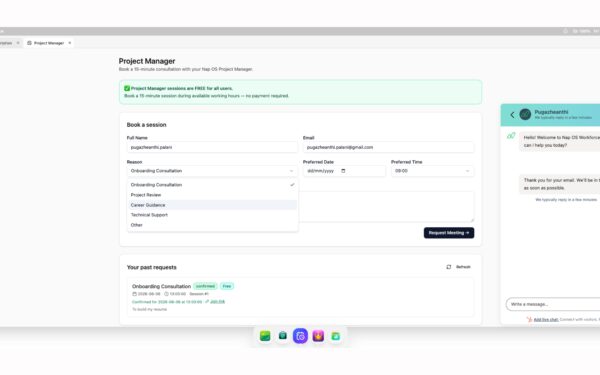
This same principle shows up in how the product itself is structured. Nap OS isn’t pitched as a single tool but as three interlocking systems — Workforce, which develops verified, job-ready individuals through AI-driven skill and experience building; Recruit, which lets employers hire on demonstrated capability instead of a CV; and Incubate, which turns employees and learners into founders through a structured venture-creation pipeline.
The value of this architecture is that each side proves the other. A job seeker who builds a verified capability profile through Workforce becomes a higher-signal candidate inside Recruit, and some share of those same people, once employed or skilled, cycle into Incubate to build something of their own. Each loop compounds the data and the credibility of the next, and — importantly — it’s a closed system a company can talk about honestly, because the outcomes are visible and self-reinforcing rather than promised.
A practical playbook for SaaS companies solving big problems
The Nap OS trajectory suggests a repeatable sequence for any SaaS company whose mission involves a large, systemic problem like employment, healthcare access, or financial inclusion, where trust is the actual bottleneck rather than awareness.
Start by publishing consistently in public, on a cadence you can sustain for years rather than months. A daily or near-daily newsletter compounds in a way that occasional campaigns never do — 210+ editions is not a marketing tactic, it’s an accumulated body of evidence that the company has been thinking about this problem seriously and continuously.
Write about the systemic problem before you write about the solution. Content that names the dysfunction clearly — CV-based hiring, hollow AI-generated résumés, disconnected education systems — earns attention from people living the problem, independent of whether they’ve heard of your product yet.
Don’t discount adjacent-topic search traffic as off-brand. The homeschooling and QQI-levels content driving the largest share of new Nap OS users demonstrates that organic discovery often arrives through the surrounding context of people’s lives, not through direct competitor keywords. Meeting people where their real questions already are is more efficient than trying to manufacture demand for a category that doesn’t yet exist in searchers’ minds.
Publish real numbers, even small ones. Four paying customers and two B2B conversations, stated plainly, do more for credibility than a polished projection ever could, because specificity signals honesty.
Design the product so that early users generate visible proof of value for the next cohort — verified profiles, tracked outcomes, and case studies that exist because the system produces them, not because a marketing team fabricated them.
Why this matters beyond one company
Unemployment, hiring inefficiency, and the absence of accessible pathways into entrepreneurship are not problems that respond to clever acquisition funnels. They respond to sustained, visible, honest effort to fix something people have stopped believing anyone will actually fix. A SaaS company that wants to be trusted with that scale of problem has to behave, from day one, like an institution earning credibility rather than a startup chasing conversions — publishing consistently, naming the dysfunction honestly, and letting real, if modest, outcomes do the persuading that advertising never could.