Last updated: May 29, 2026
6 min read
Executive Overview
The global workforce is undergoing structural transformation. Automation, artificial intelligence, hybrid work systems, skill volatility, and shortened industry life cycles have fundamentally altered the mechanics of career progression.
Traditional career ladders have fragmented into dynamic, non-linear trajectories. Individuals no longer simply grow into roles — they must execute transitions, pivots, certifications, applications, relocations, and opportunity captures with precision.
Nap OS was architected in response to this structural inefficiency.
Nap OS Mission: Building One Million Career Executions by 2040 is not a marketing aspiration. It is a quantified systems objective. It reflects the deliberate construction of infrastructure designed to enable one million verified, measurable, structured career transitions executed successfully through an intelligent operating layer.
This article outlines:
- What “career execution” means in operational terms
- Why the workforce needs execution infrastructure
- How Nap OS enables structured career progression
- The roadmap to one million executions
- The economic and societal implications of achieving the mission
Defining Career Execution
A career execution is a completed, outcome-based professional milestone facilitated through structured guidance, data-driven alignment, and action orchestration.
Examples include:
- Securing new employment aligned to skill profile
- Achieving a promotion through tracked competency development
- Transitioning industries with verified skills alignment
- Completing certification pathways leading to role eligibility
- Securing grant funding based on eligibility signals
- Launching a self-employed career pathway
A career execution is not passive career growth. It is the successful realization of a defined professional objective through coordinated actions.
Traditional career systems measure input (education, years of experience). Nap OS measures output: executed milestones.
The Structural Problem in Modern Careers
Three macro forces define today’s employment landscape:
1. Skill Half-Life Compression
Technical and business skills now depreciate rapidly. Industry research suggests core digital skills can lose relevance within 3–5 years. Static resumes and passive job boards cannot adapt to this volatility.
2. Information Fragmentation
Career development data is scattered across:
- CVs
- Social platforms
- Learning platforms
- Job boards
- Certification records
- Government eligibility systems
There is no unified execution layer.
3. Decision Paralysis
Individuals face overwhelming opportunity surfaces:
- Thousands of job listings
- Hundreds of certifications
- Multiple geographic considerations
- Complex funding and grant options
Without structured orchestration, most users stall in analysis rather than execute.
Nap OS was built as a response to this systemic fragmentation.
What Is Nap OS?
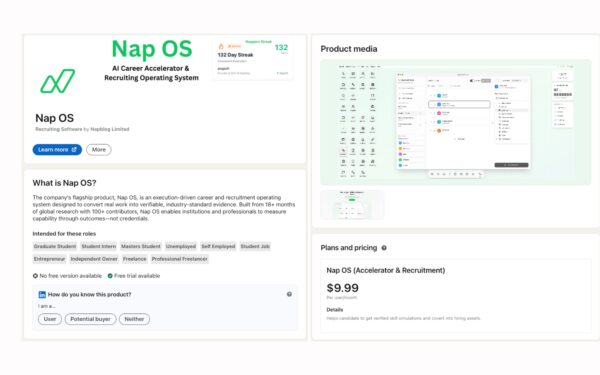
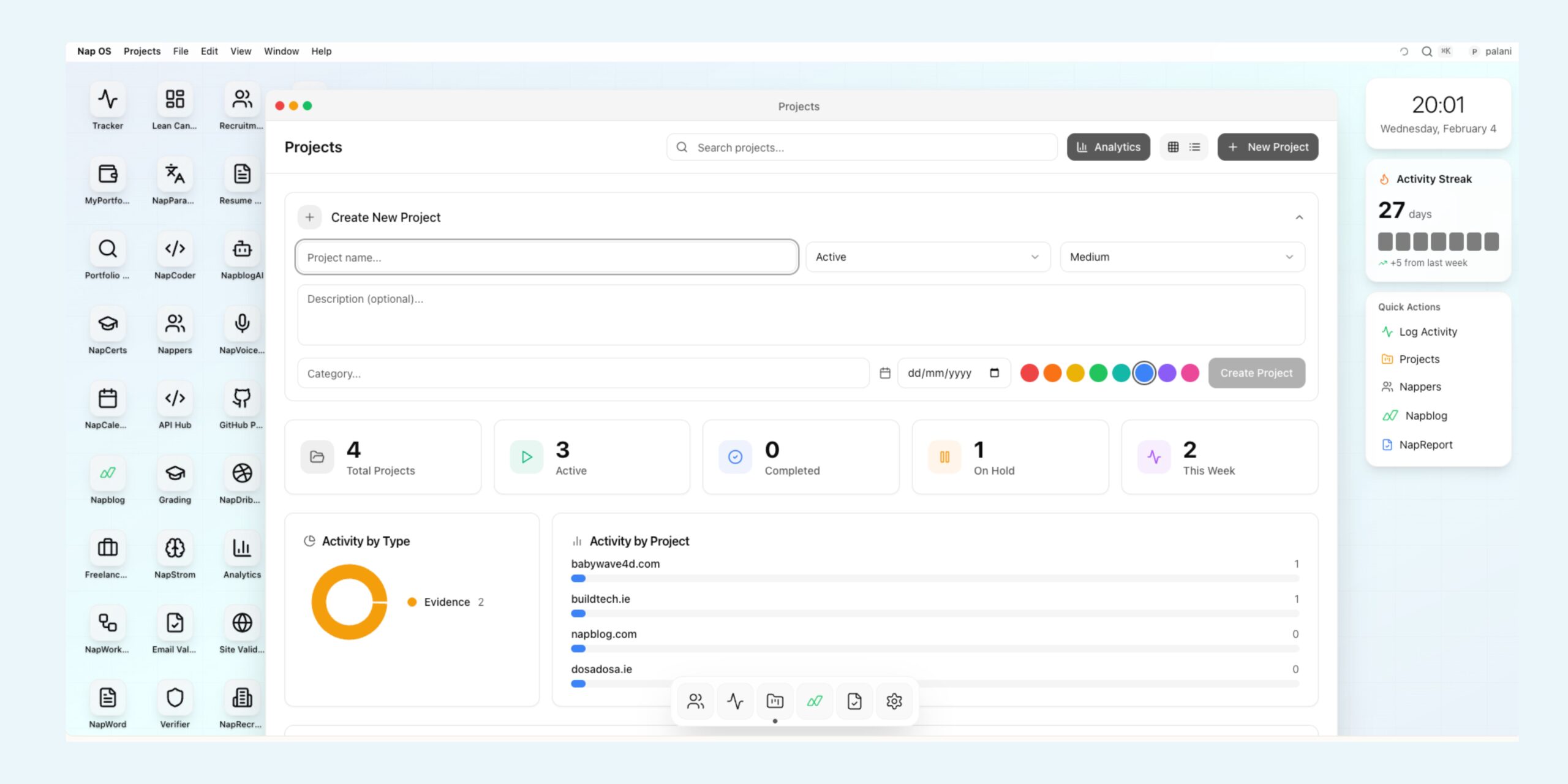
Nap OS is a career operating system — an intelligent orchestration layer that integrates:
- Profile intelligence
- Skills mapping
- Opportunity matching
- Eligibility detection
- Execution tracking
- Outcome validation
Rather than functioning as a static platform, Nap OS behaves as an adaptive professional engine that continuously aligns user context with executable opportunities.
Core System Components
- Profile Intelligence Layer
Dynamic profile modeling that evolves based on:- Employment history
- Skills acquisition
- Engagement signals
- Geographic location
- Industry trends
- Opportunity Alignment Engine
Matches users to:- Employment roles
- Grants
- Certifications
- Partnerships
- Funding pathways
- Execution Tracking Framework
Every milestone is logged as structured progression data:- Duration in ecosystem
- Position evolution
- Activity patterns
- Application outcomes
- Adaptive CTA Architecture
Context-aware calls-to-action that dynamically shift based on user readiness and eligibility.
Nap OS transforms passive browsing into structured execution.
Why “One Million” by 2040?
The mission horizon — 2040 — represents a 15-year transformation window.
To achieve one million executions, Nap OS must enable:
- ~66,700 executions per year
- ~5,560 executions per month
- ~183 executions per day
This is not dependent on viral growth alone. It requires:
- Infrastructure scalability
- Enterprise partnerships
- Government integrations
- AI-driven automation
- Standardized tracking metrics
The mission is not merely about user count. It is about validated, documented career outcomes.
Strategic Pillars of the Mission
Pillar 1: Infrastructure Before Scale
Nap OS prioritizes architecture depth:
- Modular intelligence
- Scalable data models
- Interoperable APIs
- Secure identity mapping
Execution reliability precedes expansion.
Pillar 2: AI-Native Decision Systems
Career decisions are increasingly data-intensive. Nap OS embeds AI across:
- Skill gap analysis
- Industry trend forecasting
- Role compatibility scoring
- Grant eligibility detection
- Personalized execution sequencing
The goal is reduction of decision latency.
Pillar 3: Measurable Progression
Unlike platforms that emphasize engagement metrics, Nap OS emphasizes:
- Verified role transitions
- Time-to-execution reduction
- Execution velocity
- Multi-stage progression
Career execution becomes a quantifiable dataset.
Pillar 4: Ecosystem Integration
To reach one million executions, Nap OS integrates with:
- Employers
- Recruitment agencies
- Educational institutions
- Government funding bodies
- Enterprise HR systems
Career execution becomes a shared ecosystem objective.
Execution Use Cases
1. Employment Transition
A marketing project member in Ireland with 4 months ecosystem duration progresses to business development representation. Nap OS identifies skill adjacency, suggests micro-certifications, and aligns open roles.
Execution is logged upon role confirmation.
2. Grant Eligibility Capture
User activity patterns indicate eligibility for a regional innovation grant. Nap OS surfaces application guidance and deadline tracking.
Execution is logged upon funding approval.
3. Industry Pivot
A user in retail transitions into SaaS sales via structured skill mapping and mentorship routing.
Execution occurs when employment in new industry is secured.
The Economic Multiplier Effect
One million career executions generate systemic impact:
Individual Impact
- Income growth
- Geographic mobility
- Skill diversification
- Reduced unemployment duration
Enterprise Impact
- Faster hiring cycles
- Reduced talent mismatch
- Lower onboarding risk
Government Impact
- Optimized grant distribution
- Workforce upskilling alignment
- Reduced social welfare strain
Nap OS positions career execution as economic infrastructure.
Roadmap to 2040
Phase 1: Foundation (2026–2028)
- Product refinement
- Core AI enhancement
- Early adoption cohorts
- 10,000 executions milestone
Phase 2: Ecosystem Expansion (2028–2033)
- Enterprise integration
- Government partnership pilots
- International scaling
- 250,000 executions milestone
Phase 3: Global Standardization (2033–2040)
- Career execution benchmarking
- API standard adoption
- Industry-wide interoperability
- One million verified executions
Differentiation in the Market
Nap OS does not compete as:
- A job board
- A social network
- A learning platform
It competes as execution infrastructure.
Where traditional platforms provide information, Nap OS provides orchestration.
Where others track engagement, Nap OS tracks outcomes.
Ethical Considerations
Scaling career execution must maintain:
- Data privacy compliance
- Algorithmic fairness
- Transparent scoring models
- Bias mitigation systems
AI-driven recommendations must not reinforce inequality. Ethical governance frameworks are embedded in system architecture.
Measuring Success
The mission requires rigorous metrics:
- Total Executions
- Time-to-Execution Reduction
- Skill Alignment Accuracy
- Execution Recurrence Rate
- Geographic Mobility Metrics
- Income Growth Post-Execution
The objective is longitudinal impact, not short-term activity.
The Cultural Shift: From Career Hope to Career Strategy
Historically, career progression relied on:
- Networking luck
- Timing
- Employer discretion
Nap OS introduces structured intentionality.
Execution replaces hope.
Data replaces assumption.
Action replaces stagnation.
Why 2040 Matters?
By 2040:
- AI will automate significant cognitive labor segments
- Cross-border remote work will normalize
- Credentialing systems will digitize
- Skill volatility will increase
Without structured orchestration, millions risk professional stagnation.
Nap OS positions itself as anticipatory infrastructure for that future.
The Million Execution Impact Narrative
If one million individuals execute structured career milestones:
- Families experience upward mobility
- Small businesses scale
- Regions attract talent
- Innovation cycles accelerate
The compounding economic and social return is exponential.
Career execution becomes not only personal progress but systemic advancement.
Conclusion
Nap OS Mission: Building One Million Career Executions by 2040 represents a deliberate redefinition of professional progression.
It reframes careers from passive timelines into executable systems.
It integrates AI, structured data, ecosystem partnerships, and measurable outcomes into a unified operating layer.
The mission is bold but methodical.
One million executions is not symbolic — it is operational.
By 2040, success will not be measured in platform users, clicks, or impressions.
It will be measured in documented promotions, verified transitions, secured funding, industry pivots, and measurable income growth.
It will be measured in executed careers.
Nap OS is not building another career platform.
It is building the infrastructure for career execution at scale.