9 min read
1. The prediction
India is Ireland’s largest source of international students. In 2024/25, 9,175 Indian students were enrolled in Irish higher education, up 30% in a year and just over one in five of all international students. Industry reports put the wider Indian student population, including those outside universities, at around 13,000.
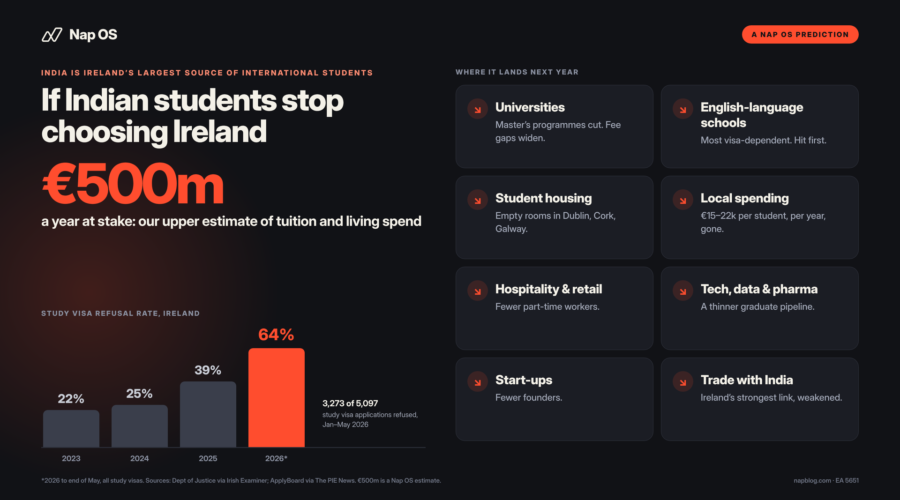
Together, by our estimate, they bring Ireland between €275 million and €520 million a year in tuition and living costs. The upper end is the €500 million in our title.
Our prediction is not that all of that disappears. It is that a meaningful share of it is now at risk, that most of the loss would land within a single year, and that the damage would reach well beyond university budgets: into rented rooms, corner shops, restaurant kitchens, tech teams and Ireland’s standing in one of the world’s fastest-growing economies.
We set out how we reached our numbers, where official data runs out, and twenty specific consequences, sector by sector.
2. How we get to €500 million
Ireland does not publish a figure for what Indian students are worth, so we estimated it.
- Tuition. Most Indian students take one-year taught master’s degrees in business, data and computing, where non-EU fees typically run from €14,000 to €20,000.
- Living costs. Rent, food, transport and everything else add another €15,000 to €22,000 a year, more in Dublin.
- Per student, that is roughly €30,000 to €40,000 a year spent in Ireland.
Across the 9,175 in higher education, that gives about €275 million to €367 million. Across the wider population of around 13,000, it gives about €390 million to €520 million.
One feature of this market makes it unusually fragile. Because most Indian students take one-year master’s programmes, the whole cohort turns over almost every year. If fewer arrive next September, there is no long tail of continuing students to soften the blow. The loss shows up within twelve months.
3. What the visa numbers already show
By the end of May 2026, the Department of Justice had received 5,097 study visa applications and refused 3,273: a refusal rate of 64%. In 2025 the rate was 39%. In 2024 it was around 25%, and in 2023, 22%.
Three cautions matter. The 2026 figure covers only five months. It includes every kind of study visa, including English-language courses and fee-paying secondary schools. And no refusal rate has been published for Indian applicants specifically, though India has been the largest source of applications every year since 2023. The Department says there has been no change to policy or criteria, and that refused applicants can appeal.
Still, the direction is clear. Irish universities have already reported more than €8 million in lost fee income this academic year from students who were accepted but could not come.
Our three scenarios for next year:
| If Indian arrivals fall by… | Ireland loses roughly… |
|---|---|
| A quarter | €100–130 million a year |
| Two-fifths (the drop in the share of applications granted between 2025 and 2026) | €160–210 million a year |
| Indian students stop choosing Ireland | Up to €500 million a year |
Our central case is the middle row. It assumes Indian applicants are refused at the same rate as everyone else, which may prove too pessimistic or too kind. Either way, because the cohort turns over every year, a loss of €160 million to €210 million in tuition and living spend would land within a single academic year, across every sector below.
4. Following the numbers across the country
Big totals are easy to ignore, so here is our central case, a fall of about two-fifths in Indian arrivals, broken down into what it means on the ground.
| What changes | Central case |
|---|---|
| Indian students not arriving | About 3,800 in higher education; about 5,300 across the wider population |
| Tuition lost by universities and colleges | €53–75 million a year |
| Living spend lost by the wider economy | €80–117 million a year |
| Spending gone from shops, transport and rent | About €220,000–320,000 every day |
| People no longer looking for somewhere to live | About 3,800–5,300 |
| Part-time work no longer available to employers | Up to 75,000–107,000 hours a week in term time, the equivalent of up to 1,900–2,700 full-time workers |
| Graduates no longer entering the Irish job market | About 3,800 a year |
The money does not stay where it lands. Tuition pays lecturers, technicians and administrators, who spend in their own towns. Rent pays landlords and mortgages. Wages from part-time work are spent in the same local shops. When a student does not arrive, the loss is felt first on campus, then on the street around it, and then, more faintly, everywhere that money would have travelled next.
It also spreads beyond Dublin. International fees help sustain courses at universities and colleges in every region. When those fees fall, the courses that close may be ones local students relied on.
These figures are our arithmetic on the estimates in section 2, not official data. Part-time hours are an upper limit, because not every student works the maximum hours permitted.
5. How it will feel, group by group
We have not run a survey, so this is our reading of what each group is likely to experience if the numbers above come true.
- Students already here will feel exposed. They borrowed heavily to come, and now the decision looks riskier in hindsight. Many will feel they have to prove, quickly, that it was worth it.
- Families in India will hesitate. A year in Ireland costs the equivalent of ₹30–40 lakh. When the visa outcome feels like a coin toss, many will spend that money somewhere that feels more certain.
- Universities and colleges will move from celebrating record international numbers to defending budgets. Expect quiet recruitment drives in new markets and louder calls for funding.
- Landlords and local businesses near campuses will notice quieter streets in September before any statistic confirms it.
- Employers will be frustrated. They are told there is a skills shortage, then watch trained graduates leave or never arrive.
- The wider public will be divided. Some will welcome less pressure on rents. Others will worry about what it says about Ireland’s welcome, and its economy.
- Ireland’s Indian community will feel the change most personally. A shrinking student population changes how welcome the next arrivals feel, and how loudly the community recommends Ireland to relatives back home.
That last point matters most. In Indian families, a recommendation from a cousin who studied in Dublin carries more weight than any university brochure. Sentiment, once it turns, is slow to turn back.
6. Twenty things Ireland faces next year
Universities and colleges
1. Fee shortfalls grow. This year’s €8 million gap came from refusals alone. A smaller Indian intake next year turns it into a structural hole.
2. Master’s programmes close. The one-year programmes Indian students fill are the most exposed. At least one technological university has already said some master’s programmes will be cut.
3. Universities scramble for replacement markets. US enrolments are rising, but at 6,125 students they cannot replace India’s 9,175 in a single recruitment cycle.
4. Global rankings slip. International student share counts towards the major rankings. A smaller Indian cohort pulls that measure down.
5. Staff on fixed-term contracts are exposed first. When fee income falls, the shortfall usually lands on contracts that are easiest not to renew.
6. English-language schools and private colleges are hit hardest. They depend most on study visas, and their representative body is already warning of a “cull”.
Housing and local spending
7. Purpose-built student housing empties. Demand from students falls in Dublin, Cork and Galway. Renters elsewhere may feel slight relief; investors who built for students will not.
8. Local spending drops. Each student spends €15,000 to €22,000 a year on living in Ireland. Groceries, transport, phones and clothing all feel it.
9. Indian businesses lose customers. Grocers, restaurants and services that grew with the student population lose their fastest-growing customer base.
Jobs and talent
10. Part-time labour shrinks. Students working limited hours in hospitality, retail, care and delivery leave gaps that employers already struggle to fill.
11. The graduate pipeline thins. Fewer Indian graduates in data, technology, pharma and finance means fewer locally trained candidates for multinationals.
12. Employers recruit from abroad instead, at higher cost. Hiring a graduate already in Ireland is cheaper and faster than relocating someone from overseas.
13. Fewer founders. Some of Ireland’s newest companies were started by former international students. Napblog Limited is one of them.
Trade and diplomacy
14. Ireland’s case in India weakens. Education is the most visible link between the two countries. Fewer students means fewer future customers, partners and advocates for Irish business.
15. Counsellors in India redirect students. Study-abroad agents follow approval rates. Germany, France, the Netherlands and the UAE are ready to take the students Ireland does not.
16. Families and lenders reprice the risk. When a destination becomes harder to get into, families think twice and lenders weigh it more carefully. Both move faster than policy.
Reputation
17. The story spreads faster than the facts. “Ireland refuses” travels across Indian social media and YouTube in days. Clarifications take years to catch up.
18. Students already here face more pressure. Those who did arrive, often on borrowed money, will be expected to prove the decision was worth it. Their outcomes become the evidence the next cohort’s families look at.
Policy
19. A contradiction becomes harder to defend. The Government is proposing to relax employment-permit ratios for sectors short of workers while study visas are being refused at record rates.
20. Outcomes become the deciding factor. The destinations that win Indian students next will be the ones that can show their graduates get hired.
7. What would change the outcome
Most of this is avoidable, and different groups can act without waiting for each other.
- Government can publish refusal rates by nationality and by course type, so families, universities and lenders react to data rather than rumour. Faster first decisions would matter as much as more approvals: a student refused in August has nowhere else to go that year.
- Universities and colleges can start supporting admitted students before they travel, rather than after they arrive, and report graduate outcomes for international students separately and honestly.
- Employers can judge international graduates on work they have actually done, instead of filtering them out for lacking Irish experience they had no way to get.
- Families in India can ask every destination the same question: what happened to last year’s graduates?
The most durable answer is the one in prediction 20. Indian families will keep choosing Ireland if they can see that Irish degrees lead to Irish jobs. That part does not depend on the Department of Justice. It depends on what happens to students once they arrive, and before.
8. Where Nap OS fits, and what we don’t claim
Nap OS is built by Napblog Limited, a Dublin company, to close the gap between the degree and the job. Students take structured project briefs, assessed by a Project Manager working in the market they want to be hired in, starting at home up to five months before they fly. They finish with proof of work employers can hire from. Napblog Limited is a Licensed Employment Agency, EA 5651.
We cannot change a visa decision, and we do not give immigration advice. A student whose visa is refused can continue our programme remotely, switch destination, pause, or take a refund for the part not delivered.
Our scenarios are estimates, not forecasts from official data. Ireland does not publish the economic value of Indian students or a refusal rate for India, and we have said where we filled those gaps. If better figures are published, we will update this piece.
Fees cover project briefs, Project Manager review and career support, not recruitment or job placement. Employment is not guaranteed.
Pugazheanthi Palani, Founder & CEO palani@napblog.com · +353 89 453 0418 Napblog Limited t/a Nap OS · CRO 812006 · Licensed Employment Agency EA 5651 · napblog.com
Sources: study visa applications and refusals, Minister of State Colm Brophy’s answer to a parliamentary question, reported by the Irish Examiner, 29 June 2026. Indian, US and total international enrolments for 2024/25, ApplyBoard data reported by The PIE News, 13 January 2026. Lost fee income, RTÉ, May 2026. English-language sector, The Irish Times, August 2026.