9 min read
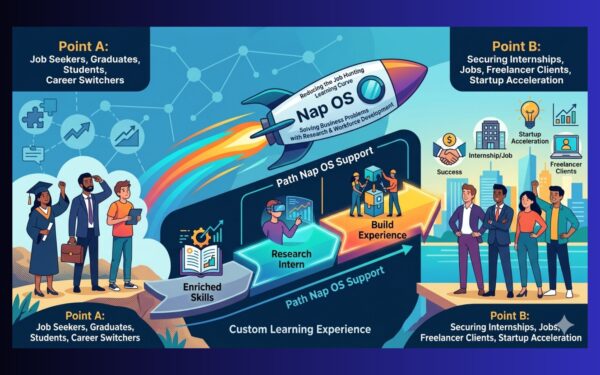
International graduates in Western countries often arrive with strong academic credentials, ambition, and technical ability, but encounter a job market that demands something different: local experience, employer-recognised evidence, clear communication, professional networks, and confidence navigating unfamiliar hiring systems. Nap OS is designed to address the core issue behind many of these barriers: the gap between what a graduate knows and what they can prove they have done.
Nap OS, built by Dublin-based Napblog Limited, is a career and recruitment operating system that helps students and professionals complete structured project work, receive reviewed feedback, build portfolios, and create verifiable records of their capabilities. It is not a job-placement agency, does not guarantee employment, and is not an immigration qualification—but it gives international graduates a practical way to build evidence before and after they arrive in a new country.
The Real Job-Search Problem
Many international graduates face a version of the same Catch-22: employers want local experience, but graduates cannot easily obtain local experience without first being hired. Nap OS frames this as the gap between knowledge and demonstrable work, and responds with structured project briefs, project-manager review, portfolio development, and records that explain what a candidate actually produced.
The problem is not simply a lack of qualifications. It is the absence of a clear, credible way to show employers how those qualifications translate into workplace performance. Nap OS aims to make execution visible through completed briefs, assessed deliverables, documented skills, and portfolio evidence.
100 Problems International Graduates Face
International graduates commonly encounter the following challenges across the job-search journey.
Career Direction and Confidence
- Uncertainty about which job roles match their degree.
- Difficulty translating academic coursework into business value.
- Limited awareness of local job titles and career paths.
- Confusion between similar roles, such as analyst, associate, coordinator, and specialist.
- Lack of clarity about required skills for target roles.
- Uncertainty about which industries hire international graduates.
- Fear of choosing the wrong career direction.
- Low confidence after repeated rejections.
- Imposter syndrome in interviews and professional settings.
- Difficulty explaining foreign education or work experience to employers.
- Limited understanding of what “entry level” means in the local market.
- Pressure from family expectations to secure a job quickly.
- Anxiety about visa timelines and financial stability.
- Difficulty setting realistic salary expectations.
- Uncertainty about whether to apply for jobs before graduation.
Resume and Application Challenges
- Not knowing how to write a locally formatted resume.
- Including too much academic detail and too little practical evidence.
- Using generic resumes for every application.
- Failing to match keywords used in job descriptions.
- Difficulty quantifying achievements.
- Listing tools without demonstrating how they were used.
- Overstating skills because of pressure to appear competitive.
- Including irrelevant experience from their home country.
- Failing to explain gaps in employment or education.
- Not knowing how to present volunteer work or university projects.
- Writing cover letters that repeat the resume.
- Using overly formal or unnatural English in applications.
- Difficulty tailoring applications at scale.
- Applying to unsuitable roles because of desperation.
- Not tracking applications, deadlines, or follow-ups.
- Missing employer-specific application requirements.
- Submitting applications with formatting or file-name errors.
- Not understanding applicant tracking systems.
- Being screened out before a human reviews the application.
- Having no portfolio link or work samples.
- Not knowing which projects belong in a portfolio.
- Presenting group projects without clarifying individual contributions.
- Having no professional email address or consistent online identity.
- Using an outdated LinkedIn profile.
- Having a LinkedIn headline that does not communicate career goals.
Experience and Evidence Gaps
- Lack of local work experience.
- Lack of internship experience.
- Inability to secure an internship before graduation.
- Limited access to employer-connected projects.
- No evidence of teamwork in a professional setting.
- No evidence of client communication.
- No evidence of meeting deadlines in a workplace context.
- No evidence of using industry tools.
- No evidence of data analysis or research skills.
- No evidence of presentation or reporting skills.
- No evidence of problem-solving beyond classroom assignments.
- Difficulty proving soft skills such as initiative and ownership.
- Difficulty proving leadership without a formal management title.
- Difficulty demonstrating cross-cultural collaboration.
- Difficulty showing familiarity with local business practices.
- Difficulty showing familiarity with local regulations or industry standards.
- Difficulty converting academic projects into employer-friendly case studies.
- Having no reviewed feedback on practical work.
- Having no record of the hours, tasks, or deliverables completed.
- Having no credible way to verify self-directed learning.
Networking and Referrals
- Limited professional networks in the destination country.
- Not knowing how to approach alumni.
- Fear of cold messaging professionals.
- Sending generic connection requests.
- Asking for referrals too early or too directly.
- Not knowing what to say in an informational interview.
- Difficulty understanding local networking etiquette.
- Limited access to industry events.
- Not knowing which professional communities to join.
- Difficulty building relationships with recruiters.
- Not knowing how to follow up after networking events.
- Relying only on online job boards.
- Missing hidden or unadvertised roles.
- Not leveraging university career services effectively.
- Not maintaining relationships after initial contact.
Interviews and Employer Expectations
- Unfamiliarity with behavioural interview formats.
- Difficulty answering “Tell me about yourself” confidently.
- Difficulty using the STAR method.
- Lack of examples for teamwork, conflict, leadership, and failure.
- Difficulty explaining technical projects clearly.
- Nervousness speaking English in high-pressure interviews.
- Difficulty understanding local workplace communication styles.
- Not knowing how to discuss salary expectations.
- Not knowing how to ask questions about sponsorship or work authorization.
- Fear that visa status will lead to immediate rejection.
- Not knowing how to position OPT, post-study work rights, or other permissions.
- Difficulty explaining why they want to work in the destination country.
- Lack of preparation for case studies or technical assessments.
- Difficulty handling group interviews or assessment centres.
- Not knowing how to follow up professionally after interviews.
Visa, Timing, and Market Barriers
- Uncertainty about work-authorization rules.
- Limited time to find employment after graduation.
- Employer reluctance to consider candidates needing future sponsorship.
- Confusion between OPT, STEM OPT, post-study work visas, and employer sponsorship.
- Difficulty finding employers enrolled in required verification programmes.
- Visa processing delays affecting job-start dates.
- Financial pressure while waiting for employment.
- Competition from local graduates with established networks.
- Employer assumptions about language, communication, or cultural fit.
- No structured system to turn learning into verifiable, employer-ready evidence.
These problems are interconnected. A graduate may have strong technical ability but struggle to present it; another may have good communication skills but lack local work samples; another may understand the role but lack the confidence or network to access opportunities. Nap OS is designed to address the evidence gap that sits beneath many of these issues.
How Nap OS Addresses the Gap
Nap OS positions itself as an “executable skill operating system”: a platform that connects learning, projects, portfolios, career records, and employer-facing evidence. Its public materials describe more than 30 integrated apps, AI-supported career workflows, and a system intended to make career milestones actionable rather than merely aspirational.
For international graduates, the central value is not a promise of a job. It is a structured way to build and document capability before employers make a hiring decision.
Structured Project Work
Nap OS offers project briefs across five domains: startup and entrepreneurship, strategy and operations, marketing and sales, product and research, and data and AI. Participants choose a relevant domain, complete defined tasks, submit work, receive feedback, revise if needed, and retain a record of what they produced.
This approach helps graduates move beyond “I studied marketing” or “I know Python.” Instead, they can show a completed market-research brief, campaign plan, product analysis, data model, operations workflow, or business case. The output becomes a tangible example of ability.
Reviewed Work, Not Empty Credentials
A key difference is that Nap OS work is reviewed by a named project manager. After completion, the participant receives feedback and a record that can be added to job applications.
That matters because employers often struggle to assess unfamiliar universities, foreign work histories, or self-directed learning. A reviewed project record gives them more context: what the candidate did, what skills were demonstrated, how long the work took, and how the output was assessed.
Portfolio-Based Hiring
Nap OS also focuses on portfolio-based hiring. Its platform is designed to bring together project files, repository links, media, contextual descriptions, and verified completion records in one place.
For example, a data analyst candidate could include a churn-analysis project with the business question, dataset approach, cleaning process, model, visualisation, recommendation, and reviewer feedback. A marketing candidate could include a campaign strategy, audience segmentation, channel plan, budget, and performance framework. This makes it easier for an employer to assess practical capability rather than relying only on a degree title.
A Career System, Not a Job Guarantee
Nap OS is explicit that it does not guarantee employment. Its materials state that employment is not guaranteed, that its record is not evidence for immigration authorities, and that it is not an accredited qualification.
That transparency is important. International graduates should use Nap OS as one part of a broader strategy that includes networking, tailored applications, interview preparation, work authorization planning, and engagement with university career services. Nap OS can help build the evidence base; it cannot remove visa restrictions, create vacancies, or replace employer judgment.
A Practical Way to Use Nap OS
An international graduate can use Nap OS in a simple, repeatable cycle:
- Choose a target role. Identify two or three realistic job titles based on degree, interests, and market demand.
- Select a relevant project brief. Choose work in a domain aligned with the target role, such as data and AI, product and research, marketing, operations, or entrepreneurship.
- Complete the work professionally. Treat the brief like a workplace assignment: define the problem, gather evidence, produce a deliverable, and explain decisions.
- Submit for review. Use project-manager feedback to improve the work rather than treating the first version as final.
- Build a portfolio record. Add the final deliverable, tools used, skills demonstrated, time spent, and reviewer assessment to the Nap OS profile.
- Use the evidence in applications. Add the project to a resume, LinkedIn profile, portfolio, and interview examples.
- Repeat with increasing complexity. Build a small portfolio of three to five relevant projects rather than relying on one isolated example.
Why Evidence Matters
Employers increasingly want proof that candidates can perform real work. NACE’s 2026 research found that internship experience is often the deciding factor between otherwise similar candidates, and that employers place substantial value on practical experience.
For international graduates, this creates both a challenge and an opportunity. The challenge is that many arrive without local internships or professional references. The opportunity is that structured, reviewed project work can create credible evidence of ability before a traditional internship becomes available.
Nap OS is built around that opportunity. Its proposition is not “we will find you a job,” but “we will help you create evidence that makes your capability easier to assess.”
What International Graduates Should Avoid
International graduates should be cautious of any service that promises guaranteed jobs, guarantees visas, claims to replace university qualifications, or asks for payment in exchange for placement. Nap OS itself states that it is not accredited, does not guarantee employment, and does not claim that its record is evidence for immigration authorities.
A credible career-development approach should be transparent about limits. Nap OS provides project work, review, career support, and a record of completed activity—not recruitment or job placement.
The Bigger Opportunity
The international graduate job market needs better infrastructure. Universities can teach knowledge; employers need evidence of execution. Job boards can list vacancies; candidates need a way to demonstrate readiness. Recruiters need reliable signals; candidates need a fair way to show what they can do.
Nap OS is attempting to build that missing layer: a system where learning becomes project work, project work becomes reviewed output, and reviewed output becomes a professional record employers can examine.
For the 100 problems international graduates face, no single platform can solve every barrier. Visa rules, employer bias, financial pressure, language confidence, and market competition remain real. But a graduate who can show completed work, explain their decisions, receive professional feedback, and present a coherent portfolio has a stronger starting position than one who has only a degree and a list of courses.
Nap OS’s core idea is simple: execution meets evidence. For international graduates navigating competitive Western job markets, that may be the difference between saying “I am qualified” and showing an employer exactly what they can do.