7 min read
1. The number that actually decides it
Almost every “is Ireland worth it” article answers the wrong question. They compare tuition fees across countries, add living costs, and leave you with a total. That total tells you what you will spend. It tells you nothing about whether you will be able to stay.
Here is the number that decides it.
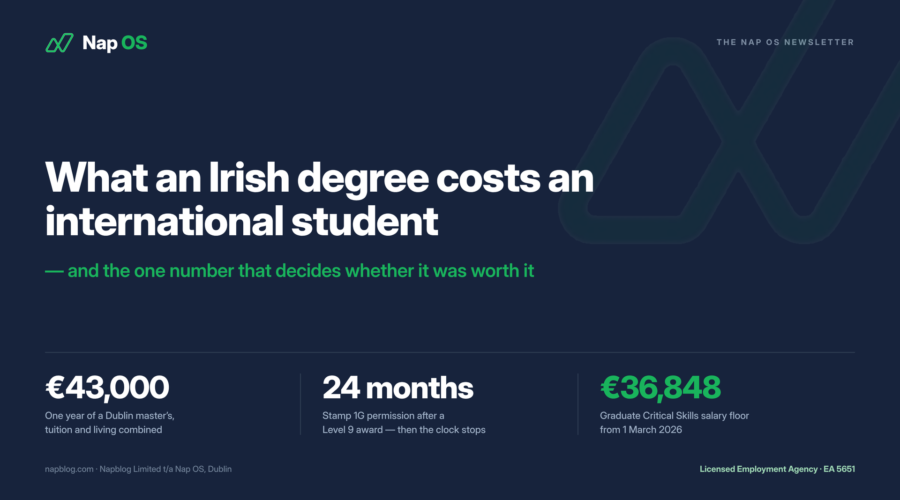
Finish a Level 9 master’s in Ireland and you get up to 24 months on a Stamp 1G graduate permission — 12 months after a Level 8 bachelor’s. During that window you can work full time without sponsorship. When it ends, you need an employment permit, and an employment permit has a salary floor.
From 1 March 2026 those floors are: €36,605 for a standard General Employment Permit, with a €34,009 graduate rate for recent graduates of recognised Irish institutions applying within twelve months of graduating. The Critical Skills Employment Permit sits at €40,904 with a relevant degree, €68,911 without one, and a €36,848 graduate rate. They are scheduled to keep rising to 2030.
So the real question is not “what does the degree cost.” It is: can you reach roughly €35,000 to €41,000 a year, in an Irish job, before a specific date?
Everything else — fee tables, city comparisons, rankings — is secondary to that one line. If you clear it, the investment works. If you do not, you go home having spent the money anyway.
2. What you actually pay
Tuition for non-EU students runs roughly €10,000 to €30,000 a year at undergraduate level and €12,000 to €35,000 for a taught master’s, with medicine and some health programmes well above that. Living costs add somewhere between €11,000 and €21,500 a year, with Dublin at the top of that range by a wide margin.
A concrete example, because ranges hide the thing that matters. Trinity College Dublin’s MSc in Digital Marketing Strategy charges €16,575 for EU students and €24,600 for non-EU students in 2027/28. Same lecturers, same classroom, same award. The non-EU student pays about 48% more for the identical product.
That premium is not a scandal — it is how Irish higher education is funded, and it is the same almost everywhere. But it should be named honestly, because it changes the maths. Add a one-year Dublin master’s at €24,600 to living costs of €18,000 and you are at roughly €43,000 for twelve months, before flights, before the visa, before the deposit on a room you probably cannot find.
Against that, Ireland offers something real: the European headquarters of a long list of major employers, a one-year master’s rather than two, and one of the more generous post-study work permissions in the English-speaking world at a time when the UK, Canada, Australia and the United States are all tightening theirs.
The offer is genuinely good. The execution risk sits entirely with you.
3. The Catch-22, stated precisely
Here is where most of that €43,000 gets lost.
You arrive with a degree and no Irish work history. You apply. The employer, filling a graduate role from a hundred applicants, filters on something — and the easiest thing to filter on is prior local experience. You do not have it. You cannot get it, because the only way to get Irish experience is to be given an Irish job.
That is the whole trap, and it is not irrational on the employer’s side. They are not being unfair. They are managing risk with the only evidence they have been given, which is a CV asserting things about you that nobody has checked.
The clock makes it worse. A UK or EU graduate who spends eight months finding their footing has lost eight months. A non-EU graduate who spends eight months has lost a third of their permission, and the salary floor does not move to accommodate them.
So the failure mode is specific and common: a capable graduate, properly qualified, spends their Stamp 1G in roles that will never reach the permit threshold, and leaves. The degree was not wasted. The window was.
4. Why the CV stopped working
Something changed in the last two years that almost nobody has adjusted to.
A student can now produce a competent market analysis, a campaign plan, a dashboard or a financial model in an afternoon, with help from tools everyone has. The artefact is no longer evidence of anything, and employers know it. A portfolio piece proves you had access to a model, not that you can think.
This is why “build a portfolio” has quietly stopped working as advice, and why employers have fallen back even harder on the one signal AI cannot fake: somebody I trust watched this person work.
That is what local experience actually is. Not knowledge of Ireland. Not familiarity with Irish spelling. It is a named professional, in this market, who has seen your output and will stand over an opinion about it.
If that is the real currency, then the question becomes obvious: why is the only way to obtain it to already have the job?
5. What project-based hiring changes
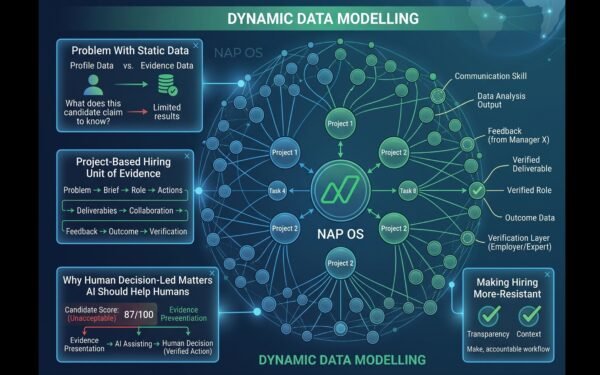
Project-based hiring inverts the order. Instead of screening a CV and then discovering what someone can do, the employer looks at assessed work first.
For that to mean anything, four things have to be true, and most “virtual experience” offerings fail at least two:
- The work is set by a practitioner, not generated by a platform.
- The marking criteria are published before you start, so the judgement can be checked rather than trusted.
- The assessor is named, and their name travels with the record.
- The record is yours, portable, and inspectable by an employer without asking permission from the provider.
Get those four right and you have manufactured, legitimately, the thing the Catch-22 withholds: a named Irish professional who has examined your work and said something specific about it. Not a certificate. Not a badge. An opinion with a name attached and criteria behind it.
6. How Nap OS works, and what it costs
Nap OS is built by Napblog Limited, a Dublin company, and that is exactly what it does.
You take a structured project brief every fortnight — up to ten briefs across five domains: Startup and Entrepreneurship, Strategy and Operations, Marketing and Sales, Product and Research, and Data and AI. Or you take a single industry project on a thesis track. The criteria are published before you begin. A Project Manager — a practitioner with five or more years in their field and real hiring responsibility — assesses what you submit and returns written feedback within seven days, under their own name.
At the end you hold a record: the brief, what you produced, the criteria it was measured against, and who measured it. Where you authorise it, an employer can inspect that record before asking for a CV. Because Napblog Limited holds an Irish employment agency licence (EA 5651), we are permitted to operate the hiring process that follows.
The programme runs for twelve months and can start up to six months before you fly — while your visa is still processing. That pre-departure window is the part no one else occupies, and it is the difference between arriving to begin building Irish evidence and arriving already holding some.
What it costs. The programme is €999 for twelve months. Where an institution has bought places for its students, it is invoiced to the institution and the student is not charged. Otherwise it is self-funded. There is also a €49.99 monthly plan for students who want to run at their own pace.
Set that against €43,000 for a Dublin master’s year. The programme is roughly 2% of what you are already spending to put yourself in a position where the other 98% can pay off.
Required, and we mean it: fees cover project briefs, Project Manager review and career support — not recruitment or job placement. Employment is not guaranteed. No one pays us to apply for, or be interviewed for, any role. That is a condition of our licence and we would not want it otherwise.
7. What we do not claim
If we are asking you to spend money during the most expensive year of your life, you are owed the limits.
We do not guarantee employment, interviews, or any immigration outcome, and we never will. We are not an accredited award, and involvement by any university does not accredit us.
We have never measured our reviewer agreement rate. If two qualified assessors mark the same work against the same published criteria and reach different conclusions, the criteria are doing no work and the assessment is one person’s opinion on one afternoon. We measure it for the first time by 31 January 2027, and we will publish the figure per cohort whatever it shows.
Our belief that graduates who arrive holding Irish-assessed work get hired sooner is a belief, not a finding. We think the mechanism is obvious. We have not proven it, and until we do we will keep calling it a hypothesis.
8. If you are deciding right now
Still choosing a country. Price the salary floor, not the fee. Ask of any programme: what does a graduate of this course actually earn in year one, and does that clear €35,000? If the honest answer is no, the ranking does not matter.
Already here, on Stamp 1G. Count the months you have left, today. Then use your term-time work allowance for anything that produces an Irish reference, and start building assessed evidence now rather than after the fiftieth rejection.
Still at home, waiting on a visa. This is the cheapest time you will ever have. Use it.
The artefact became free. The judgement did not.
Pugazheanthi Palani, Founder & CEO palani@napblog.com · +353 89 453 0418 Napblog Limited t/a Nap OS · CRO 812006 · Licensed Employment Agency EA 5651 77 Camden Street Lower, Saint Kevin’s, Dublin 2, D02 XE80 · napblog.com
Employment permit thresholds: Department of Enterprise, Tourism and Employment, effective 1 March 2026. Fee example: Trinity College Dublin, MSc Digital Marketing Strategy, 2027/28. Tuition and living-cost ranges are indicative and vary by institution, discipline and city.