7 min read
Employers increasingly want candidates to explain what they can do—not simply list what they have studied. Nap OS connects that expectation with structured projects, assessed outputs, and evidence learners can discuss.
A qualification can open a conversation. Practical evidence helps candidates explain why they belong in it.
That distinction sits at the heart of Nap OS. The platform’s purpose is to help students, graduates, and career changers move beyond unsupported skill claims by completing structured projects and producing work they can show.
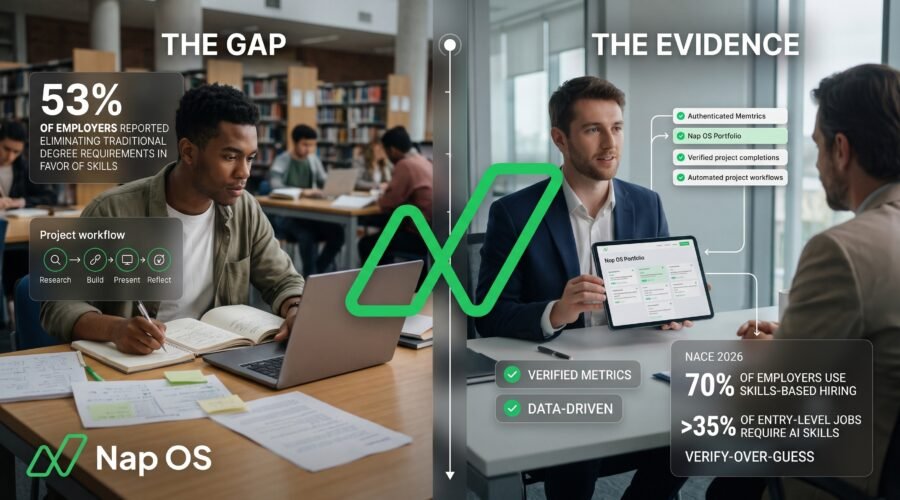
Research supports the importance of this approach—but not the sweeping claim that degrees have become irrelevant. The National Association of Colleges and Employers’ Job Outlook 2026 reports that nearly 70% of surveyed employers use skills-based hiring. It also emphasises experiential learning and candidates’ ability to describe situations in which they applied their skills.
For Nap OS, the opportunity is not to replace education. It is to make the connection between learning and capability more visible.
What the Hiring Statistics Actually Tell Us
Skills-based hiring, removing degree requirements, and requiring project portfolios are different practices.
An employer can assess practical skills while retaining degree requirements. Another can remove a qualification requirement without requesting a portfolio. A third may value projects but still prioritise relevant academic knowledge.
A Forbes contributor article reports that 53% of employers have eliminated degree requirements, drawing on NACE and TestGorilla data. That figure should not be presented as a verified percentage of all employers worldwide—or as evidence that 53% now require projects instead.
NACE’s own published finding is narrower: nearly 70% of respondents report using skills-based hiring. Its survey concerns graduate recruitment and collected responses between August and September 2025 for the 2026 outlook. It is not a census of Irish or European employers.
The useful conclusion is that demonstrated capability matters alongside credentials.
Ireland’s Evidence Points Towards Complementarity
The University of Limerick’s Early Careers Employer Survey 2026 provides a relevant Irish perspective.
The report reflects responses from 269 employers that hired graduates or student interns in 2025 and 2026, alongside student and higher-education careers perspectives. It identifies work placement as a key differentiator and a proxy for graduate readiness.ul
Yet its findings do not describe a wholesale abandonment of qualifications. Among surveyed employers, 87% require a CV and covering letter, while 63% confirm academic qualifications before an offer. Degree discipline also remains important, particularly for technical roles.
This is the environment Nap OS should address: employers using several signals to understand candidates.
A project portfolio is most useful when it adds relevant evidence to an application—not when it claims to make every other signal unnecessary.
The Problem Nap OS Is Built to Address
For early-career candidates, a skills-based process creates an immediate challenge: where does the evidence come from?
Someone may understand marketing principles but lack a campaign example. A student may know statistical methods but struggle to explain a practical analysis. A career changer may have transferable capabilities without examples that resemble their target role.
Nap OS addresses this gap through project-based practice.
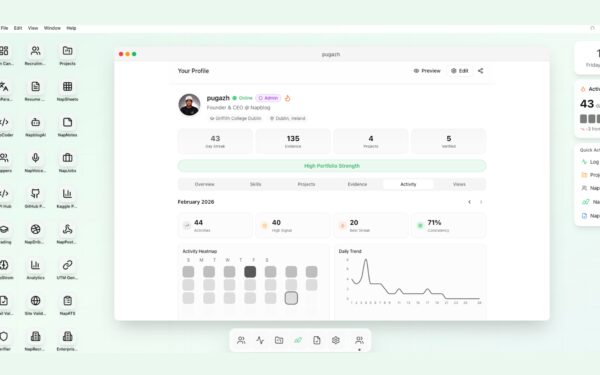
Its published methodology describes career-matched briefs, assessed deliverables, and completion records. The platform explicitly describes itself as a work-experience simulator rather than an employer.
That distinction matters. Simulated assignments can provide useful practice and discussion material, but they should not be represented as employment or client delivery.
The value lies in demonstrating selected capabilities honestly.
A Structured Route from Brief to Deliverable
Nap OS organises its published methodology around four phases: research, build, present, and reflect.
Each phase serves a different purpose.
Research asks the participant to understand a problem, examine sources, and develop an informed approach.
Build turns that approach into an output: an analysis, prototype, report, or other deliverable.
Present requires the participant to communicate the work for an intended audience.
Reflect asks what worked, what remained difficult, and what should improve.
Together, these activities create a richer story than “I completed a course.”
They also give the participant specific decisions to discuss. The goal is not merely to possess a polished file, but to explain how it came into existence and what it demonstrates.
What Useful Project Evidence Looks Like
Consider a hypothetical graduate targeting a junior data role.
Instead of listing “data analysis” without context, the graduate completes a project investigating a defined business question. They document the dataset, cleaning decisions, assumptions, calculations, and limitations.
The final output might be a dashboard accompanied by a short recommendation.
For an employer, the informative material is not simply the dashboard’s appearance. It is the reasoning behind it.
A useful evidence record should answer:
- What was the original task?
- What did the participant personally contribute?
- Which tools and assistance were used?
- How was accuracy checked?
- What feedback changed the work?
- What remains uncertain?
These questions provide a practical standard for Nap OS’s proof-of-work approach.
A Portfolio Should Make Interviews More Specific
NACE reports that employers recommend students prepare examples of situations where they used skills to solve problems. Employers also emphasise connecting coursework and extracurricular activities with professional capabilities.
Nap OS can support that preparation by giving participants concrete work to explain.
Instead of saying, “I am a strong communicator,” a candidate could describe how they revised a presentation after feedback.
Instead of saying, “I solve problems,” they could explain why an initial approach failed and how they adjusted.
This does not guarantee an interview or job offer. It creates more substantial material for evaluation.
The employer can then probe understanding, relevance, and individual contribution rather than relying entirely on confident descriptions.
AI Raises the Importance of Process
AI adds another reason to examine how work was produced.
A professional-looking output does not, by itself, establish that its presenter understands the analysis or can reproduce the task.
The University of Limerick report identifies practical, responsible AI literacy as an emerging expectation through its careers-expert insights. It also reports that 53% of surveyed employers regard over-reliance on AI-generated application content as a red flag.
For Nap OS, this suggests a clear assessment principle: evaluate judgement, not just output.
Participants should be able to explain where AI helped, which suggestions they rejected, how they checked information, and what decisions remained their responsibility.
Responsible use should be visible within the project narrative, rather than concealed or treated as automatic competence.
Avoiding Misleading AI Claims
The supplied search overview claims that more than 35% of entry-level postings require AI competency. That should not be confused with the figure on NACE’s original Job Outlook 2026 page, which displays 10.5% for entry-level job posts requiring AI skills. The Forbes article attributes its higher figure to a later spring update. These are differently timed claims, not interchangeable statistics.naceweb+1
Nap OS does not need an exaggerated number to explain its relevance.
A stronger proposition is that learners should practise appropriate AI use within meaningful tasks and demonstrate their understanding.
For example, a research assignment could require source checking and correction of an AI-generated error. A coding task could require explaining and testing suggested code.
The evidence should show competence beyond tool access.
Universities Can Connect Academic and Career Evidence
For universities, Nap OS’s proposed role is complementary.
A university-facing programme could help students translate academic learning into project records suitable for career discussions. Careers teams could help participants select relevant examples, while academic staff could advise on disciplinary standards.
The University of Limerick report describes institutions embedding employability earlier, strengthening employer partnerships, and expanding work-based learning. That provides a relevant context, not proof that a particular institution has adopted Nap OS.
Any deployment would need agreement on assessment, accessibility, staff effort, data handling, and the distinction between academic credit and additional practice.
The objective should be clearer connections between education and employment—not duplication of existing provision.
Verification Must Mean Something Specific
Nap OS’s methodology describes completion records with unique identifiers and portfolios containing assessed work.
Those records need precise explanations.
Confirming completion differs from checking technical accuracy. Reviewing a deliverable differs from observing independent performance. A short simulation differs from sustained employment.
A trustworthy record should make its scope understandable: what was reviewed, by whom, against which criteria, and with what limitations.
Participants should receive credit for their genuine contribution without broader implications being attached to it.
This clarity is central to proof of work. Without it, a new badge risks becoming another credential whose meaning employers must guess.
Turning Skills-Based Intentions into Practice
The gap between hiring announcements and hiring behaviour also matters. The Forbes article discusses research finding that removing degree requirements often produced limited changes in actual hiring.
Nap OS should therefore avoid assuming that employers will adopt portfolios simply because they express interest in skills.
The product must make evidence practical to review.
That means concise summaries, relevant deliverables, transparent assessment, and clear links to role requirements.
Its effectiveness should then be tested: can participants explain their work better? Do employers find the records useful? Are assessments consistent? Does the evidence improve recruitment conversations?
Participation, demonstrated capability, interviews, and employment should remain separate measures.
Beyond Degrees Versus Projects
The future Nap OS should pursue is not a contest between universities and portfolios.
Education can provide foundations. Projects can demonstrate application. Interviews can test understanding. Employment can reveal performance over time.
The research reviewed here supports combining these signals rather than declaring one universally sufficient.ul+1
Nap OS’s contribution is to help learners build something meaningful between studying a subject and asking someone to trust their capability.
The strongest message is therefore straightforward: do not discard your education, and do not rely on it to tell your entire story.
Apply it. Document your contribution. Explain your decisions. Show what you learned—and what you are ready to do next.