8 min read
Nap OS runs a twelve-month International Work Experience Program. A student who is moving abroad to study does real project work for a year — six months before they fly, six months after they land — and a working professional reads and judges every piece of it against criteria published before the student begins.
The person doing that judging is what we call a Project Manager. It is the whole product. We are hiring more of them, and this explains exactly what the job is, so that the right people apply and the wrong ones don’t waste an afternoon on the questions at the end.
Where we are: 200 active members, 600 project briefs generated, 28 alumni now working at 24 employers. Small, and real.
The one thing that decides it
We want people who have sat on the hiring side of the table.
Not “experienced professionals” in general. People who have interviewed candidates, read applications, run a graduate intake, or made the call on who gets the offer. If you have done that, you know the thing a student cannot learn from a course: what a hiring manager in your market actually notices, and what quietly ends an application.
That is the judgement we are buying. A reviewer who has never hired can tell a student whether the work is good. A reviewer who hires can tell them whether it would get them an interview, and those are different sentences.
Years of experience matter, but they are a quality metric, not a qualification. We publish the years on each record where they are specific and true — nine years in Data and AI, four of them in the Irish market — rather than making a blanket claim on a website.
Three tiers, and what each one is allowed to do
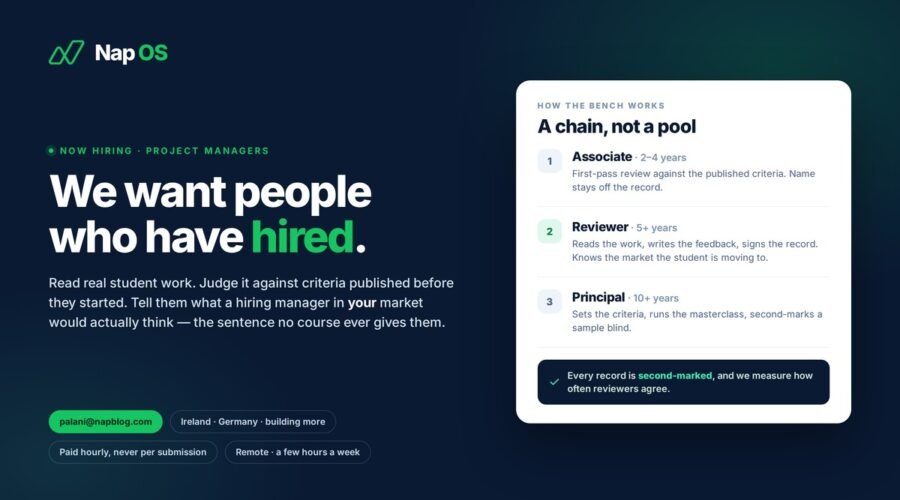
We run a chain rather than a pool, because a record is only worth something if different reviewers judge the same work the same way.
Associate reviewer. Two to four years. First-pass review against the published criteria — is the work complete, does it meet the brief, where is it weak. Your name does not appear on the student’s record; a senior reviewer signs it.
Reviewer. Five or more years in the domain, with real experience of the market the student is moving to. You read the work, write the feedback and sign the record. Your name is on it.
Principal. Ten or more years. You design the briefs and marking criteria, run group masterclasses, second-mark a sample of other people’s work blind, and settle disputes. You rarely review an individual brief, because your hour is worth more divided across a cohort than spent on one student.
Most people apply for one tier and belong in another. We will tell you which, and why.
The domains we need, and the one we are short of
Five project domains: Startup and Entrepreneurship, Strategy and Operations, Marketing and Sales, Product and Research, Data and AI.
We are deepest in Data and AI and Strategy and Operations. We are short in Marketing and Sales — specifically someone with five or more years in performance marketing, brand, content or business development who has also hired into those teams. If that is you, apply today rather than next month.
There is also a cross-cutting role that is not a domain at all. Every brief is a project: the student has to scope it, plan it, manage dependencies, deliver it and present it. Someone who assesses that layer — project and change management — works across all five domains at once.
The corridors we need
A corridor is one country a student leaves and one country they arrive in. The briefs and criteria are identical everywhere. The only thing that changes is which reviewer we match.
We are strongest in Ireland today. We are building Germany, where Indian enrolment reached 69,816 students in 2025/26 and grew 17.5% in a single year. We need reviewers who work in the Netherlands, Canada, Australia, the UK and the US — not to serve students we already have, but because we open a corridor only when we have someone who can staff it honestly.
If you are based in a market we have not opened and you bring reviewers as well as yourself, say so. That conversation is more valuable to us than a single application.
How we pay, and the one structural choice behind it
We don’t publish rates, and we would rather you set the number. Tell us what your time is worth — for review and written feedback, for one-to-one sessions, and for group delivery. We negotiate per person and per tier, and we have already agreed terms across a wide range. If your number and the tier don’t meet, we will tell you quickly rather than string it out.
Preparation, written feedback, assessment and onboarding are paid. If we require it, we pay for it. Rates are quoted before VAT, invoiced monthly.
Reviewers are paid by the hour, never per submission. Paying per submission rewards speed, and what we are buying is somebody taking the time to read the work properly. That sentence is in the contract, not just in the marketing.
Hours are not guaranteed. Work depends on enrolment, and we confirm scheduled sessions at least seven days ahead. If you need a guaranteed income, this is not that job — and we would rather say so now.
What a month actually looks like
A reviewer carrying sixty students handles roughly two briefs per student per month, batched by brief so you read ten submissions of the same task in one sitting with the same criteria in mind. That is about forty hours a month, written feedback included.
You also take a small number of fifteen-minute one-to-one calls, booked by students when they need them, and you are expected to offer a slot within seven calendar days of a request. Not to be on call — to be reachable within a week.
A principal does something different: one group masterclass a month across a whole cohort, a sample of blind second marking, and an hour a month per reviewer on calibration.
The quality system, because this is not a freelancer pool
Three things hold the standard together, and they are why a Nap OS record means anything at all:
Criteria are published before the student starts. Nobody marks to fit whatever was produced.
A sample of every reviewer’s work is blind second-marked by a principal who has not seen the first judgement.
We measure the agreement rate between them. If two calibrated reviewers reach the same judgement on the same work, the record is worth showing an employer. If they don’t, we have a problem we can see and fix. Most of this industry has no such number. We intend to publish ours.
If a measured check on your own judgement would irritate you, this is the wrong job. If it is the reason you are interested, it is the right one.
Four things a Nap OS Project Manager never does
We hold an Irish employment agency licence (EA 5651), and it carries a prohibition: we may not charge a jobseeker a fee for finding them work. That shapes the role.
You never promise or imply employment, or suggest a record improves a visa application. You never give immigration advice. You never commit Nap OS to anything — you refer it. And you never set a brief that benefits your own business, or quietly recruit the student you just assessed; if you want to hire someone you reviewed, you declare it and it goes through Nap Recruit with a fee.
Several applicants wrote these boundaries into their answers before we mentioned them. That is the instinct we are looking for.
How the process runs
One. You email the answers below.
Two. If it fits, we send you one anonymised student submission and the criteria it was marked against, and ask for the written feedback you would return. We pay you for it. It is the only part of the process that tells either of us whether you can do the job — a CV does not.
Three. A conversation about tier, domain, corridor and terms.
Four. Paid onboarding, then calibration against two other reviewers before you sign your first record.
The questions
Send your answers to palani@napblog.com. Plain email is fine; a document is fine.
- Hiring. Have you interviewed or hired people? Roughly how many, in which market, and do you still hire today?
- Background. Your current or most recent role, the domain you would review in, and how many years you have in that domain — not in total.
- Market. Which country’s hiring norms do you know from working there, and for how long?
- Application. How would you help a student understand what a workplace expects? Give one concrete example of a project or exercise you could set and assess.
- Availability. Country, time zone, usual days and hours, minimum and maximum weekly hours, earliest start date, and anything that will restrict you in the next twelve months.
- Seven days. Could you generally offer an appointment within seven calendar days of a student’s request, and would you tell us promptly when you can’t?
- Variable work. Hours are not guaranteed and we confirm seven days ahead. Does that suit you, and what minimum booking do you need?
- Feedback. How long do you need after a session to write useful feedback, and what would you cover?
- Being reviewed. Are you comfortable with student feedback and blind second marking of your own judgements?
- Recording. We may record and transcribe sessions for quality review. Any conditions? We do not use recordings for marketing without separate consent.
- Profile. May we publish an approved biography, photograph and credentials?
- Boundaries. Are you comfortable with the four limits above?
- Rates. Your hourly rates for review and written feedback, one-to-one sessions, group delivery, and preparation. Minimum billable length. Cancellation and no-show terms.
- Proof. A CV or LinkedIn profile — this one is required, not optional — and one example of work you are free to share.
If you have spent years learning what a good piece of work looks like, and you have watched capable people fail to get hired because nobody ever told them what was missing, this is a straightforward way to spend a few hours a week fixing that.
Pugazheanthi Palani · Founder & CEO, Napblog Limited (Nap OS) palani@napblog.com · napblog.com
Napblog Limited, trading as Nap OS. 77 Camden Street Lower, Saint Kevin’s, Dublin 2, D02 XE80, Ireland. Company No. 812006 · Licensed Employment Agency EA 5651. Project Managers are engaged as independent contractors, not employees, unless separately agreed in writing. Fees cover project briefs, Project Manager review and career support — not recruitment or job placement. Employment is not guaranteed. Nap OS is not accredited and is not a qualification. Platform figures October 2026. German enrolment data: DAAD/Destatis via The PIE News, winter semester 2025/26.