7 min read
An execution plan for international career readiness—before departure and after arrival
An international education journey does not begin at the airport, and it should not end with an admission letter.
For students, the journey involves more than choosing a university. It means preparing to learn, communicate and demonstrate capability in a new environment. For parents, it means supporting an important decision while wanting reassurance that their child has a structured plan beyond travel and enrolment.
Education consultancies help families navigate the path to overseas study. Nap OS proposes a complementary layer: career readiness built through practical projects, experienced human feedback and a documented development journey.
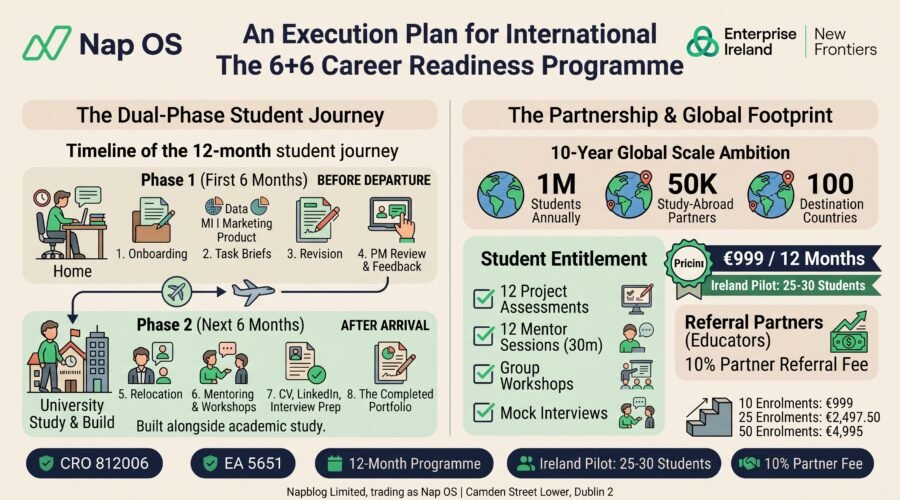
Our proposed 12-month programme follows a simple structure:
Six months of preparation before departure. Six months of continued development after arrival.
The purpose is not to promise employment. It is to help students use their preparation time productively, develop reviewed portfolio work and approach their international journey with clearer expectations.
1. The ambition—and the responsibility behind it
Nap OS’s long-term ambition is to reach one million students annually through a potential network of 50,000 study-abroad partners serving students across 100 destination countries.
That is an illustrative scale ambition, not an existing network, verified market estimate or enrolment forecast. It assumes an average of 20 annual enrolments per active partner.
Execution must begin much smaller.
Our initial proposed pathway focuses on Ireland-bound students, with selected education and training partners, a clearly defined programme and a capacity-confirmed pilot.Before expanding, we need evidence that students value the service, partners can introduce it accurately, and Nap OS can consistently deliver useful feedback at sustainable cost.
The operating principle is straightforward: scale what works—not merely what attracts interest.
2. The 6+6 programme: one continuous development journey
The programme is designed to connect two periods that students may otherwise experience separately: preparation at home and adaptation abroad.
During the first six months, participants begin building practical evidence before travelling.
During the next six months, they continue developing that evidence alongside their studies and changing circumstances.
The timeline is a programme design, not a condition that relocation must happen on a particular date. Where departure is delayed or cancelled, continuation remotely or an agreed pause would follow the written programme terms.
The initial project domains are:
- Data and AI.
- Marketing and sales.
- Product and research.
- Strategy and operations.
- Startup development.
Participants choose a relevant direction rather than attempting every domain.
3. Months 1–6: build a foundation before departure
The first phase begins with onboarding, expectations and a realistic development plan.
A student preparing for a data-related degree might work on an analytical brief. A marketing student might develop a campaign proposal. A business student might prepare a market assessment or operational recommendation.
Each activity should have a defined scope, expected output and assessment criteria.
The learning cycle is:
Brief → independent work → submission → Project Manager feedback → revision → documented output.
The goal is not to fill six months with disconnected assignments. It is to develop a repeatable way of approaching professional tasks.
Participants practise explaining assumptions, managing deadlines, communicating decisions and improving their work after feedback.
Pre-departure orientation also introduces Irish workplace expectations relevant to the initial pathway. This is preparation and discussion—not a substitute for professional immigration or legal advice.
4. Months 7–12: continue development after arrival
Arrival brings competing demands: classes, accommodation, finances, new relationships and unfamiliar routines.
The second phase must therefore be practical and flexible.
Participants continue project work around their academic commitments, revisit their development goals and use mentoring sessions to identify manageable next steps.
Career preparation becomes more connected to the portfolio they have built:
- What did they produce?
- Why did they choose that approach?
- What feedback did they receive?
- What changed after revision?
- What can they explain confidently in an interview?
CV and LinkedIn support should reflect actual activity. Mock interviews should help participants discuss their work accurately.
Nap OS will not present learning projects as employment, an internship or a formal placement when they are not.
The intended outcome is a stronger ability to demonstrate preparation—not a guaranteed job offer.
5. Make the student entitlement clear
The proposed programme price is €999 for 12 months, paid to Napblog Limited.
The proposed package includes:
- A new project brief available fortnightly across the programme domains.
- Up to 12 completed-project assessments.
- One revision review per assessed project.
- Twelve individual mentoring sessions of 30 minutes.
- Six online group workshops.
- Two mock interviews of 30 minutes.
- One initial and one final CV and LinkedIn review.
- Email support, with a proposed response time of three working days.
- A completion record where stated criteria are met.
These commitments must be confirmed in the student agreement before enrolment.
Participants should know what is included, what requires their own effort, how appointments work and what happens if they withdraw.
A defined service is more credible than an open-ended promise of “international opportunities.”
6. Invite education consultancies into a bounded partnership
Nap OS invites education consultancies and training organisations to explore a non-exclusive referral partnership.
The consultancy continues to own its existing admissions and student-support services. Nap OS provides the separate project-learning and career-readiness programme.
The proposed partner responsibilities are limited:
- Nominate one coordinator.
- Introduce the programme to suitable students.
- Use approved information and branding.
- Explain the service without making outcome guarantees.
- Share student information only with appropriate permission.
- Use the agreed referral link or code.
Napblog would train the coordinator, provide materials, run a student information session, record attribution and handle programme contracting, payment, delivery, questions, complaints and refunds.
Before launch, both organisations should map their services to avoid duplication.
7. Provide a transparent commercial incentive
The proposed partner fee is 10% of eligible programme fees actually collected.
For a qualifying full-price €999 enrolment, that is €99.90 before applicable adjustments under the commercial agreement.
For illustration:
- Ten qualifying full-price enrolments generate €999 in partner fees.
- Twenty-five generate €2,497.50.
- Fifty generate €4,995.
These are examples, not enrolment forecasts.
Written terms must define attribution, discounts, instalments, taxes, refunds, chargebacks, payout timing and disputes.
The student price does not increase because a referral partner is involved.
Most importantly, the fee rewards an eligible programme enrolment. It is never dependent on the student obtaining employment.
A partner should not be expected to deliver additional teaching, events or ongoing support within that referral fee unless separately agreed.
8. Begin with a controlled pilot
The initial proposed pilot is Ireland-only, involving one or two participating branches and a capacity-confirmed cohort of approximately 25–30 students.
The first task is discovery.
We will discuss relevant course profiles, departure timelines, current support services and how counsellors would introduce Nap OS.
The second task is evidence review.
Prospective partners should see a sample brief, participant output, review process, Project Manager profile and clear service schedule.
The third task is agreement.
Both parties need written responsibilities, approved communications, referral rules and an escalation process.
Only then should counsellor training and student onboarding begin.
A signed MoU is a useful milestone, but the commercial test comes later: suitable referrals, paid enrolments, engagement and successful delivery.
9. Build parent confidence through transparency
Parents should receive a clear explanation of what the programme does—and what it does not do.
Reassurance should come from a visible structure: named contacts, defined entitlements, realistic expectations and a process for raising concerns.
It should not come from promises of employment, sponsorship, admission or visa approval.
Where an adult student wants a parent involved, the scope of any progress communication should be agreed with the student. Payment by a parent should not be treated as automatic permission to disclose the student’s information.
The proposition is simple: a defined development programme with accountable delivery, rather than uncertainty about what happens after payment.
That can support peace of mind without pretending to remove every risk from overseas study.
10. Match enrolments to delivery capacity
Every student commitment creates work.
The proposed mentoring and mock-interview package alone represents seven hours of individual sessions per participant, before project assessments, revisions and administration.
Nap OS must therefore confirm reviewer availability before accepting a cohort.
Execution requires:
- Named Project Managers with relevant experience.
- Clear allocation of participants.
- Consistent assessment criteria.
- Scheduling and turnaround monitoring.
- Quality checks and escalation procedures.
- Cost tracking per participant.
Shared project briefs can make delivery more efficient. They do not eliminate the need for meaningful individual feedback.
Growth should follow confirmed capacity, not precede it.
11. Measure outcomes before expanding
The pilot dashboard should distinguish marketing activity from commercial and learning results.
We propose tracking:
- Suitable enquiries and paid enrolments.
- Programme activation.
- First-brief completion.
- Assessment turnaround.
- Mentoring attendance.
- Participant and parent feedback, where appropriate.
- Withdrawals and refunds.
- Counsellor time.
- Acquisition and delivery costs.
- Repeat referrals from partners.
Illustrative pilot thresholds could include 70% activation, 60% first-brief completion and feedback within seven days. Final thresholds must reflect the agreed service and available capacity.
Employment outcomes, where recorded with consent, must be described carefully. Participation does not establish that Nap OS caused a later job offer.
Expansion decisions should follow the full picture.
12. An invitation to build the first cohorts
We are inviting education consultancies and training organisations with suitable Ireland-bound students to discuss becoming early Nap OS referral partners.
The first conversation should answer four questions:
- Which students would genuinely benefit?
- How does this complement your existing services?
- Who will coordinate the pilot?
- What evidence would justify a second cohort?
There is no need to begin with a large enrolment commitment. Begin with service mapping, a programme demonstration and a realistic pilot.
The international education journey deserves support beyond admission.
Our ambition is to work with partners who help students reach their destination—and then help those students build the practical evidence, confidence and preparation to make better use of the journey.
Partnership enquiries: palani@napblog.com
Pugazheanthi Palani, Founder & CEO, Napblog Limited — Nap OS