7 min read
For many graduates, the barrier to employment is not a lack of intelligence, ambition or academic knowledge. It is the absence of credible evidence that they can solve a relevant problem in a working environment. Employers want experience before offering an opportunity, while graduates need an opportunity to gain it. The result is applications filled with qualifications but limited proof of how someone thinks, collaborates and delivers.
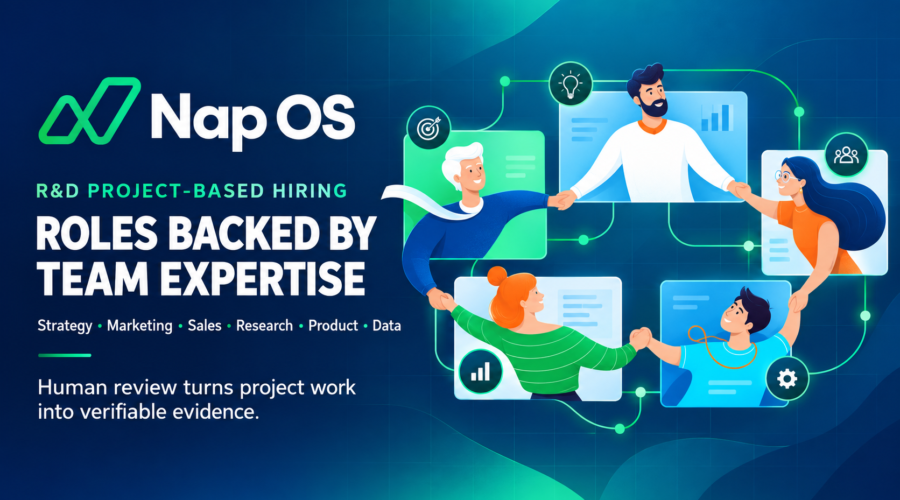
Nap OS is being built to challenge that gap. Our approach is evidence-first: give people access to meaningful project briefs, help them translate knowledge into execution, and enable them to leave with work they can explain and demonstrate. Where human review is selected, a Project Manager can assess the process and outputs so that the candidate has more than a self-written claim. The objective is not to promise employment. It is to make ability more visible, specific and verifiable.
Nap OS is not only being designed for graduates. It is being developed with graduates, professionals, researchers and early-stage founders. The gradireland campaign demonstrates this model: contributors across marketing, data, software, HR, research, student engagement and venture development share a business outcome. It is more than promotion; it is a live environment in which people take responsibility, work across functions and solve relevant problems.
A workforce platform built in the same way it teaches
The philosophy behind Nap OS is simple: relevance is created through action. A course can introduce a framework, and AI can help someone generate ideas or speed up production, but neither automatically proves judgement, accountability or the ability to work with other people. Those qualities become visible when a person faces a defined problem, makes decisions, produces an output, responds to feedback and improves the work.
Nap OS therefore treats product, marketing, research and talent development as connected projects. A campaign question can reveal a product problem; student feedback can improve onboarding; data can change a message; and an employer conversation can reshape a brief. Contributors see how their work affects a wider system while practising what employers value: understanding context, communicating across roles and moving a problem toward a useful outcome.
The gradireland campaign as a live operating project
The Nap OS gradireland campaign team is working around a clear challenge: how do we explain project-based hiring to graduates quickly, honestly and convincingly, while creating a reliable journey from first contact to project participation? Answering it requires more than social posts and flyers. The team must understand the audience, clarify the offer, test messages, coordinate the event, capture consented leads, support enquiries, organise follow-up and learn from the results.
The stand plan makes that collaboration concrete. Twelve contributors rotate through six operating states: Puller, Scanner, Explainer or Project Manager desk, Floater, Observer and Rest. Each visitor question has a specialist destination, and the handoff rule is to walk the person to the right colleague rather than point across the stand. Form counts are checked every 15 minutes so the team can respond to evidence during the day instead of waiting for a retrospective report.
Anirudh Viswanath and Subramanyam Dhandapani staff the Project Manager desk as the human proof behind the proposition. Other team members own student conversations, HR questions, campaign capture, institutional enquiries, media, technical troubleshooting and risk resolution. Portuguese-speaking contributors expand the team’s ability to welcome international visitors. Contingencies cover staff shortages, an empty Project Manager desk and QR or form failure. Clear language guardrails prevent anyone from promising a job, presenting Nap OS as an accredited qualification or making unsupported claims.
This creates a practical learning environment producing research, scripts, creative assets, workflows and recommendations. Contributors can explain why an artefact was created, what constraint it addressed, how feedback changed it and what happened after use. That explanation turns an output into evidence of problem-solving.
Different disciplines, one shared outcome
Nap OS benefits from a team whose experience crosses technology, business and education.
Pugazheanthi Palani, Founder and CEO, connects workforce technology, product strategy, project-based hiring and employer partnerships. His role is to keep the work anchored to the core problem: helping people convert execution into evidence that employers can understand.
Anirudh Viswanath, Promoter and Project Manager, brings software engineering, data analytics and technical product delivery into that vision. He helps translate the Nap OS proposition into review stages, credible technical explanations and systems that can be measured and improved.
Subramanyam Dhandapani, Promoter and Project Manager, contributes business intelligence, SQL, data analytics and operational-efficiency thinking. He helps participants connect project activity to evidence and examine what the data can—and cannot—prove.
Balaji Rajasekar, from the HR team, supports recruitment, people operations, training and development. This ensures that project participation is considered from the human side: role clarity, expectations, communication, feedback and growth.
Mridhula Vijayakumar, Student Ambassador at NCI, brings software, analytics, peer mentoring and direct student engagement together. Her contribution helps Nap OS understand how the platform and its message are experienced by the people it is intended to serve.
Karthik Sumod, the UCD × Nap OS Pilot Thesis Student, connects international marketing, academic research, media and university–industry collaboration. Research adds discipline to the work by turning assumptions into questions that can be examined.
The gradireland marketing contributors add complementary strengths. Namrata Ghoghari works across digital marketing, SEO, advertising and research. Danielly Apodaca contributes branding, visual communication and customer experience. Amanda Martins focuses on content and storytelling. Heloísa Moreira supports campaign coordination, student outreach and event marketing. Nefise Adiloglu contributes digital communications and campaign support.
James Cody, a Nap OS Incubate pilot candidate, extends the model into entrepreneurship through sustainable product development, Irish manufacturing and early-stage venture development. Project-based experience can support employment or help someone test and build a venture.
The strength lies in how these disciplines interact. A strong visual without a clear proposition will not convert. A sound product without understandable onboarding will lose users. Data without context can mislead, while outreach without follow-up wastes attention. Collaboration makes these dependencies visible.
How the operating model develops problem solvers
Nap OS structures collaboration around a repeatable project cycle. The team defines the problem and intended outcome; gives contributors clear ownership; develops the work in visible stages; reviews outputs against the brief; and organises the completed brief, contribution, output, feedback and improvement into evidence. The team then decides what should be repeated, changed or stopped.
This cycle develops five transferable behaviours: framing a problem before acting; explaining decisions; delivering something usable; collaborating across roles; and learning from evidence. Whether a project involves marketing, data, software, research or operations, the ability to move from ambiguity to accountable execution applies across careers.
Human review is important within this model. AI can accelerate research, drafting, analysis and ideation, but speed is not the same as competence. A Project Manager can ask why a decision was made, whether the evidence supports it, how feedback was handled and which parts of the work the participant genuinely owns. That conversation helps separate polished output from demonstrated understanding and supports a verifiable project record.
From project contributor to project-based hiring
Traditional recruitment often asks an employer to infer capability from a CV, a short interview and previous job titles. Project-based hiring gives the conversation a stronger starting point. A candidate can discuss a real brief, show an artefact, describe collaboration and explain how the work improved. The employer gains richer evidence; the candidate gains a more credible story.
This does not mean that every project leads to a job, and Nap OS does not guarantee employment. Project evidence must sit alongside the employer’s requirements, fair selection, communication skills and many other factors. What it can do is reduce the distance between “I believe I can do this” and “Here is how I approached something relevant.”
The gradireland campaign team embodies that transition. Each contributor is helping build an actual campaign, while creating a record of decisions, deliverables, feedback and collaboration. The project becomes both business value for Nap OS and professional evidence for the person who helped create it.
Building a community of relevant problem solvers
Nap OS is building toward a model in which graduates are not empty CVs waiting to be chosen. They can contribute, learn, document and improve. Employers can engage with clearer evidence of how a person works; universities gain a practical bridge between learning and execution; and early-stage ventures meet people seeking meaningful problems.
Our team represents this model in motion. Software informs operations. Research strengthens strategy. Student engagement challenges assumptions. Marketing translates value. HR supports the people doing the work. Data tests what we think we know. Incubation expands the pathway from careers into venture creation.
Nap OS is therefore being built through the same principle it offers to others: do the work, make the work visible, invite review and turn the result into evidence. When graduates collaborate on relevant problems, they do more than gain another line for a CV. They learn how to create value with other people—and that is the foundation of project-based hiring.