7 min read
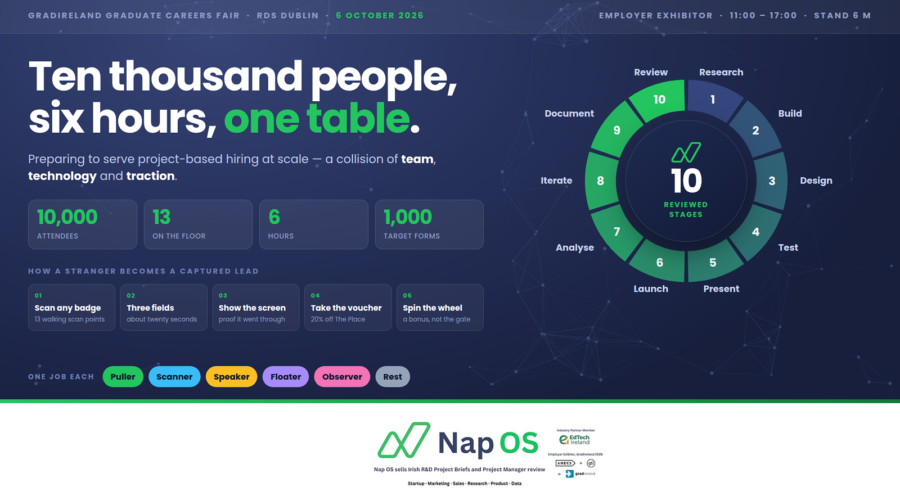
On 6 October, Napblog brings thirteen people to the RDS for the gradireland Graduate Careers Fair. Six metres of stand, one table, four chairs, six hours between eleven and five. Around ten thousand graduates will move through that hall.
Most exhibitors treat those numbers as background colour. We treated them as a constraint, and the constraint turned out to be the most useful thing we had.
We did the arithmetic before we did the design
We want a thousand completed forms — ten per cent of the floating audience. An active exhibitor at a fair this size normally captures two to five per cent, so we are aiming at roughly double what good looks like. Saying that out loud is uncomfortable, which is why it is worth doing: a target you cannot defend with arithmetic is not a target, it is a hope.
The first thing the arithmetic told us was that our most obvious idea would not work.
We have a prize wheel, and everybody loves a prize wheel. A spin, the handover and the reset take about forty-five seconds, so one wheel serves four hundred and eighty people across six hours — forty-eight per cent of our target. Had we made the wheel the gate, we would have capped ourselves at half our own goal before the doors opened, and found out at two in the afternoon when the queue became a wall and people started walking past it.
So the wheel stopped being the gate. It is now a bonus for people who come to the stand, and capture moved elsewhere.
Technology: every badge is a scan point
Each of the thirteen ID cards we had printed carries a QR code on the front and a larger one on the back. That is not decoration. It means we do not have one capture point at a stand; we have thirteen walking capture points distributed across a hall.
Someone scans a badge in the coffee queue and completes the form standing there, on their own phone, in about twenty seconds. They arrive already captured — or they never arrive at all, and we still have them. The transaction at the table drops from ninety seconds to twenty-five, and our ceiling roughly doubles.
The codes are tagged so badge scans separate cleanly from flyer scans in our analytics. We will know by Tuesday which surface produced the leads, rather than guessing for a year.
Then there is the thing that made the target arithmetically possible at all: four thousand flyers, each carrying twenty per cent off The Place Street Food on the back.
We modelled three versions of the same day with the same seven people on the floor. Hand the flyer out freely, with no reason for anyone to fill anything in: near six hundred and seventy forms. Ask for the form with nothing in your hand: near seven hundred and eighty. Give the voucher after the form is submitted: near a thousand.
Same people, same hours. The only variable is whether the flyer is a handout or a reward. So our rule is one sentence every one of the thirteen can repeat: show me the confirmation screen, take the voucher.
Team: six roles, and nobody does two of them
The most common way a stand fails is not laziness. It is everyone doing a little of everything and nobody owning the capture. So we split the day into four ninety-minute blocks and gave every person exactly one job per block.
Puller. Seven of the thirteen at any moment. Two stand three metres out in the aisle, facing the flow — not behind the table, because a stand with people behind a table reads as closed. The other five work the hall: coffee queues, seating areas, the lines at other exhibitors, people leaving the seminar rooms. They open with a question, never a pitch, and they carry vouchers. A Puller without vouchers in hand is just a person asking strangers for their email address.
Scanner. Two people. One owns the wheel, one owns the table and catches anyone whose phone, signal or patience fails. The Scanner sets the pace and does not get drawn into conversation, because every ten seconds spent explaining at the wheel costs a lead somewhere down the queue.
Speaker. One, and two through both peak blocks. This is our Project Manager desk, and it is the only place a five-minute conversation is allowed to happen. Anirudh Viswanath and Subramanyam Dhandapani staff it in rotation so that a Project Manager is on it in every single block of the day.
Holding two Speakers through the peaks costs a Puller in each, roughly fifty openings across the day. We pay that willingly. Assessed by a Project Manager is the claim the whole proposition rests on, and a graduate who asks how assessment works and gets a vague answer from a marketing intern is a graduate we have lost. We would rather point at our Project Managers than describe them.
Floater. One, with no fixed post, which is the point. Caps the visible queue at four — past four, people keep walking — and intercepts the fifth with a flyer and a time to come back, turning a lost lead into a second visit. Also resolves whatever breaks: a jam, a complaint, a dead phone, a missing box of flyers.
Observer. One, and the role most exhibitors never staff. The Observer does not sell. Their job is that the capture actually works: watching real scans succeed, testing the QR themselves every hour, counting completed forms every fifteen minutes. That cadence is the point — a broken link gets caught in fifteen minutes rather than at five o’clock. They also note the objection heard more than twice and which opening line genuinely stops people, and report it in sixty seconds at each changeover. It is the difference between a fair you attended and a fair you learned from.
Rest. One person, genuinely off the floor — not loitering behind the table, because idle bodies at a stand are the most reliable way to make it look dead.
Above all six, our founder runs the day: the count, the changeovers, the decision to change tactics, and every employer, university staffer and journalist who walks up.
Routing matters more than knowledge
Thirteen people is only an advantage if the right visitor reaches the right person. Nobody is expected to answer everything. The skill we are drilling is knowing who to walk someone to.
A student who looks new and lost goes to Mridhula Vijayakumar, an International Peer Mentor at NCI — settling international students into Dublin is literally her job. A dissertation question goes to Karthik Sumod, who is running his own UCD thesis with Nap OS and describes it first-hand rather than pitching it. A question about the record itself goes to James Cody, who completed our B2B Account-Based Marketing track in September and holds the thing he is describing. Anything technical goes to the Project Manager desk.
Between the thirteen of us we can switch into Portuguese, Tamil, Hindi, Gujarati or Malayalam, and at least one Portuguese speaker is visitor-facing in every block of the day. At an Irish graduate fair, that is not a nice-to-have.
Traction: the number that actually matters is not the number
Here is the part most fair write-ups leave out.
A thousand leads at a ten per cent activation rate is a hundred new people arriving at a review system. Every one of them consumes Project Manager time, because our entire promise is that a person reviews the work. Which means the fair succeeding is the thing that puts pressure on delivery in November.
We would rather say that now than discover it quietly later. Our real constraint has never been graduate demand; it is review capacity. So the week after is planned as carefully as the day itself: a thank-you to every captured lead within forty-eight hours, and an honest recap with the actual number in it, including the parts that did not work.
What we are not saying
We are a licensed employment agency, EA 5651, and that licence is precisely why we are careful. Nobody on our stand will tell a graduate this leads to a job, because it does not. Nap OS is not recruitment and not placement. It produces project work, assessed at each of ten stages by a Project Manager, ending in a record with a verification code — and the work itself, which the graduate owns outright.
It is not a qualification and it is not accredited. We say so before anyone asks, because the people who care about that distinction are exactly the people we most want to convince.
The collision
Team without technology produces good conversations nobody can find again. Technology without a team produces a beautifully instrumented empty stand. Both of them without a traction plan produce a thousand email addresses that quietly go cold.
We think the value is in the collision — thirteen people who know their one job, a capture layer that works anywhere in the building, and an honest plan for what happens to the people we meet. That is also, not coincidentally, what project-based hiring is: evidence you can check, produced by people doing real work, measured properly.
Come and find us on 6 October. Ask our Project Managers something difficult.
Napblog Limited, trading as Nap OS. Registered in Ireland No. 812006. Licensed Employment Agency EA 5651. EdTech Ireland network member. 77 Camden Street Lower, Dublin 2. Fees cover project briefs, Project Manager review and career support — not recruitment or job placement. Employment is not guaranteed.