8 min read
A message landed in my LinkedIn inbox at eight o’clock on Wednesday night. Short, and not a pitch. A student wanted a view on his business — a recruitment platform for footballers — from someone who had built something. I replied at 8:16 and offered a call the next morning. He asked for the afternoon instead, because he had school.
By four o’clock on Thursday I was looking at a product called ConnEasy and had realised something uncomfortable. He is building the thing I built and abandoned, and he has solved the part I never properly attempted.
His name is Freddie Horne. He is seventeen, in his final year at Blackrock College, and he plays academy football. He is building ConnEasy with a co-founder, also still at school. It opens in summer 2027; right now it is a waiting list and a community channel, which is exactly what it should be.
This is not a story about a prodigy. It is about one engineering decision most adults in this market have got wrong, and I want to be precise about it, because precision is worth more to him than praise.
The problem is real, and I have lived it
Club sport in Ireland runs on word of mouth. That sounds harmless until you are the one outside it.
I came to Ireland seven years ago to do a master’s. I play hockey and I have played cricket, and for two or three seasons my only method was turning up at clubs on random evenings, playing blind with strangers, hoping somebody there knew somebody. You take that risk with no idea whether you will fit the squad, the standard or the culture. Most people, quite reasonably, do not take it. They stop playing.
Freddie hit the same wall from the other side. He and his co-founder kept hearing one thing from people in the game: players want to move to clubs that suit them better, and there is no route to a coach that does not run through a mutual acquaintance. You can generate a list of club email addresses in four seconds now. That is not the missing piece. The missing piece is a reason for the stranger at the other end to take you seriously.
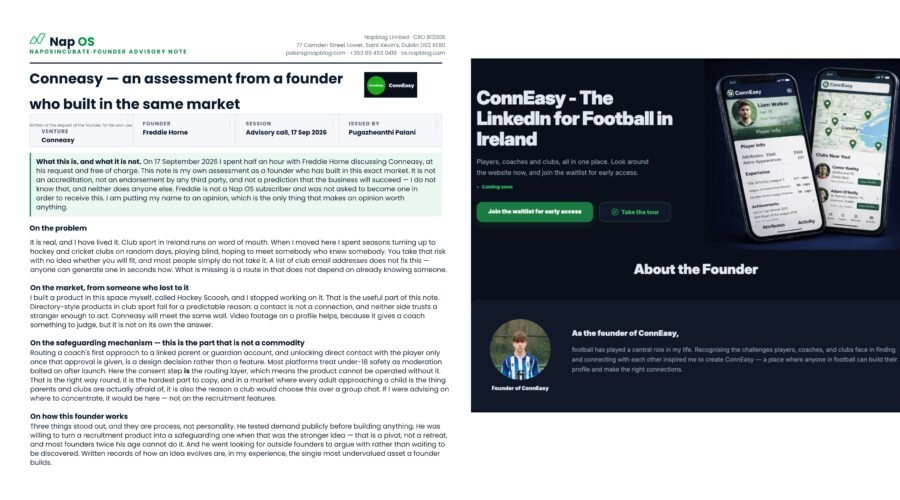
So: ConnEasy. Players build a profile with positions, club history, stats and clips. Coaches search for players who fit the squad they are assembling. Clubs appear on a map so they can be found at all. He calls it the LinkedIn for football in Ireland.
If you have been near sports technology you are already composing the objection. I made it myself, out loud, on the call.
What happened when I built it
A few years ago I built a product in this space called Hockey Scoosh. I no longer work on it.
Directory products in club sport fail for a reason you can predict from an armchair, which is why people keep building them. A contact is not a connection. Put every coach in the country behind a search box and the player still will not send the message, and the coach still will not answer, because neither has reason to trust a stranger. Marketplaces rarely die of empty databases. They die of populated databases nobody acts on.
I said this to Freddie plainly. He did not flinch, which told me something. Then he showed me the part of ConnEasy he is entering into this year’s Young Scientist & Technology Exhibition, and the conversation changed direction.
Consent as the routing layer
Because ConnEasy’s players are largely under eighteen, the founders had to answer the question every platform in this category eventually faces and most answer badly: what happens when an adult wants to contact a child?
The usual answer is moderation. Launch, let adults message children, add reporting tools, hire a trust-and-safety team when it goes wrong, write a blog post about how seriously you take it.
ConnEasy’s answer is structural. A player under eighteen emails an invitation to a parent from inside their own settings; the link creates the parent’s account and links the two. Nothing about the child is public until the parent has reviewed and approved the profile, and the parent can make it private again at any time. The parent approves every connection. And every message goes to the parent — not a copy, not a digest. It arrives with the adult, never directly with the child.
That is not a safety feature bolted onto a messaging product. It is the messaging architecture. Strip it out and the product does not run in a degraded mode; it does not run. Three things follow.
It is the hardest thing in the build to copy. Search, profiles, video and a map are commodity work — a funded competitor ships them in a quarter. Rebuilding an entire routing model around a consent gate after launch, once adults are already messaging children in production, is not a sprint. It is an amputation.
It answers the trust problem I could not solve. I was trying to make two strangers trust each other. ConnEasy does not ask them to. It inserts the one person already fully invested in the child’s outcome and hands them the controls. The parent is not a compliance obstacle here. The parent is the introduction.
And it is why a club would choose this over the WhatsApp group it uses today. Ask any club secretary in Ireland what actually frightens them about their under-age section. It is not that players struggle to find clubs. It is an unknown adult in a direct message with a fourteen-year-old. A platform that makes that structurally impossible is not selling recruitment. It is selling the removal of a risk that already keeps people awake. That is where I would spend the next twelve months, not on the recruitment features, and I said so.
Entering the mechanism, not the company
The Young Scientist & Technology Exhibition is not a startup competition, so Freddie is not entering ConnEasy as a business. He is entering the parental-consent mechanism as a technology project about making platforms safer for minors — which, judged on its merits, is what it honestly is. Submissions close at five o’clock on Friday 25 September; the exhibition runs 6–9 January at the RDS.
Most founders twice his age would not make that separation. They would enter the business, be told it is a business and not a science project, and lose. He worked out that the defensible idea inside his company has a life independent of the company — and that one of the two can win a national exhibition in January while the other is still a waiting list.
Three habits, not three talents
He tested demand before building. Posts went out on social media before a line of the platform existed, to find out whether the problem he had noticed was one other people had. It was. Cheapest research there is, and almost nobody does it first.
He let the idea move. A recruitment platform became, for this purpose, a child-safeguarding project. Most founders would feel that as a retreat from the real business. He followed the strongest part of the idea instead. Pivoting without ego is rarer at thirty-five than it apparently is at seventeen.
He went looking for someone to argue with him, rather than waiting to be discovered. He got a blunt view and wrote it down.
That last habit is the one I would press on anyone reading this, at fifteen or forty. Write it down. Every time the idea changes, record what changed and why. I have kept that record for twelve years and it is the most undervalued asset I own. It is what makes the next conversation with an investor, a professor or a judge short instead of long.
What is still unsolved
It would be a disservice to publish this without the hard part.
Who pays, and when? Players want it free. Coaches want it free. Clubs want it free. One of the three has to not, and that answer shapes the whole product.
Verification runs one way. A parental gate protects the conversation. It does not establish that the coach on the other side is a coach. That is the next wall.
Consent that leads nowhere is consent you lose. If parents approve connections that produce nothing, they stop approving.
None of that is pessimism; it is the ordinary work of building something. I have no idea whether ConnEasy will succeed and neither does anyone else, its founders included. What I can say is that its hardest design decision has been made correctly, and I could not have said that about my own attempt.
Why I am writing this
Freddie is not a Nap OS member. He has paid us nothing. He asked for half an hour and a straight answer and got both, free, because that is what the half hour is for.
The pattern I see in schools and universities is never a shortage of ideas or nerve among Irish students. It is a shortage of one adult who will engage with the idea seriously instead of saying “that’s great, well done” and changing the subject. Encouragement is cheap and slightly insulting. Argument is the useful thing, and a young founder almost never gets it.
That is what Nap OS Incubate is for — week by week, with someone who has built and failed and will tell you which of your assumptions is about to break. It is €49.99 a month, for founders aged eighteen and over, and you can pause it for exams.
The first thirty-minute call costs nothing and never will. If you are in school or college in Ireland and building something, email me at palani@napblog.com. Under eighteen, bring a parent or guardian onto the thread and we will talk there.
Freddie sent that message on a Wednesday night without knowing whether anyone would reply. That is the whole skill. The rest is work.
Pugazheanthi Palani is the founder of Napblog Limited (CRO 812006), Dublin, and is building Nap OS, a Workforce Operating System for project-based hiring. Napblog Limited is in the Enterprise Ireland New Frontiers Phase 2 process and is an Industry Partner Member of the EdTech Ireland Network. ConnEasy is at conneasy.ie. Published with the agreement of ConnEasy’s founders and, as they are under eighteen, with parental consent. This is one founder’s opinion — not an endorsement, an accreditation, or a prediction about any company’s prospects.