6 min read
The way organisations discover, evaluate, and hire talent has remained surprisingly unchanged for decades. While every other business function has embraced digital transformation, recruitment still relies heavily on CVs, interviews, keyword matching, and references that often provide only a partial picture of a candidate’s capabilities.
Today, however, the labour market is changing faster than ever. Artificial intelligence is reshaping jobs, graduates are entering the workforce with diverse learning experiences, remote work has expanded global talent pools, and employers increasingly seek evidence of capability rather than claims of experience.
The question facing HR leaders is no longer “Where do we find candidates?” Instead, it is becoming:
“How do we identify people who can actually perform the work?”
This shift creates an opportunity for an entirely new category of workforce technology.
The Current Recruitment Technology Landscape
The recruitment technology ecosystem has evolved significantly over the past twenty years.
Professional networking platforms help candidates build digital profiles and connect with employers.
Job boards make vacancies accessible to millions of people.
Applicant Tracking Systems (ATS) streamline recruitment workflows.
Recruitment agencies source candidates on behalf of employers.
Project-based learning platforms provide simulated work experiences for students.
Each platform solves an important problem.
Yet none of them fully answers one of the biggest questions in hiring:
Can this person consistently demonstrate the capability required to perform the role?
A CV tells employers where someone has worked.
LinkedIn highlights connections and career history.
A portfolio showcases selected achievements.
An interview assesses communication and knowledge.
References provide opinions from previous employers.
Each offers valuable signals, but they are often fragmented, static, and difficult to verify consistently.
Hiring Still Relies on Trust Rather Than Evidence
Recruitment has traditionally been built on trust.
Candidates describe their experience.
Recruiters evaluate those descriptions.
Hiring managers interpret interviews.
Employers make decisions based on limited information.
While this process works reasonably well, it also introduces uncertainty.
Questions frequently remain unanswered:
- Was the candidate actually responsible for the project?
- How recently have they demonstrated those skills?
- Can they apply those skills consistently?
- How did they collaborate with others?
- Has their capability improved over time?
The answers are rarely visible.
Why Continuous Capability Matters
Modern careers are no longer linear.
Professionals continuously learn new technologies, complete certifications, contribute to projects, collaborate remotely, and build experience across multiple organisations.
Unfortunately, traditional recruitment captures only snapshots.
A CV might be updated every six months.
LinkedIn profiles change occasionally.
References are collected only when applying for a new role.
The workforce, however, develops continuously.
Recruitment systems generally do not.
This creates a gap between how capability develops and how capability is measured.
The Emergence of Verified Workforce Data
Across industries, verification has become increasingly important.
Financial institutions verify identities.
Educational institutions verify qualifications.
Cloud providers verify certifications.
Digital payment systems verify transactions.
The workforce is beginning to move in the same direction.
Instead of relying solely on self-declared information, organisations are increasingly interested in evidence-based capability.
Examples include:
- Verified project contributions
- Skills demonstrated through practical work
- Employer feedback
- Mentor evaluations
- Continuous professional development
- Real outcomes rather than claimed experience
This shift represents more than incremental improvement.
It represents a different way of thinking about employability.
Introducing Continuous Workforce Verification
A new generation of workforce platforms is beginning to explore an important idea:
Capability should be continuously demonstrated rather than periodically claimed.
Instead of treating recruitment as a one-time transaction, workforce development becomes an ongoing process.
Candidates continue building experience.
Projects provide measurable evidence.
Employers contribute verification.
Mentors provide structured feedback.
Professional identity evolves throughout an individual’s career.
This creates richer workforce intelligence for both candidates and employers.
Why This Matters to HR Departments
For HR professionals, every hiring decision involves balancing speed, quality, and risk.
Hiring mistakes are expensive.
Poor recruitment decisions affect productivity, team performance, onboarding costs, and employee retention.
Imagine if recruiters could review not only a CV but also:
- Verified project history
- Employer-validated outcomes
- Recent practical work
- Continuous skills development
- Structured mentor feedback
- Professional growth over time
This provides a much deeper understanding of candidate capability than traditional recruitment data alone.
From Candidate Profiles to Workforce Intelligence
Most recruitment technology focuses on creating candidate profiles.
The next generation of workforce technology focuses on building workforce intelligence.
The distinction is important.
A profile describes someone.
Workforce intelligence demonstrates capability.
This enables organisations to make hiring decisions using richer evidence.
Rather than asking candidates to repeatedly prove themselves during every recruitment process, evidence accumulates over time.
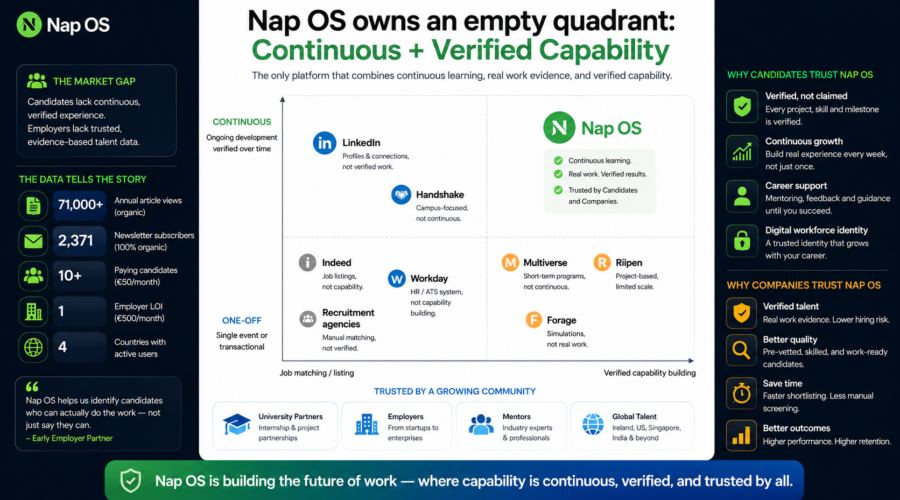
A New Workforce Platform: Nap OS
Nap OS has been designed around this emerging concept.
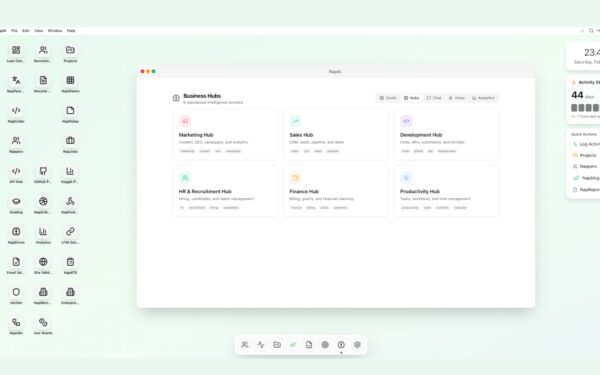
Rather than functioning solely as another recruitment platform or job board, it combines several workforce capabilities into a single environment.
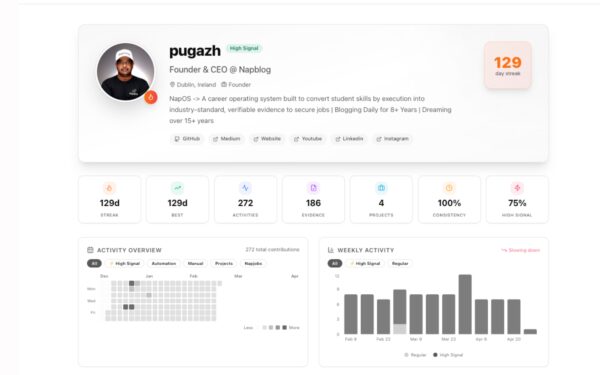
Candidates can build verified portfolios through real projects.
Mentors can provide structured guidance.
Employers can review practical evidence rather than relying only on CVs.
Professional capability becomes continuous instead of static.
The objective is not simply helping candidates find jobs.
It is helping candidates continuously develop trusted professional identities while giving employers access to richer workforce intelligence.
Why Candidates Benefit
Graduates and early-career professionals often face a familiar challenge.
Employers ask for experience.
Candidates need employment to gain that experience.
Breaking this cycle is difficult.
A platform centred on verified capability enables candidates to demonstrate practical work before securing full-time employment.
Instead of saying:
“I know this technology.”
Candidates can demonstrate:
“Here is verified evidence showing how I applied this technology in real work.”
This distinction becomes increasingly valuable as employers prioritise practical capability.
Why Employers Benefit
For employers, workforce verification offers several potential advantages.
Better Hiring Decisions
Evidence provides greater confidence than assumptions.
Reduced Hiring Risk
Verified work history complements interviews and references.
Faster Candidate Evaluation
Recruiters spend less time interpreting CVs and more time reviewing demonstrated capability.
Improved Talent Discovery
Candidates who might otherwise be overlooked become easier to identify through evidence-based portfolios.
Stronger Graduate Recruitment
Universities and employers gain a more structured pathway for developing work-ready graduates.
Why Universities Matter
Universities play a crucial role in preparing future talent.
However, employers increasingly seek graduates who possess both academic knowledge and practical capability.
Workforce platforms that integrate universities, employers, mentors, and students can help bridge this gap.
Rather than graduation marking the beginning of professional identity, students can begin building verified experience throughout their education.
This creates stronger employment outcomes while helping employers discover talent earlier.
The Future of Workforce Technology
Recruitment technology has evolved through several distinct stages.
The first generation digitised job advertisements.
The second generation digitised recruitment workflows.
The third generation introduced AI-powered matching.
The next generation may focus on continuous workforce verification.
Rather than asking:
“Who applied?”
Organisations may increasingly ask:
“Who has consistently demonstrated the capability required?”
This represents a meaningful shift in how talent is identified and developed.
Building Trust Through Evidence
Trust remains one of the most valuable assets in recruitment.
Candidates want opportunities to demonstrate their abilities fairly.
Employers want confidence that hiring decisions are based on reliable information.
Technology cannot replace human judgement.
However, it can provide better evidence to support that judgement.
Verified projects, continuous learning, employer validation, and professional development together create stronger signals than isolated documents or interviews alone.
Looking Ahead
The workforce of the future will likely become increasingly dynamic.
People will change careers more frequently.
Skills will evolve continuously.
Artificial intelligence will automate routine work while increasing demand for adaptable professionals.
In this environment, professional identity cannot remain static.
It must evolve continuously alongside capability.
For HR leaders, the opportunity is not simply adopting another recruitment platform.
It is adopting technologies that improve workforce visibility, reduce hiring uncertainty, and help identify talent through demonstrated capability rather than assumptions alone.
The organisations that embrace evidence-based workforce intelligence early may gain a significant competitive advantage in attracting, developing, and retaining exceptional talent.
As recruitment continues to evolve, one thing is becoming increasingly clear:
The future of hiring is unlikely to be defined by better CVs. It will be defined by better evidence.
And that shift—from claimed experience to continuously verified capability—may become one of the most significant innovations in workforce technology over the coming decade.