Last updated: May 29, 2026
7 min read
For decades, education systems around the world have largely followed the same formula.
Students attend lectures.
Take notes.
Complete assignments.
Pass examinations.
Graduate.
Then somehow, magically, become employable.
But reality tells a very different story.
Millions of students graduate every year feeling unprepared for the actual world of work.
Not because they lack intelligence.
Not because they lack ambition.
But because most students never receive structured opportunities to practice real-world execution with mentorship before entering the labour market.
The modern employability problem is not simply a skills problem.
It is a structure problem.
At Napblog Limited, we believe one of the biggest reasons students struggle with employability is because they are expected to become professionals without ever being trained inside professional systems.
That is exactly why Nap OS was built.
Not as another course.
Not as another certification platform.
Not as another passive learning ecosystem.
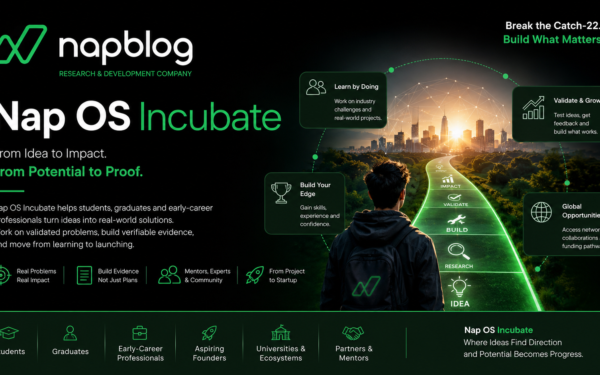
But as The World’s First Executable Skill Operating System — designed to help students learn, practice, execute, and build meaningful work experience through structured real-world execution and 1-to-1 mentorship.
Because students do not simply need education.
Students need structure.
And increasingly, they need it at scale.
The Education-to-Employment Gap Is Bigger Than Most People Realise
Across the world, millions of students face the same painful transition:
University → Graduation → Confusion.
Many students leave education with:
• theoretical knowledge
• academic confidence
• certifications
• completed modules
• strong grades
Yet employers continue asking:
“Do you have practical experience?”
This creates one of the biggest contradictions in modern hiring.
Students are expected to have professional experience before they are given professional opportunities.
But how exactly are students supposed to gain that experience?
That question rarely gets answered.
Instead, many students are left navigating uncertainty alone.
They begin applying for internships.
Entry-level jobs.
Graduate schemes.
Only to repeatedly hear:
“Not enough experience.”
This is not merely frustrating.
It becomes emotionally exhausting.
Because students begin questioning themselves.
“Am I not capable?”
“Did I choose the wrong course?”
“Why is everyone else progressing?”
“Why am I still stuck?”
But often, the issue is not capability.
The issue is missing structure.
Students Need More Than Information
Modern education has become incredibly effective at delivering information.
But information alone rarely creates capability.
You can watch hundreds of videos about marketing.
That does not automatically make you employable.
You can study programming theory.
That does not automatically make you a software engineer.
You can complete leadership courses.
That does not automatically make you capable of managing people.
The reality is simple:
Skills become valuable only when executed.
Capability compounds through practice.
Confidence compounds through repetition.
Professional readiness compounds through exposure.
Students need environments where they can:
• practice real work
• make mistakes safely
• receive guidance
• improve through feedback
• understand workplace expectations
• build confidence through doing
Yet most systems stop at teaching.
Very few systems focus deeply on execution training.
That is the gap Nap OS is solving.
Why Structure Matters More Than Motivation
One of the biggest misconceptions in student development is assuming motivation solves everything.
It does not.
Many students are motivated.
What they lack is structure.
Without structure:
People procrastinate.
People feel overwhelmed.
People overthink.
People lose confidence.
People stop progressing.
Because uncertainty creates friction.
Students often ask:
“What skill should I learn?”
“How do I practice?”
“What project should I work on?”
“How do I build experience?”
“How do I know if I’m improving?”
“How do I explain my work to recruiters?”
Without clear systems, students spend months — sometimes years — stuck in career confusion.
Structure removes that confusion.
Structure creates clarity.
And clarity accelerates growth.
That is exactly the philosophy behind Nap OS.
Why Real-World Project Work Matters
Employers increasingly care about one thing:
Can you execute?
Not theory.
Not confidence alone.
Not polished LinkedIn profiles.
Execution.
Can somebody actually perform?
Can they think critically?
Can they solve problems?
Can they communicate professionally?
Can they complete meaningful work?
Can they adapt?
Can they work independently?
These capabilities are difficult to assess through traditional education systems.
That is why real-world project work matters.
Because projects expose reality.
Projects reveal:
• ownership
• problem-solving
• consistency
• communication
• creativity
• resilience
• execution capability
This is why Nap OS focuses heavily on practical execution.
Students do not simply consume information.
They practice.
They execute.
They contribute.
They build.
They improve.
They document.
They learn through real-world action.
Because employability is built through repetition.
Not assumption.
The Missing Layer: 1-to-1 Mentorship
One of the biggest failures in modern education is the lack of personalised guidance.
Students often learn in large classrooms.
Large online courses.
Pre-recorded videos.
Generic learning environments.
But careers are deeply individual.
Everyone’s journey looks different.
Different ambitions.
Different strengths.
Different struggles.
Different confidence levels.
Different career directions.
This is why 1-to-1 mentorship matters.
Students often do not need someone to simply teach them.
They need someone to guide them.
Someone who helps reduce confusion.
Someone who gives context.
Someone who provides honest feedback.
Someone who says:
“You’re improving.”
“This is what employers care about.”
“You should focus here.”
“Your portfolio needs this.”
“Your communication can improve.”
“Your thinking is strong.”
That kind of mentorship shortens the learning curve dramatically.
It helps students avoid years of unnecessary trial and error.
At Napblog Limited, we believe meaningful mentorship is one of the strongest accelerators of employability.
That is why Nap OS combines:
real-world project execution + structured systems + mentorship
instead of relying purely on passive education.
Why Passive Learning Is Becoming Dangerous
The labour market is changing faster than ever.
Artificial intelligence is evolving.
Entry-level jobs are transforming.
Automation is increasing.
Job descriptions evolve monthly.
Industries change rapidly.
In this environment, passive learning becomes risky.
Because watching content without execution creates false confidence.
Students may feel productive.
But employers increasingly care about outputs.
Can somebody demonstrate capability?
Can they prove what they know?
Can they show evidence of work?
Can they adapt to changing environments?
This is why static credentials alone are no longer enough.
The future increasingly rewards:
people who can execute consistently.
Nap OS was built with this future in mind.
Not simply helping students learn.
Helping students practice execution repeatedly.
What Nap OS Actually Solves
Nap OS exists to solve a core structural problem:
Students lack a system to practice employable execution consistently.
Traditional systems often focus on:
Education → Assessment → Graduation.
Nap OS introduces something different:
Learning → Practice → Execution → Feedback → Portfolio → Employability.
Inside Nap OS, students receive opportunities to:
1. Practice Real Skills
Not simulated theory.
But structured skill execution.
Skills become practiced through tools, workflows, outputs, and repetition.
2. Work on Real-World Projects
Students gain practical exposure through execution-driven projects.
Projects become evidence of capability.
Not assumptions.
3. Receive 1-to-1 Mentorship
Guidance matters.
Students receive direction to shorten learning curves and improve professional clarity.
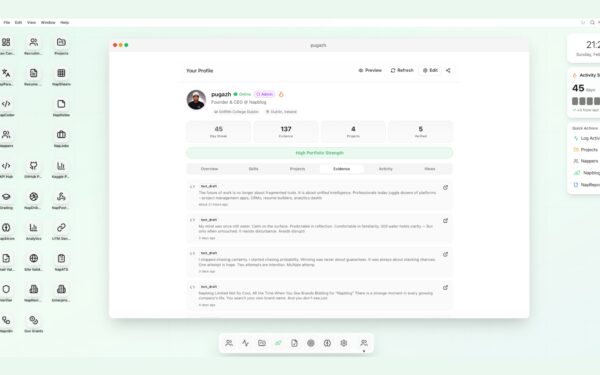
4. Build Live Portfolios
Instead of static resumes, students develop living evidence of execution.
Recruiters increasingly care about proof.
Portfolios become credibility.
5. Learn Professional Thinking
Students begin understanding:
• decision-making
• communication
• execution quality
• accountability
• systems thinking
• workplace expectations
This reduces employability friction significantly.
Why This Problem Exists at Global Scale
This is not a local problem.
It is international.
Across:
Ireland,
Canada,
Australia,
United Kingdom,
Germany,
France,
India,
and the United States,
students face similar struggles.
The challenge is remarkably consistent:
“How do I gain relevant work experience before someone hires me?”
This challenge impacts millions.
Particularly students aged 18–30 navigating the difficult transition into adulthood and financial independence.
The world tells students:
“Be job ready.”
But rarely provides the systems required to actually become job ready.
That is the structural gap Nap OS addresses.
Why Nap OS Is Solving This at Scale
Nap OS was never designed to operate like a traditional training company.
The vision is bigger.
The objective is to create infrastructure.
Employability infrastructure.
Execution infrastructure.
Career infrastructure.
Systems that help students repeatedly practice meaningful execution at scale.
Instead of one-time interventions.
Nap OS is being built to support:
• students
• graduates
• international students
• career changers
• freelancers
• aspiring professionals
through structured execution systems.
The mission is simple:
Reduce the learning curve for employability.
Because students should not need years of confusion to feel career-ready.
The Future of Education Is Practice
The future of education will likely become increasingly execution-first.
Degrees will still matter.
Knowledge will still matter.
But execution will matter more.
Students who thrive will increasingly be those who can show:
“I have done the work.”
“I understand professional systems.”
“I can execute independently.”
“I know how to solve problems.”
“I have practical evidence.”
That future requires infrastructure.
Not just inspiration.
Not just content.
Not just theory.
Infrastructure for practicing capability.
That is the long-term vision behind Nap OS.
Final Thought
At Napblog Limited, we believe students deserve more than motivational advice.
They deserve systems.
Students deserve:
clarity,
structure,
mentorship,
practical exposure,
and opportunities to practice meaningful work before entering high-pressure employment markets.
Because confidence does not magically appear after graduation.
Confidence comes from doing.
From repetition.
From guidance.
From evidence.
From execution.
Students do not simply need education anymore.
Students need structure to learn and practice real-world project work experience with meaningful 1-to-1 mentorship.
That is exactly what Nap OS is solving.