Last updated: May 29, 2026
6 min read
The biggest flaw in modern education is not the lack of information.
It is the lack of context.
Students are taught concepts without being placed inside the environments where those concepts are actually used. They learn marketing without running campaigns, study programming without shipping products, and understand business without making decisions under pressure.
The result is predictable:
Graduates leave institutions prepared in theory but untested in reality.
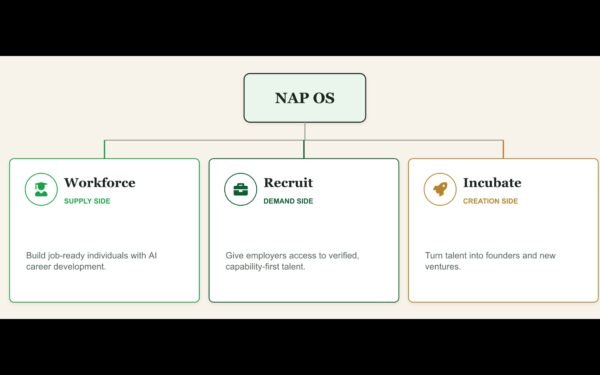
At Napblog Limited, Nap OS was built to solve this exact problem—not by adding more courses, but by reverse engineering the workplace itself and bringing it to the student.
Nap OS is not a learning platform.
It is a simulated execution environment.
A system designed to replicate how work actually happens—so students do not just learn before employment, but operate as if they are already employed.
The Core Idea: Reverse Engineering Work, Not Education
Most systems start from education and attempt to move toward employment.
Nap OS starts from employment and works backward.
This is the principle of reverse engineering.
Instead of asking:
“What should students learn?”
Nap OS asks:
“What does the job actually require?”
From there, it deconstructs:
- Tasks
- Tools
- Workflows
- Outputs
- Decision-making patterns
These components are then rebuilt into structured execution modules that students can engage with.
This ensures that every action inside Nap OS has a direct connection to real-world expectations.
Understanding the Gap: Why Traditional Learning Falls Short
The traditional pathway looks like this:
Learn → Test → Certify → Apply → Hope to be hired
The problem is that:
- Learning is disconnected from execution
- Testing does not reflect real scenarios
- Certification does not prove capability
- Applications rely on assumptions
Employers, on the other hand, operate in a completely different reality:
- They need results
- They work with tools
- They operate under constraints
- They expect ownership
This mismatch creates friction.
Nap OS removes this friction by aligning the student environment with the employer environment.
Simulating the Work Environment Inside Nap OS
Nap OS creates a simulated work environment through a structured system that includes:
1. Role-Based Execution Context
Students are not treated as learners.
They are placed into roles.
For example:
- Marketing Analyst
- Data Analyst
- Product Associate
- Developer
- Operations Coordinator
Each role comes with:
- Defined responsibilities
- Expected outputs
- Performance expectations
This creates a shift in mindset:
From “I am learning” to “I am doing.”
2. Tool-Based Skill Execution
Work is not performed in isolation. It happens through tools.
Nap OS integrates real-world tools across domains such as:
- Analytics platforms
- Advertising dashboards
- CRM systems
- Design software
- Programming environments
- Automation tools
Students do not just learn about tools.
They use them.
This ensures familiarity with:
- Interfaces
- Workflows
- Data handling
- Decision-making processes
3. Task Simulation
Tasks inside Nap OS are designed to reflect real-world scenarios.
These include:
- Campaign setup and optimisation
- Data analysis and reporting
- Content creation and distribution
- Process automation
- Customer journey mapping
Each task is:
- Structured
- Contextual
- Outcome-driven
This allows students to experience the nature of real work.
4. Output-Oriented Execution
Every task produces an output.
Outputs may include:
- Reports
- Dashboards
- Campaign results
- Code
- Designs
- Documentation
These outputs are not theoretical.
They are practical and measurable.
This is where Nap OS differs fundamentally from traditional systems.
It does not measure effort.
It measures output.
5. Time and Pressure Simulation
Work environments are defined by constraints.
Nap OS introduces:
- Deadlines
- Iterations
- Performance tracking
- Feedback cycles
This helps students develop:
- Discipline
- Time management
- Decision-making under pressure
These are critical employability skills.
The Psychology Shift: From Student to Professional
One of the most powerful outcomes of reverse engineering work environments is the psychological transformation it creates.
Students begin to:
- Take ownership of tasks
- Think in terms of outcomes
- Accept responsibility for results
- Reflect on performance
They are no longer passive participants.
They become active contributors.
This shift is essential for employability.
Because employers do not hire learners.
They hire contributors.
Building Evidence Through Simulation
Simulation alone is not enough.
It must be documented and verified.
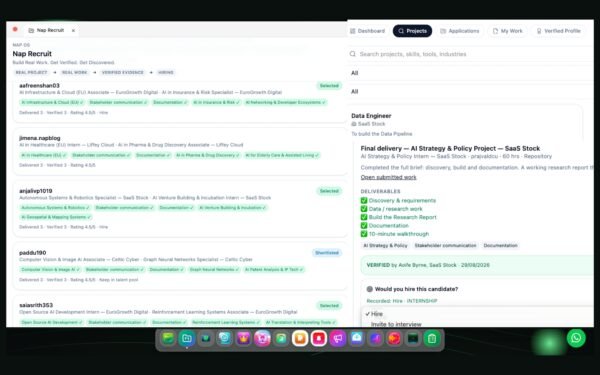
Nap OS ensures that every simulated task contributes to:
- A live portfolio
- A record of execution
- A body of evidence
This includes:
- What was done
- How it was done
- What tools were used
- What results were achieved
Over time, this creates a comprehensive view of a candidate’s capability.
Not based on claims.
But on proof.
Aligning Simulation With Real Market Demand
Simulation inside Nap OS is not generic.
It is aligned with:
- Current job descriptions
- Industry requirements
- Market trends
This ensures that students are not just practising.
They are preparing for specific roles.
For example:
If a role requires:
- Google Ads optimisation
- Data interpretation
- CRM management
Nap OS simulates those exact workflows.
This creates direct relevance.
The Role of Consistency in Simulation
Real work is not defined by one-time performance.
It is defined by consistency.
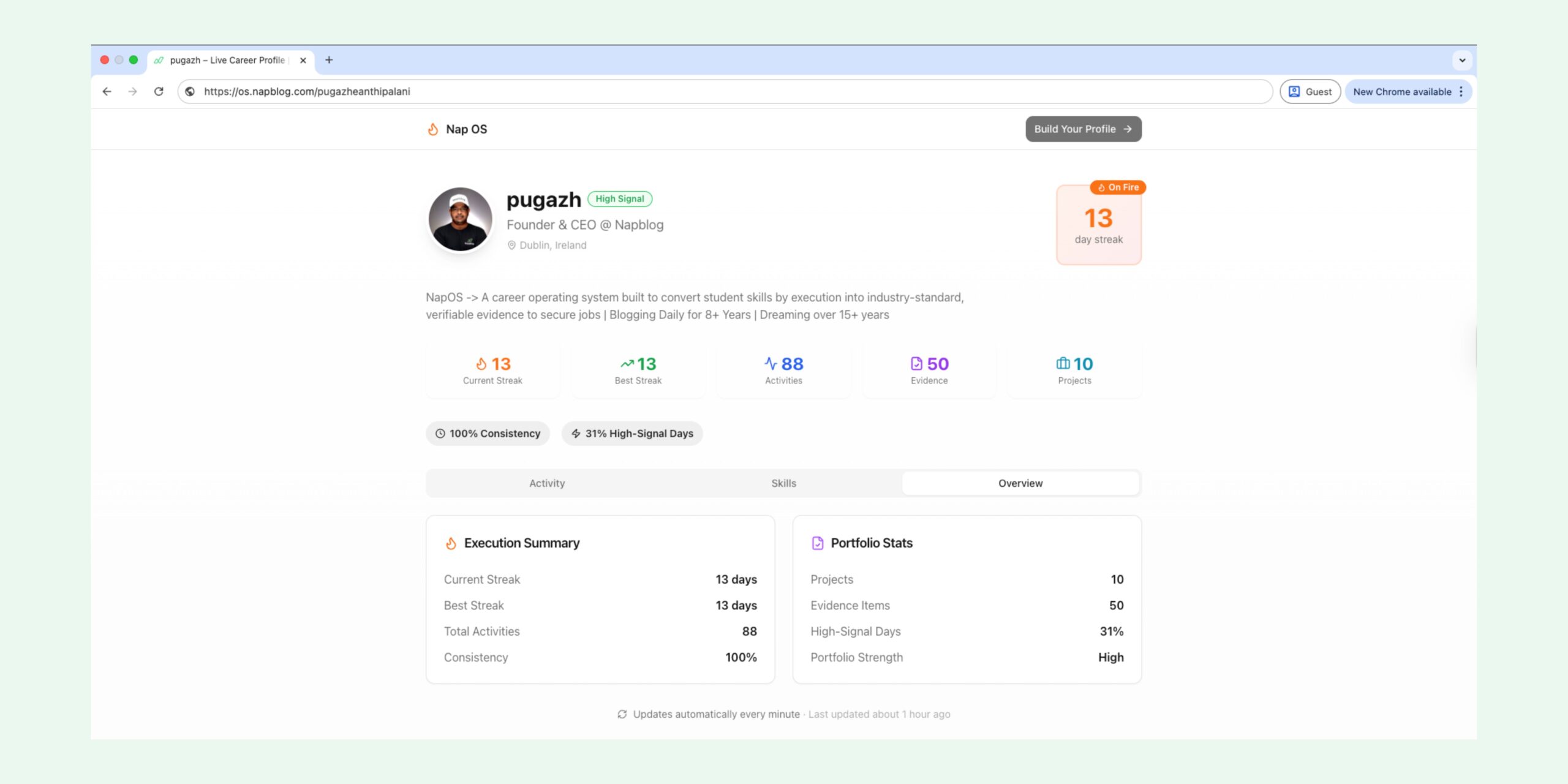
Nap OS incorporates a streak-based system that encourages:
- Daily execution
- Continuous improvement
- Habit formation
This ensures that students:
- Do not rely on bursts of effort
- Build long-term discipline
- Develop sustainable workflows
Consistency becomes a measurable signal.
From Simulation to Employment
The ultimate goal of simulation is not practice.
It is employment.
Nap OS bridges this gap by:
- Translating outputs into portfolios
- Aligning portfolios with job requirements
- Enabling recruiters to verify work
This creates a direct pathway:
Simulated Work → Verified Evidence → Job Opportunity
Students are no longer applying with potential.
They are applying with proof.
Why Reverse Engineering Works
Reverse engineering is effective because it removes ambiguity.
Instead of guessing what employers want, Nap OS:
- Studies real job environments
- Extracts core requirements
- Builds systems around them
This ensures alignment.
It also ensures efficiency.
Students spend time on what matters.
Not on irrelevant or outdated practices.
The Advantage Over Traditional Internships
Traditional internships provide exposure.
But they have limitations:
- Limited availability
- Inconsistent quality
- Lack of structured learning
- Dependency on companies
Nap OS simulation offers:
- Scalable access
- Structured execution
- Consistent quality
- Independence from external constraints
It complements internships.
And in many cases, prepares students better for them.
The Long-Term Vision
Nap OS simulation is not static.
It evolves with:
- Industry changes
- Technological advancements
- Market demands
Over time, it aims to:
- Cover multiple industries
- Support diverse roles
- Adapt to new tools and workflows
This ensures long-term relevance.
Challenges in Simulating Work
Simulating real environments is complex.
Challenges include:
- Keeping simulations updated
- Ensuring realism
- Maintaining engagement
- Scaling across domains
Napblog Limited addresses these by:
- Continuous research
- Feedback loops
- Iterative development
- Integration with real-world data
The goal is not perfection.
It is continuous improvement.
The Broader Impact
Reverse engineering work environments has implications beyond individual students.
It can:
- Influence educational institutions
- Improve hiring systems
- Reduce unemployment gaps
- Increase workforce readiness
It creates a system where:
- Learning is practical
- Work is accessible
- Opportunities are earned
Conclusion
Nap OS represents a shift in how we prepare individuals for the workforce.
By reverse engineering real work environments and simulating them within a structured system, it ensures that students:
- Do not just learn concepts
- Do not just complete courses
- Do not just collect certificates
They execute.
They produce.
They prove.
This transforms the journey from education to employment into something more direct, more efficient, and more credible.
Because in the end, employability is not about what you know.
It is about what you can do.
And Nap OS ensures that students do not just understand work.
They experience it—before they are ever hired.