Last updated: May 29, 2026
4 min read
The Battle Is Not External, It Is Internal
Every generation faces challenges.
Economic.
Technological.
Social.
But Gen Z faces something different.
An internal overload.
Too much information.
Too many options.
Too little clarity.
At Napblog Limited,
Through Intuition Psychology OS,
we observe a pattern.
The problem is not lack of opportunity.
It is mismanagement of attention.
And attention
Shapes mentality.
What Is Preventive Carelessness?
It is not laziness.
It is not ignorance.
It is subtle.
It is when individuals know
What they should do
But do not act.
Not because they cannot.
But because they drift.
Distracted.
Overwhelmed.
Disconnected.
Why This Is More Dangerous Than Failure
Failure teaches.
Creates feedback.
Forces adjustment.
Carelessness does not.
It delays.
Silently.
Without visible consequence.
Until time compounds it.
The Gen Z Environment: Constant Stimulation
Notifications.
Content streams.
Short-form dopamine.
Endless comparison.
This creates fragmentation.
Attention becomes divided.
Shallow.
Reactive.
The Illusion of Productivity
Scrolling feels like learning.
Watching feels like progress.
Saving feels like action.
But none of these
Create output.
This illusion
Reinforces carelessness.
Why Awareness Alone Is Not Enough
Many Gen Z individuals
Are self-aware.
They know the problem.
But awareness
Without systems
Does not create change.
The Role of Intuition Psychology OS
Intuition Psychology OS
Does not eliminate complexity.
It structures it.
Helping individuals:
Observe
Interpret
Act
Consistently
Self-Mastery Begins with Observation
Before action
There must be awareness.
Not general awareness.
Specific observation.
Patterns of distraction.
Moments of drift.
Energy fluctuations.
Identifying Mental Leakage Points
Where does attention go?
What triggers distraction?
When does focus drop?
These are leakage points.
They must be identified.
From Reaction to Intentionality
Most behaviour is reactive.
Stimulus → response.
Intuition introduces pause.
Pause creates choice.
Choice creates control.
Building Preventive Systems
Correction is reactive.
Prevention is strategic.
Instead of fixing mistakes
After they occur
Design systems
To avoid them.
Micro-Discipline as a Core Lever
Big changes fail.
Small disciplines succeed.
Daily actions.
Repeated consistently.
These create structure.
The Role of Environment in Mental Control
Environment shapes behaviour.
Digital environment.
Physical space.
Social circle.
All influence mentality.
Designing Friction for Distraction
Make distractions harder.
Limit access.
Create barriers.
This reduces impulsive behaviour.
Designing Ease for Execution
Make meaningful actions easier.
Accessible.
Visible.
Immediate.
This increases consistency.
The Shift from Motivation to Systems
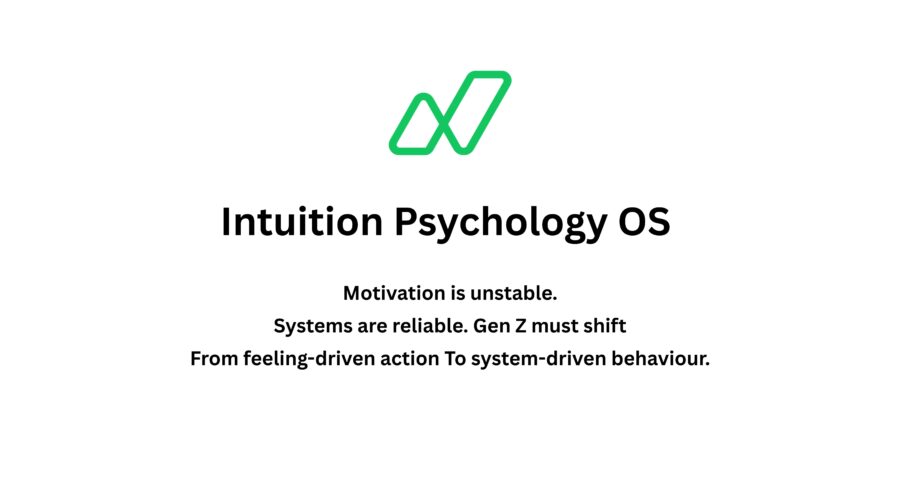
Motivation is unstable.
Systems are reliable.
Gen Z must shift
From feeling-driven action
To system-driven behaviour.
The Role of Identity in Self-Mastery
Behaviour follows identity.
If identity is unclear
Behaviour is inconsistent.
Define:
Who am I becoming?
From Consumption to Creation
Consumption is passive.
Creation is active.
Shifting focus
From input
To output
Changes mentality.
Execution as a Feedback Mechanism
Action creates feedback.
Feedback refines direction.
Without action
There is no correction.
The Importance of Visible Progress
Progress must be seen.
Tracked.
Measured.
This reinforces behaviour.
Managing Emotional Volatility
Gen Z experiences
High emotional fluctuation.
This affects consistency.
Emotions must be acknowledged.
But not control behaviour.
Separating Feeling from Action
You may not feel like acting.
But action must continue.
This creates stability.
The Role of Intuition in Decision-Making
Intuition is pattern recognition.
Built through experience.
It improves with practice.
And reflection.
Reflection as a Daily Practice
What worked?
What did not?
What needs adjustment?
This builds awareness.
Avoiding Over-Optimisation
Too much analysis
Leads to inaction.
Balance is required.
Think enough.
Act more.
The Compounding Effect of Discipline
Small actions accumulate.
Daily effort compounds.
Over time
This creates transformation.
The Risk of External Validation Dependency
Social media reinforces validation loops.
Likes.
Comments.
Recognition.
This creates dependency.
Building Internal Validation Systems
Measure your own progress.
Define your own metrics.
This creates independence.
The Role of Community in Self-Mastery
Surroundings influence behaviour.
Aligned individuals
Support growth.
Misaligned environments
Create friction.
The Shift from Chaos to Structure
Unstructured time
Leads to drift.
Structured systems
Create clarity.
The Psychological Cost of Carelessness
Guilt.
Frustration.
Lost confidence.
These accumulate.
Preventing This Through Early Intervention
Recognise patterns early.
Adjust quickly.
Do not let drift compound.
The Role of Technology in Both Problem and Solution
Technology creates distraction.
But also enables systems.
Use it intentionally.
Building a Personal Operating System
Track actions.
Define routines.
Measure outcomes.
Adjust continuously.
Why Gen Z Has an Advantage
Digital native.
Access to tools.
Awareness of systems.
This can be leveraged.
But Only with Discipline
Access without discipline
Creates chaos.
Discipline creates advantage.
A Founder’s Perspective on This Shift
From observing patterns
One insight is clear.
Those who manage their mind
Outperform those who do not.
The Future of Self-Mastery
Not external competition.
Internal optimisation.
Managing attention.
Managing behaviour.
Managing mentality.
Conclusion: Mastering the Mind Before the World
Gen Z does not lack potential.
It lacks structure.
Preventive carelessness
Is the silent barrier.
But it can be managed.
Through observation.
Through systems.
Through discipline.
Intuition Psychology OS — by Napblog Limited —
Provides this framework.
Because in the end
Success is not determined
By opportunity alone.
But by how well
You manage yourself
When no one is watching.
And those who master
Their internal systems
Will not just perform better.
They will live
With clarity
Consistency
And control
In a world
That constantly tries
To take it away.