5 min read
Search engines are not merely directories of websites. They are complex intent-detection systems designed to match user queries with the most relevant entities in the digital ecosystem.
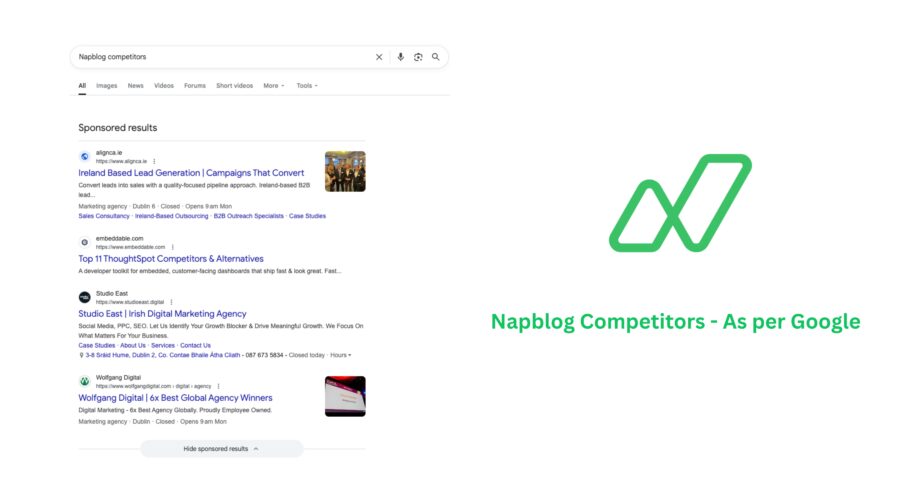
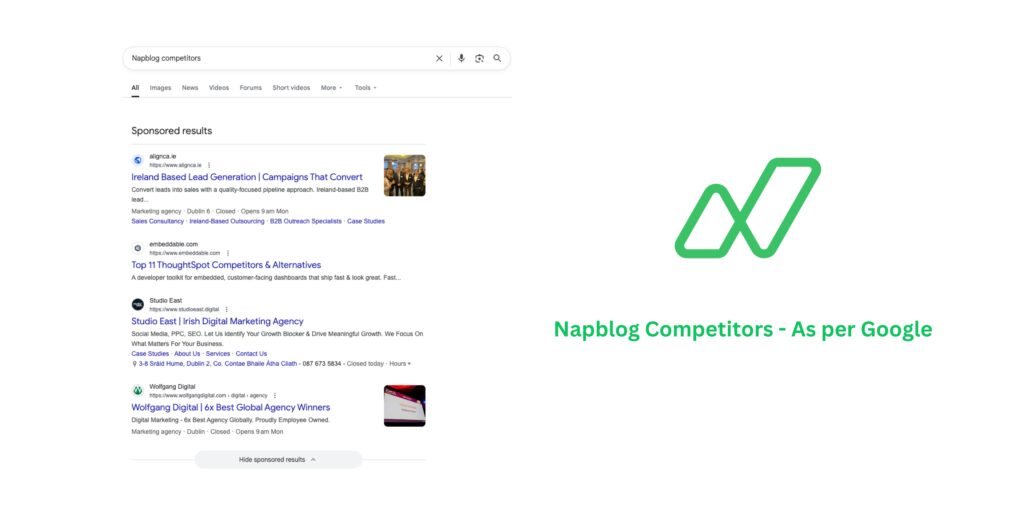
When someone searches “Napblog competitors”, the expectation might be that Google simply lists companies similar to Napblog Limited.
However, the results reveal something deeper.
Google instead displays brands such as:
- Alignca
- Embeddable
- Studio East
- Wolfgang Digital
These companies appear not because they are identical to Napblog, but because Google interprets the query through contextual signals.
Understanding why these brands appear helps explain how search engines identify competitive landscapes.
Understanding the Search Intent Behind “Napblog Competitors”
When Google processes a search query, the algorithm first determines user intent.
In this case, the intent is interpreted as:
“What companies provide similar services to Napblog?”
However, the algorithm does not fully understand Napblog’s evolving model, which combines:
- media ecosystem development
- AI-driven marketing infrastructure
- portfolio-based career acceleration
- digital marketing services.
Instead, Google maps the query to known categories with stronger existing data signals.
Those categories include:
- digital marketing agencies
- lead generation companies
- marketing consultancies
- analytics platforms.
Because these industries already have strong SEO footprints, the algorithm surfaces companies within them.
Factor 1: Category Authority
The first major ranking factor is category authority.
Google maintains knowledge graphs connecting companies to industries.
For example:
Wolfgang Digital is widely recognized as a digital marketing agency, with multiple awards and strong online references.
Similarly, Studio East is categorized clearly within SEO, PPC, and social media marketing services.
Because Napblog also operates within marketing and digital media spaces, the algorithm assumes these companies belong to the same competitive category.
This demonstrates how industry classification affects competitor discovery.
Factor 2: Content Relevance
Another reason these brands appear is content relevance.
Search engines prioritize pages containing:
- marketing services
- growth strategies
- lead generation
- campaign optimization.
For instance, Alignca focuses on B2B lead generation and sales pipelines, which aligns closely with the broader marketing ecosystem Napblog participates in.
Similarly, Embeddable appears because its content discusses analytics platforms and business intelligence tools, which intersect with marketing technology.
Even though these companies may not be direct competitors, their content aligns with the algorithm’s interpretation of the query.
Factor 3: Domain Authority
Another critical ranking signal is domain authority.
Companies such as Wolfgang Digital have built strong authority through:
- years of published marketing research
- backlinks from industry publications
- award recognition
- high-performing SEO content.
Google trusts these domains because they have demonstrated long-term credibility.
If Napblog wants to appear more prominently for competitive queries, the strategy involves building similar signals:
- long-form research content
- industry citations
- high-quality backlinks.
Domain authority is essentially a reputation score for websites.
Factor 4: Local SEO Signals
Local signals also play an important role.
Companies such as Studio East and Wolfgang Digital have strong location-based optimization in Dublin.
These signals include:
- Google Business listings
- local citations
- geographic keywords.
Since Napblog is also connected to Ireland, Google surfaces Irish marketing companies when users search for competitors.
Local SEO essentially tells Google:
“These businesses operate in the same geographical market.”
Factor 5: Structured Data and Business Profiles
Companies that rank frequently in search results often implement structured data markup.
Structured data allows search engines to clearly understand:
- company name
- services offered
- location
- reviews
- awards.
For example, companies like Wolfgang Digital benefit from strong structured data and industry references.
This allows Google to connect them with queries related to:
digital marketing
marketing agencies
growth strategy services.
Structured data acts as a translator between websites and search engines.
Factor 6: Search Demand Alignment
Search engines prioritize entities that match existing search demand.
If thousands of users frequently search for:
“best digital marketing agencies in Ireland”
then companies ranking for that query gain visibility across related searches.
Because Studio East and Wolfgang Digital already perform well for those queries, Google associates them with competitor searches.
This is known as semantic proximity.
The more frequently two search topics appear together, the stronger their relationship becomes in Google’s algorithm.
Factor 7: Backlink Ecosystems
Backlinks remain one of the strongest ranking signals.
Companies appearing in the search results have typically built strong backlink networks through:
- marketing publications
- industry blogs
- conference presentations
- research reports.
For instance, companies like Wolfgang Digital often publish industry insights that attract citations from other websites.
These backlinks signal to Google that the brand is trusted and influential within its industry.
Napblog can strengthen its visibility by creating research-based content that earns similar citations.
Factor 8: Content Depth and Topical Authority
Google favors websites that demonstrate topical authority.
This means producing extensive content around a specific subject.
Marketing agencies appearing in the search results often publish articles covering:
SEO strategies
PPC campaigns
growth marketing
conversion optimization.
By consistently producing content across these topics, companies like Studio East signal to Google that they are experts in digital marketing.
Topical authority makes it easier for search engines to associate them with related queries.
Factor 9: Brand Mentions Across the Web
Search engines also analyze brand mentions, even when they are not direct backlinks.
If a company is mentioned across:
news articles
industry reports
conference websites
then Google interprets that as a signal of influence.
Brands such as Wolfgang Digital frequently appear in marketing award lists and research publications.
These mentions strengthen the algorithm’s confidence in the brand’s relevance.
What This Means for Napblog
The appearance of these companies reveals an important insight.
Google currently categorizes Napblog Limited primarily within the digital marketing ecosystem.
However, Napblog’s long-term vision extends far beyond that category.
Napblog is developing platforms such as:
- Nap OS
- portfolio-based career acceleration models
- AI-driven execution tracking systems.
These innovations position Napblog closer to career infrastructure and talent development platforms, rather than traditional marketing agencies.
As Napblog publishes more content about these concepts, search engines will gradually update their understanding of the brand’s category.
The Strategic Opportunity
Instead of trying to compete directly with existing agencies, Napblog can redefine its category.
By publishing research around:
AI-driven career acceleration
portfolio-based hiring systems
execution-based learning models
Napblog can establish a new search category where it becomes the primary authority.
In this scenario, future competitor searches may return entirely different entities — companies operating in career technology and talent infrastructure.
Conclusion
The search results for “Napblog competitors” reveal more about Google’s interpretation of the digital ecosystem than about Napblog itself.
Companies such as:
- Alignca
- Embeddable
- Studio East
- Wolfgang Digital
appear because they possess strong signals in areas Google currently associates with Napblog’s activities.
These signals include:
category authority
content relevance
domain strength
local SEO
backlink networks.
For Napblog, this insight is valuable.
It reveals how search engines currently position the brand — and provides a roadmap for shaping how it will be understood in the future.
By building authority around its emerging platforms, especially Nap OS, Napblog can gradually shift from being perceived as a marketing agency to becoming something far more influential:
a global infrastructure platform for career acceleration and execution-based learning.