5 min read
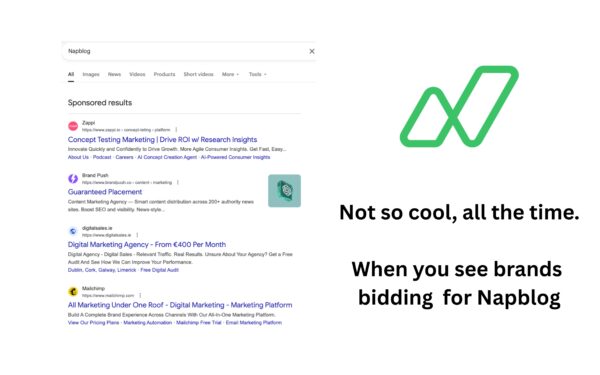
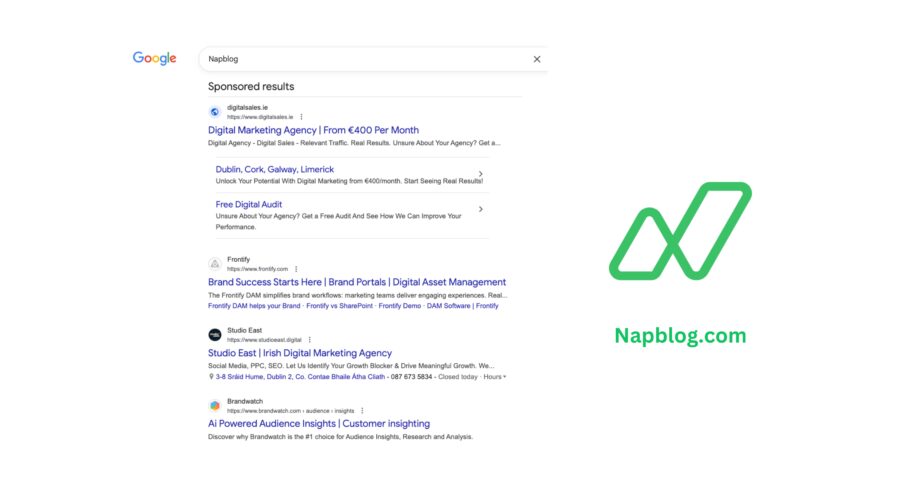
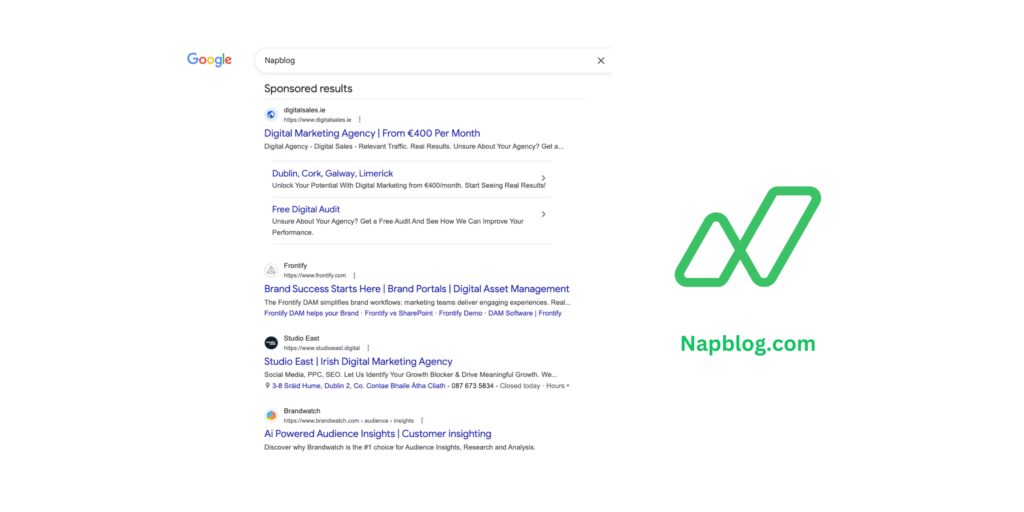
When someone searches “Napblog” on Google in Ireland…
They are not searching for:
Digital Sales
Frontify
Studio East
Brandwatch
Yet these brands appear under Sponsored Results.
Why?
Because branded search is the most valuable traffic on the internet.
And Google Ads allows competitors to bid on it.
This article breaks down:
- Why they rank
- Why Google allows it
- What it means for Napblog
- How to respond structurally
- The deeper strategic signal
Let’s unpack it.
1. Branded Keywords = High-Intent Traffic
When a user types “Napblog”:
This is not discovery-stage traffic.
This is:
• Brand-aware
• Consideration-stage
• Decision-ready
• High-intent
In paid search economics, branded keywords:
- Have higher conversion rates
- Have lower bounce rates
- Have clearer intent
Competitors understand this.
So they bid.
Not because they are relevant to Napblog.
But because the intent is valuable.
2. Google’s Policy on Competitor Bidding
Google Ads allows advertisers to:
Bid on competitor brand names as keywords.
They cannot (in most cases) use the trademark inside ad copy without permission.
But they can target the keyword itself.
So when:
digitalsales.ie
Frontify
Studio East
Brandwatch
Appear for “Napblog” — it is legally and technically permitted.
Google’s auction system does not prioritize brand ownership.
It prioritizes:
• Bid amount
• Quality score
• Expected CTR
• Ad relevance
• Landing page experience
If a competitor bids aggressively and has a strong quality score, they win a slot.
Even on your brand term.
3. Why These Specific Companies Appear
Let’s analyze the pattern.
A. digitalsales.ie
Positioning: Digital marketing agency
Messaging: Performance, traffic, audits
Why they rank:
Because Google categorizes Napblog partially within digital marketing intent clusters.
If Napblog publishes:
• Marketing content
• LinkedIn Ads in Ireland
• SEO-related material
Then Google associates Napblog with marketing service intent.
Digital agencies bid on broad marketing clusters.
“Napblog” falls into that category contextually.
So they appear.
Not because they are similar.
But because Google’s semantic clustering overlaps.
B. Frontify
Positioning: Brand portal, DAM software
Why they rank:
Frontify bids aggressively on marketing and branding-related keywords globally.
If Napblog content touches:
• Brand building
• Content systems
• Marketing workflows
Google may categorize it near brand management software.
Frontify is not targeting Napblog directly.
They are targeting the broader semantic category.
Your brand happens to be within that ecosystem.
C. Studio East
Positioning: Irish digital marketing agency
Why they rank:
Geo-targeted bidding.
Studio East likely runs:
Ireland-focused PPC campaigns targeting marketing-related terms.
Google sometimes broad matches branded queries within related intent clusters.
Especially if:
- No defensive bidding exists
- The branded keyword has low CPC competition
- The system predicts ad relevance
Your absence in paid defense invites occupation.
D. Brandwatch
Positioning: AI-powered audience insights
Why they rank:
Brandwatch runs global campaigns targeting marketing intelligence, audience research, brand analysis.
If Napblog content intersects with:
• Audience research
• Insights
• Performance analysis
• Marketing data
Then Google’s system places Brandwatch within related ad auctions.
Again:
This is not personal targeting.
This is semantic ecosystem overlap.
4. The Core Reason They Rank
The real reason is simple:
Napblog is not bidding on Napblog.
When a brand does not run defensive branded campaigns:
The auction opens.
And Google will always fill inventory.
Search results do not leave ad space empty.
If you do not occupy your branded ad slot:
Someone else will.
5. Why This Matters Strategically
Most founders ignore branded paid search because:
“We rank #1 organically.”
That is incomplete thinking.
Sponsored results appear:
Above organic results.
Which means:
The first interaction the user sees is not you.
Even if they scroll and click Napblog organically:
Their brain processed alternatives first.
This introduces:
• Comparison bias
• Perceived competition
• Authority dilution
• Brand repositioning
Instead of:
User searches Napblog → sees Napblog → clicks Napblog
It becomes:
User searches Napblog → sees 4 other brands → evaluates → then clicks
That micro-second shift changes cognitive framing.
6. What This Signals About Napblog
Here is the positive interpretation.
If companies bid on your branded term:
It means:
• The search volume is measurable
• The traffic is commercially valuable
• The brand is recognized
• The intent is strong
No one bids on irrelevant brands.
If Napblog had zero value:
No competitor would appear.
Branded competition is validation.
But unmanaged validation becomes vulnerability.
7. Structural Response Strategy
Napblog’s response should not be emotional.
It should be architectural.
Step 1: Defensive Branded Campaign
Launch a Google Ads campaign targeting:
Exact match: [Napblog]
Phrase match: “Napblog”
Goals:
• Secure top sponsored slot
• Control ad messaging
• Increase SERP dominance
• Reduce competitor CTR
Cost?
Usually low.
Branded CPCs are cheap when you own the brand.
But if competitors bid aggressively, CPC rises.
Which means:
You force competitors to pay more to target you.
Step 2: Structured Ad Messaging
Instead of generic copy:
Use strategic positioning.
Example:
Napblog Official Site
Verified Career Portfolio Builder
Nap OS – Structured Execution for Students & Professionals
Reinforce identity.
Clarify positioning.
Reduce confusion.
Step 3: Landing Page Alignment
If a user clicks your branded ad:
They should not land on a generic homepage.
They should land on:
A brand reinforcement page.
Explaining:
• What Napblog is
• Who it is for
• Why it is different
• What to do next
Eliminate ambiguity.
Ambiguity invites comparison.
Step 4: Competitor Analysis Through Auction Insights
Google Ads provides:
Auction insights reports.
This reveals:
• Impression share
• Overlap rate
• Position above rate
• Top of page rate
This data shows:
How aggressively competitors are bidding on your name.
Instead of guessing, measure.
8. The Bigger Strategic Lesson
This is not about ads.
This is about market positioning.
If Google associates Napblog with:
• Marketing agencies
• DAM software
• Audience research tools
Then your brand categorization is still fluid.
The more defined your identity becomes:
The less Google broad-matches you into generic clusters.
Brand clarity reduces semantic bleed.
9. Clean SERP vs Contested SERP
There are two branded search states.
Contested SERP:
Multiple competitor ads
Mixed organic listings
Comparison noise
Clean SERP:
Brand ad
Brand organic
Brand sitelinks
Brand LinkedIn
Brand articles
Napblog should aim for Clean SERP dominance.
Not passive organic ranking.
10. Why Google Does This
Because Google is an auction marketplace.
Revenue increases when:
Multiple advertisers compete.
Google has no incentive to protect brand owners.
Unless you participate in the auction.
Search is not owned territory.
It is rented space.
11. Founder Mindset Shift
Seeing competitor ads on your brand name triggers ego.
But ego is irrelevant in auctions.
The correct response is:
System response.
Not emotional response.
Ask:
Why are we categorically placed near these brands?
Where is positioning unclear?
Are we bidding defensively?
Are we monitoring auctions?
Are we measuring leakage?
12. The Execution Blueprint for Napblog
To fully control branded SERP in Ireland:
- Launch defensive branded campaign
- Optimize Quality Score
- Build sitelink extensions
- Use callout extensions
- Implement structured snippet extensions
- Monitor auction insights monthly
- Increase brand search demand via content
- Strengthen organic authority
- Refine semantic positioning
- Track branded conversion rate
This creates:
Layered SERP dominance.
Final Perspective
Competitors appearing for “Napblog” does not mean:
They are attacking you.
It means:
Your traffic is valuable.
Google Ads is designed to monetize intent.
If Napblog wants full control of its branded search experience:
It must participate structurally.
Ranking organically is visibility.
Running branded defense is control.
And in high-intent search environments:
Control determines revenue stability.