5 min read
The Shift from Claims to Proof
The hiring market is changing, but slowly and unevenly.
For decades, recruitment has been based on signals that are easy to present but hard to verify.
Resumes.
Degrees.
Job titles.
These are claims.
Not proof.
At Napblog Limited, through Nap OS, we operate on a different belief system.
Work should be measured by what has been done, not what is written.
This is where portfolio-based hiring comes in.
And the reality is, many of the world’s most influential companies have already moved in this direction.
Not as a trend.
But as a necessity.
What Is Portfolio-Based Hiring?
Portfolio-based hiring is simple in principle but powerful in execution.
Instead of evaluating candidates based on:
Education
Years of experience
Self-reported achievements
Companies evaluate:
Real projects
Actual outputs
Demonstrated skills
A portfolio becomes a living record of execution.
Not a static summary.
It answers one critical question.
What can this person actually do?
Why Traditional Hiring Is Breaking
The traditional hiring model worked when:
Career paths were linear
Skills were stable
Industries changed slowly
That world no longer exists.
Today:
Skills evolve rapidly
Careers are non-linear
Tools change constantly
A degree earned years ago does not guarantee current capability.
A job title does not explain real contribution.
A resume cannot capture depth.
This creates a gap.
Between perception and reality.
Portfolio-based hiring closes that gap.
Companies Already Leading Portfolio-Based Hiring
Some of the world’s most respected companies have already shifted towards portfolio-driven evaluation.
In technology, companies like Google, Microsoft, and Apple increasingly prioritise demonstrated skills over formal credentials, especially in technical and creative roles.
Developers are evaluated through GitHub repositories.
Designers through UX case studies.
Marketers through campaign performance.
These companies are not asking, “Where did you study?”
They are asking, “What have you built?”
In the SaaS ecosystem, companies like Shopify and Atlassian actively review portfolios for developers, designers, and product roles.
They look for:
Consistency of work
Depth of thinking
Problem-solving ability
Not just polished outputs.
Even enterprise firms like IBM focus on the journey behind the work.
They assess:
How a problem was approached
How it was solved
How it evolved over time
This is a deeper level of evaluation.
Industries Where Portfolio Hiring Is Already Standard
Portfolio-based hiring is not limited to tech.
It is already dominant in several industries.
In software and data roles, companies like Amazon and Binance evaluate candidates through real-world projects, codebases, and applications.
In design and marketing, portfolios are not optional.
They are mandatory.
Companies like Squarespace assess designers based on visual work, user experience thinking, and execution quality.
In finance and consulting, firms such as JPMorgan Chase and Deloitte increasingly value project-based evidence, especially for analytical and strategy roles.
Even in construction and engineering, companies like AECOM review project portfolios to understand real contributions.
This shift is not theoretical.
It is already happening.
Why Companies Prefer Portfolio-Based Hiring
The reasons are practical.
First, it reduces hiring risk.
A portfolio shows actual capability, not assumed potential.
Second, it improves role fit.
Employers can see whether a candidate’s work aligns with the job requirements.
Third, it speeds up decision-making.
Instead of multiple interview rounds, portfolios provide immediate clarity.
Fourth, it enables fairer evaluation.
Candidates without traditional backgrounds can compete based on work.
This expands the talent pool.
The Problem: Fragmented Portfolios
Despite the shift, there is a major problem.
Portfolios are scattered.
A developer has GitHub.
A designer has Behance.
A marketer has case studies.
There is no unified system.
Recruiters have to:
Search multiple platforms
Interpret incomplete data
Make assumptions
This creates friction.
And friction slows adoption.
Nap OS: Solving the Portfolio Fragmentation Problem
Nap OS was built to solve this exact issue.
At Napblog Limited, we saw that the future of hiring is portfolio-based.
But the infrastructure was missing.
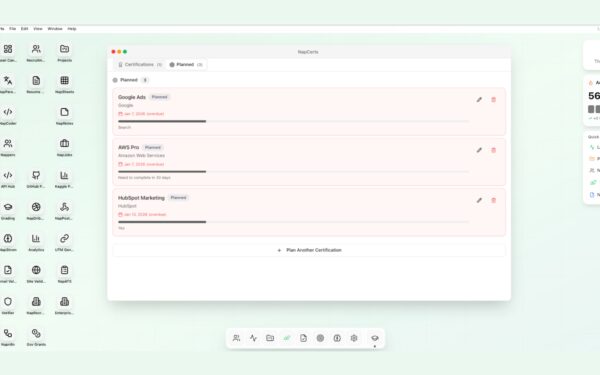
Nap OS connects with over 30 tools including:
GitHub
Google Analytics
Figma
Kaggle
It pulls real activity data into one unified portfolio.
This creates something powerful.
A verified portfolio.
Not self-reported.
But data-backed.
From Resume to Real-Time Portfolio
Traditional resumes are static.
They represent the past.
Nap OS portfolios are dynamic.
They evolve in real time.
Every project update
Every tool interaction
Every measurable output
Is reflected automatically.
This changes how candidates are evaluated.
From snapshots to continuous performance.
How Recruiters Use Portfolio Data
Recruiters using Nap OS do not search blindly.
They filter candidates based on:
Skills
Tool proficiency
Project outcomes
This creates precision.
Instead of reviewing hundreds of resumes, they focus on relevant candidates.
This improves efficiency.
And quality.
The Impact on Graduates and Career Switchers
One of the biggest beneficiaries of portfolio-based hiring is early-career talent.
Graduates often face a paradox.
No experience, no job.
No job, no experience.
Portfolios break this cycle.
By building projects, candidates can demonstrate capability without formal experience.
Career switchers also benefit.
They can prove their new skills through work, not credentials.
This creates mobility.
The Role of AI in Portfolio-Based Hiring
AI is accelerating this shift.
Systems like NapAI analyse portfolios to:
Identify strengths
Recommend improvements
Match candidates with roles
This creates a smarter hiring process.
Not just faster.
But more accurate.
Challenges in Adoption
Despite its advantages, portfolio-based hiring faces resistance.
Companies are used to traditional systems.
Recruiters rely on familiar processes.
There is also a lack of standardisation.
Different portfolios follow different formats.
This creates inconsistency.
But these challenges are temporary.
Because the benefits are too strong to ignore.
The Future: Verified Work Over Claimed Experience
The direction is clear.
Hiring will move towards:
Verified portfolios
Real-time skill tracking
Data-driven evaluation
Resumes will not disappear.
But they will become secondary.
The primary signal will be work.
Nap OS Vision
At Napblog Limited, Nap OS is not just a product.
It is a shift in how talent is understood.
We are building a system where:
Work is visible
Skills are measurable
Potential is provable
This is not just better hiring.
It is fairer hiring.
Final Thought: Show, Don’t Tell
The future belongs to those who can show their work.
Not just describe it.
Portfolio-based hiring is not a trend.
It is a correction.
A move towards reality.
Conclusion: The Hiring System Is Being Rewritten
Companies like Google, Microsoft, Apple, Shopify, Atlassian, and IBM have already moved forward.
Industries are following.
The only question is how fast others will adapt.
Nap OS is designed for this future.
A future where hiring is based on proof, not perception.
Where talent is measured by execution, not claims.
Where opportunity is created through work, not background.
Nap OS — By Napblog Limited
For candidates who want to be seen for what they can do.
For companies who want to hire based on reality.
Because in the end,
the best signal of future performance
is past execution.