5 min read
In a market saturated with agencies competing on ad spend, impressions, and vanity metrics, Napblog follows a fundamentally different strategic doctrine. It does not compete on noise. It competes on narrative infrastructure. It does not chase traffic. It engineers gravity.
Napblog’s strategy can be understood through five interlocking pillars:
- Ikigai-Based Strategic Alignment
- Pure Persuasion & Organic Growth
- Conversational, Human-Centric Marketing
- Category Creation through “Nap OS”
- Cognitive Performance & The Break Strategy
Together, these form a coherent system — not a collection of tactics. Below is a precise breakdown of how this strategy operates.
1. Ikigai Marketing: Strategy Rooted in Purpose and Performance
At the core of Napblog’s philosophy lies Ikigai Marketing — inspired by the Japanese concept of Ikigai (reason for being). However, this is not spiritual branding. It is a structural alignment model used to ensure long-term sustainability and coherence.
Napblog aligns every strategic initiative across four dimensions:
1.1 What We Love
Campaigns are built around intrinsic conviction, not trends. When teams believe in the narrative, authenticity scales naturally.
1.2 What the World Needs
Market analysis precedes messaging. Napblog identifies structural gaps — whether in career positioning, founder branding, or category confusion — and builds around real demand.
1.3 What We Are Structurally Good At
Rather than expanding into generic services, Napblog doubles down on its strengths:
- Strategic positioning
- Narrative engineering
- Long-form content infrastructure
- Category creation
- AI-integrated workflows
1.4 What Drives Measurable Results
Purpose without performance is vanity. Every campaign is mapped to:
- Organic visibility growth
- Authority building
- Strategic keyword ownership
- Conversion narrative clarity
This alignment prevents diffusion of focus — a common failure point in modern digital agencies.
2. “Pure Persuasion”: Organic Growth Without Paid Self-Promotion
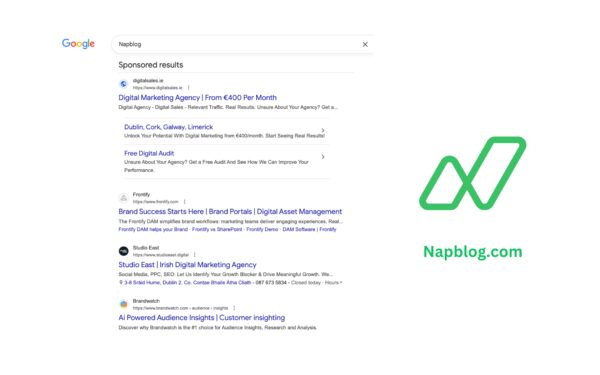
Napblog does not run paid advertisements to promote itself.
This is not ideological. It is strategic.
2.1 The Core Thesis
If a marketing firm cannot grow organically, it cannot credibly advise clients on sustainable growth.
Thus emerged the Pure Persuasion Strategy.
2.2 What Pure Persuasion Means
- Growth through 1:1 strategic conversations
- Referral-driven expansion
- High-trust networks
- Content that compounds over time
- No dependency on self-promotional paid ads
Instead of attention renting, Napblog builds attention assets.
2.3 Content as Infrastructure
Most agencies treat content as campaign fuel.
Napblog treats content as:
- Intellectual property
- Authority architecture
- Search equity infrastructure
- Narrative defensibility
Articles are written to dominate intent clusters, not to chase clicks.
This leads to one powerful outcome:
Search becomes reputation.
3. Conversational Marketing: From Campaigns to Coffee Tables
Traditional agencies polish. Napblog humanizes.
Where others brainstorm, Napblog practices what it calls “Soulstorming.”
3.1 Coffee Table Marketing
Instead of boardroom presentations filled with jargon-heavy slides, Napblog prefers:
- Raw conversations
- Founder-driven storytelling
- Honest voice documentation
- Unfiltered positioning clarity
This reduces artificial messaging layers and builds trust.
3.2 Human > Polished
The strategy intentionally avoids overproduced brand personas.
Why?
Because in a post-AI content world, hyper-polished messaging signals automation. Raw clarity signals credibility.
3.3 Community-Driven Growth
Napblog does not treat audiences as traffic segments. It builds ecosystems:
- Founders
- Students
- Professionals
- Strategic partners
Communities amplify authority more sustainably than paid distribution ever can.
4. Strategic Category Creation: “Nap OS” & Keyword Organic Domination
The most technically advanced component of Napblog’s strategy is category engineering.
Instead of competing for saturated keywords like:
- “Marketing agency”
- “Digital marketing Dublin”
- “SEO services”
Napblog chose to create and own a category:
Nap OS — The Career Operating System
Rather than positioning as a service provider, Napblog framed itself as infrastructure.
4.1 System vs App Strategy
An app solves a problem.
A system becomes indispensable.
By positioning Nap OS as a Career Operating System, Napblog elevated its perceived scale and defensibility.
4.2 Keyword Organic Domination
This was not accidental.
The process included:
- Creating a new searchable term
- Publishing authoritative long-form content around it
- Building semantic relevance
- Controlling narrative framing
- Ensuring top-of-page dominance
Instead of fighting incumbents in crowded search fields, Napblog:
Created the field.
That is category strategy in action.
5. AI Integration — With Human Judgment at the Core
Napblog integrates AI deeply — but not blindly.
The operational philosophy:
- AI accelerates execution
- Humans define direction
AI is used for:
- Draft structuring
- Data processing
- Workflow automation
- Pattern recognition
- Operational efficiency
But final positioning, tone, and judgment remain human-led.
This hybrid approach allows:
- Speed without dilution
- Scale without detachment
- Automation without loss of narrative control
6. The “Taking a Break” Strategy: Cognitive Performance as Competitive Edge
One of Napblog’s most unconventional strategic layers is its Break Strategy.
6.1 The Problem
Creative and strategic work collapses under burnout. Continuous output destroys clarity.
6.2 The Solution
Napblog institutionalizes:
- Micro-breaks
- Cognitive resets
- “Mental Naps”
- Disruption of routine
This is not leisure — it is cognitive optimization.
Breaks allow:
- Subconscious synthesis
- Pattern recognition
- Creative insight
- Long-horizon thinking
In strategic environments, clarity compounds more than effort.
7. Fluid, Solid & Relative Intelligence Framework
Napblog’s USA expansion strategy references three intelligence types:
7.1 Fluid Intelligence
Ability to solve new problems and adapt to unknown markets.
7.2 Solid Intelligence
Leveraging accumulated systems, frameworks, and operational knowledge.
7.3 Relative Intelligence
Understanding positioning relative to market context and competitors.
This tri-layer intelligence model ensures:
- Adaptability without chaos
- Structure without rigidity
- Expansion without dilution
8. Marketing Incubator Model
Napblog does not operate like a traditional agency.
It functions as a Marketing Incubator.
Meaning:
- It co-builds strategy with founders.
- It aligns long-term narrative arcs.
- It embeds deeply into positioning.
- It mentors internal marketing evolution.
This reduces client churn and increases strategic cohesion.
9. Planned vs Unplanned Strategy Balance
Napblog balances:
Planned Strategy
- Structured campaigns
- Data-driven roadmaps
- Clear deliverables
Emergent Strategy
- Market-driven adjustments
- Narrative shifts
- Opportunity capture
Rigid planning kills agility. Pure improvisation kills stability.
Napblog integrates both.
10. Anti-Volume, Pro-Authority Positioning
Many digital firms optimize for:
- Volume traffic
- Ad spend scaling
- Funnel velocity
Napblog optimizes for:
- Authority density
- Category ownership
- Trust signals
- Long-term brand equity
This creates slower initial growth but stronger compounding impact.
The Strategic Synthesis
Napblog follows a system built on five macro principles:
| Pillar | Strategic Intent |
|---|---|
| Ikigai Alignment | Purpose + Performance coherence |
| Pure Persuasion | Organic, trust-driven growth |
| Conversational Marketing | Human authenticity over polish |
| Category Creation (Nap OS) | Own the market, don’t fight for it |
| Break Strategy | Cognitive longevity & clarity |
This is not a collection of marketing tricks.
It is a philosophy of positioning, attention architecture, and sustainable authority building.
Final Positioning Statement
Napblog’s strategy can be summarized in one sentence:
Do not compete for attention. Engineer inevitability.
By aligning purpose with performance, building organic authority, creating its own category, integrating AI intelligently, and protecting cognitive performance, Napblog follows a strategy that prioritizes long-term market ownership over short-term noise.
In a world of aggressive advertising and algorithm dependency, Napblog builds infrastructure — intellectual, narrative, and strategic.
That is the strategy it follows.