6 min read
Napblog Limited did not simply rank for a term.
It engineered ownership.
This is the story of how Napblog created a new category and achieved keyword organic domination around one strategically constructed term:
“Nap OS.”
1. The Strategic Premise: If You Can’t Compete, Create
Search engines are not neutral directories. They are intent marketplaces.
When a user types a keyword into Google, they are signaling:
- Curiosity
- Commercial interest
- Problem awareness
- Brand recognition
Most companies fight for high-volume generic keywords:
- “career portfolio”
- “student CV builder”
- “professional profile tool”
These terms are saturated. Competitive density is high. Authority domains dominate.
Napblog chose a different strategy:
Do not compete for the market. Create the market.
Thus, “Nap OS” was born — not merely as a product name, but as a search ecosystem.
2. The Keyword Landscape Before Domination
Before Napblog’s intervention, the term “Nap OS” (and adjacent variants like NAP OS, napos, nap macOS) returned fragmented, unrelated results:
- Apple power management references
- Network Access Protection (NAP) documentation
- Random technical research papers
- Small independent consulting domains
- Generic app listings
The search intent was confused. There was no unified semantic authority.
This fragmentation was an opportunity.
Where there is no dominant interpretation, semantic territory is available.
Napblog identified that “Nap OS” had:
- Low structured brand ownership
- No clear product leader
- Cross-domain ambiguity
- Zero cohesive category framing
In SEO strategy terms, this is white space keyword architecture.
3. From Product Name to Operating System Narrative
Napblog did not position Nap OS as an app.
It positioned Nap OS as a system.
That distinction is strategic.
Apps compete.
Systems define ecosystems.
By framing Nap OS as:
“30+ Apps, One System”
Napblog anchored the keyword in architectural language — OS, App Store, ecosystem, intelligence layer.
This subtle reframing did three critical things:
- Elevated perceived scale
- Created defensible semantic territory
- Encouraged search engines to treat Nap OS as a branded entity
Search engines reward entity clarity. The more structured and self-referential the ecosystem, the more authority compounds.
4. The Mechanics of Keyword Organic Domination
Napblog’s domination was not accidental. It was engineered across five coordinated layers.
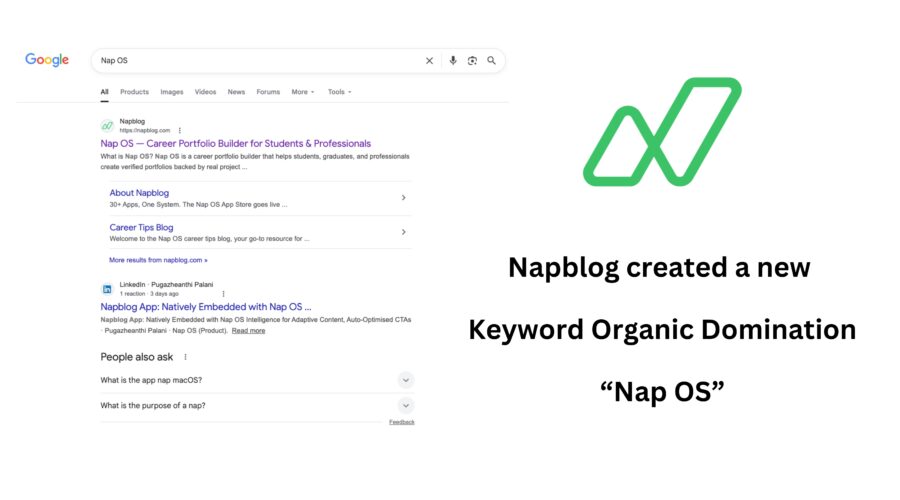
Layer 1: Branded SERP Saturation
When “Nap OS” is searched, the results are dominated by:
- Napblog main domain page
- Nap OS description page
- Internal subpages (About, Career Tips, App Store references)
- Branded LinkedIn distribution
- Structured snippets
This creates:
- Multi-link visibility
- Click-through reinforcement
- Brand familiarity bias
The first page becomes controlled real estate.
And in digital markets, real estate equals power.
Layer 2: Internal Link Graph Engineering
Napblog built an internal semantic network:
- Nap OS → Career Portfolio Builder
- Nap OS → App Store
- Nap OS → Adaptive Intelligence
- Nap OS → Career Blog
Each page reinforces the central entity.
Search engines interpret this as:
- Strong topical authority
- Entity cohesion
- High relevance
This is not random content publishing. It is structured topical clustering.
Layer 3: Distributed Authority Signals
Beyond the core domain, Napblog extended the keyword through:
- Executive LinkedIn posts
- Product-native announcements
- Adaptive content references
- Embedded intelligence descriptions
When search engines crawl external domains referencing “Nap OS” in a consistent context, they strengthen entity resolution.
In SEO terms, this is controlled off-site reinforcement.
Layer 4: Intent Hijacking Through Clarity
Previously, users searching nap-related queries could land on:
- Apple support documentation
- Academic research papers
- Wikipedia network entries
Napblog redefined the dominant interpretation:
Nap OS = Career Portfolio Operating System.
Once a term gains brand clarity, search engines adjust primary intent mapping.
The keyword shifts from ambiguous to branded.
That shift is the tipping point of organic domination.
Layer 5: Structural Rich Snippet Alignment
The Nap OS page includes:
- Clear “What is Nap OS?” definitions
- Structured descriptive paragraphs
- Category framing
- System-level positioning
This increases probability of:
- Featured snippet eligibility
- Knowledge panel development
- Structured data indexing
Organic domination is not just ranking #1.
It is owning the explanation.
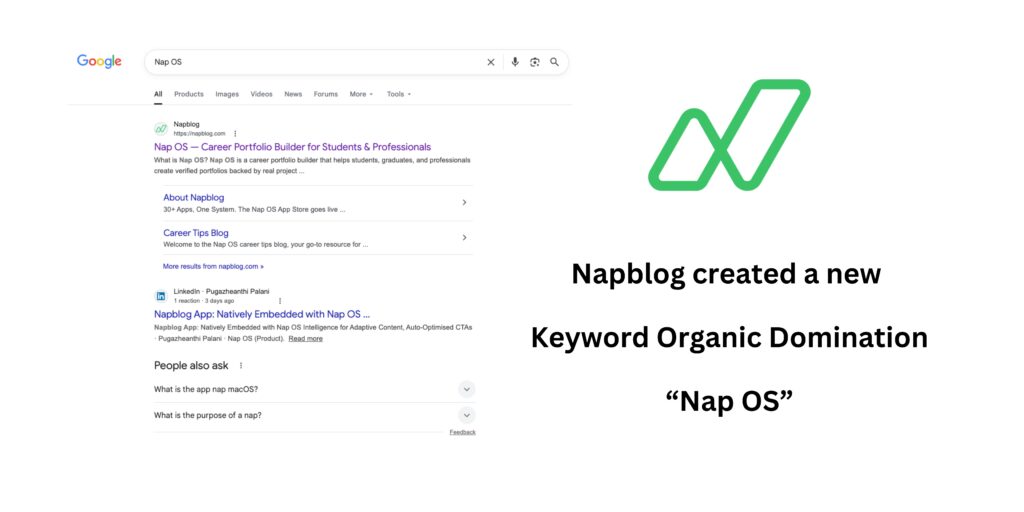
Keyword Organic Domination
“Nap OS”
5. Why “Nap OS” Was a Masterstroke
Let’s break down why this keyword works strategically.
1. It Sounds Technical
“OS” implies:
- Infrastructure
- Architecture
- Scalability
- Platform-level capability
It positions Napblog beyond a blog or a tool.
It implies technological depth.
2. It’s Short and Memorable
Two syllables.
Four letters.
Brand recall is critical in search repetition behavior.
Users who search once and remember are likely to return.
3. It’s Category-Defining
Operating systems are foundational layers.
By analogy, Nap OS becomes:
The foundational layer for career portfolios.
This reframing creates intellectual defensibility.
6. Organic Domination vs Paid Visibility
Many companies attempt visibility through paid search.
But paid traffic:
- Stops when budget stops
- Does not build entity authority
- Does not create category ownership
Napblog invested in organic entity control.
Organic domination produces:
- Long-term defensibility
- Reduced acquisition cost
- Compounding traffic
- Brand gravity
In strategic marketing terms, this is asset building — not rent paying.
7. The Psychology of Search Ownership
When a user searches a keyword and sees:
- Multiple results from the same brand
- Clear definition
- Structured ecosystem
- External references
They unconsciously infer:
“This is the official source.”
Authority perception precedes product evaluation.
Napblog engineered authority before scale.
That is strategic sequencing.
8. Building a Keyword Moat
A moat in SEO is built through:
- Entity clarity
- Content volume
- Cross-linking
- Branded queries
- Consistent language
Napblog’s moat around “Nap OS” includes:
- Product pages
- Informational pages
- Blog reinforcement
- Social signals
- Internal architecture
The result is keyword defensibility.
Future competitors entering the term must overcome:
- Established semantic authority
- Structured domain ownership
- Recognized entity status
This significantly increases their cost of entry.
9. From Keyword to Ecosystem Strategy
Nap OS is not just a keyword.
It is a narrative container.
Within it, Napblog can introduce:
- Adaptive intelligence
- Verified project portfolios
- App store extensions
- Automated career workflows
The keyword becomes a distribution gateway.
Every new feature can be framed as:
“Powered by Nap OS.”
This compounds brand architecture.
10. Organic Domination as Strategic Signaling
Dominating a keyword signals:
- Product maturity
- Infrastructure credibility
- Strategic coherence
- Category ownership
Investors interpret search dominance as:
- Market validation
- Brand traction
- Demand existence
- Organic growth capability
Thus, keyword domination is not just marketing.
It is capital signaling.
11. The Competitive Advantage of Creating Your Own Category
History shows that category creators win disproportionate value:
- Salesforce did not compete as CRM software alone. It created SaaS CRM dominance.
- Shopify redefined e-commerce enablement.
- Notion reframed productivity architecture.
Napblog’s approach mirrors this pattern:
Instead of “portfolio builder,” it built:
A Career Operating System.
Category creation reduces comparison.
And when comparison reduces, pricing power increases.
12. Technical Discipline Behind the Scenes
Achieving keyword organic domination requires:
- Consistent on-page optimization
- Clear meta-structure
- Schema deployment
- Fast page load performance
- Mobile-first indexing alignment
Search engines prioritize:
- Technical hygiene
- Structural clarity
- Authority continuity
Napblog’s infrastructure supports the semantic strategy.
Without technical precision, narrative collapses.
13. The Compounding Effect
Organic domination compounds over time.
Each of the following strengthens the keyword:
- More searches for Nap OS
- More backlinks referencing Nap OS
- More social posts mentioning Nap OS
- More internal feature expansions
Search engines detect growing brand query volume.
When branded search increases, authority amplifies.
Napblog’s strategy is not short-term.
It is cumulative.
14. The Future of “Nap OS”
Keyword domination is Phase One.
Phase Two is expansion.
Once “Nap OS” is firmly associated with Napblog, adjacent keywords become easier to control:
- Nap OS App Store
- Nap OS Intelligence
- Nap OS Verified Portfolios
- Nap OS Adaptive Career Engine
This creates a semantic cluster controlled by a single entity.
Organic domination becomes ecosystem domination.
15. Strategic Lessons from Napblog’s Playbook
For founders, marketers, and operators, the lessons are clear:
- Do not fight for crowded generic keywords.
- Create branded keywords with architectural depth.
- Control the narrative before scaling distribution.
- Build internal link graphs intentionally.
- Extend authority through consistent off-site reinforcement.
- Treat SEO as infrastructure, not promotion.
Napblog did not optimize a page.
It optimized a category.
Conclusion: Ownership Is Intent Control
Search is the front door of digital discovery.
When a company owns a keyword, it owns:
- The first impression
- The definition
- The narrative
- The comparison frame
Napblog Limited transformed “Nap OS” from a scattered term into a branded operating system identity.
This is not conventional SEO.
This is strategic keyword engineering.
And in a world where attention is scarce and competition is infinite, the companies that win are not those who shout the loudest —
They are the ones who define the language.
Napblog defined “Nap OS.”
And in doing so, created its own organic stronghold.
That is keyword organic domination.