If you have worked even one admission cycle in international education, you already know the truth no one says out loud:
the biggest problem is not demand, visas, or even regulations — it is documentation chaos.
From the first student enquiry to final visa approval, the journey is fragmented across:
- Google Sheets tracking “status”
- Google Docs for SOP drafts
- Email threads that go silent
- WhatsApp messages that get lost
- Phone calls that are never logged
- Files named
Final_Final_V2.pdf
Everyone is trying their best.
But the system itself is broken.
This is exactly the problem SIOS (Students Ireland Operating System) was built to solve — not with more tools, but with one unified flow.
This article focuses on one core capability that changes everything:
SIOS Sync-to-Flow Documentation System
A single, continuous, validated document flow from first enquiry to visa approval — shared live between students, consultants, and institutions.
The Real Problem: Documentation Is Not a File Problem, It’s a Flow Problem
Most platforms treat documents as static uploads.
But international education documentation is:
- Sequential
- Time-bound
- Role-dependent
- Country-specific
- Continuously revised
A student does not “upload documents once.”
They:
- Submit incomplete information
- Update documents over 3–6 months
- Replace files after feedback
- Re-validate documents for visa rules
- Reuse the same documents for multiple stakeholders
Traditional tools were never designed for this.
SIOS is.
What “Sync-to-Flow” Actually Means in SIOS
Sync-to-Flow is not a sync button.
It is a living documentation pipeline where:
- Every document has context
- Every upload has purpose
- Every change is tracked
- Every stakeholder sees only what matters to them
One Student → One Case → One Source of Truth
In SIOS:
- A student has one case
- That case has structured stages
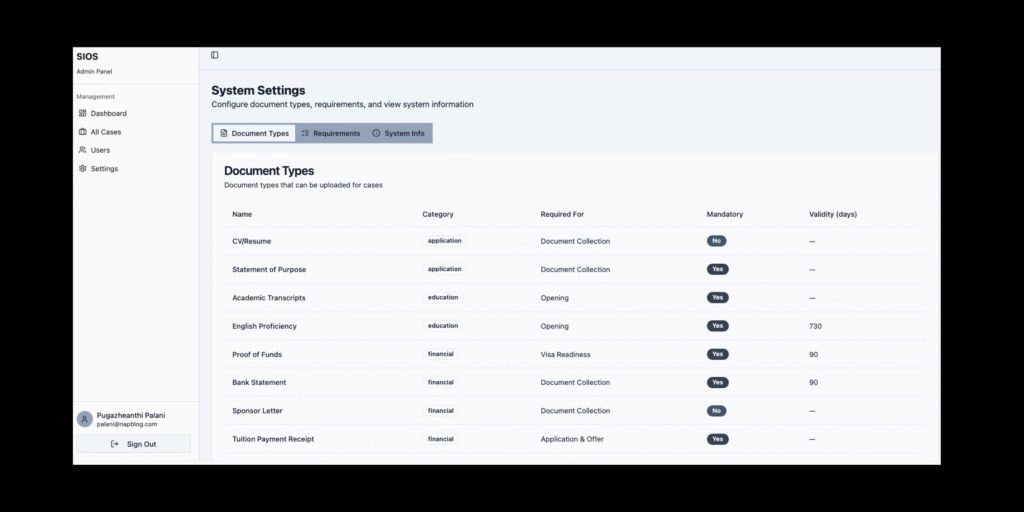
- Each stage has document requirements
- Each document has:
- Category
- Mandatory status
- Validity period
- Role-based visibility
- Approval state
No duplication.
No confusion.
No parallel spreadsheets.
From First Enquiry to Visa Approval — One Continuous Flow
Let’s walk through the real journey.
Stage 1: First Enquiry (Zero Pressure, Zero Chaos)
When a student first enquires:
- No documents are forced
- A lightweight case is created
- Consultant captures intent, destination, intake
SIOS automatically prepares:
- A future document roadmap
- Based on country (Ireland)
- Based on visa pathway
- Based on education level
The student sees clarity before confusion begins.
Stage 2: Document Collection (Guided, Not Chased)
Instead of email checklists, SIOS provides:
- A dynamic document panel
- Clear labels: mandatory vs optional
- Real-time status indicators
- Validity countdowns (e.g., bank statements)
Students upload directly into the flow.
Consultants:
- Review in the same system
- Comment inline
- Approve or request changes
- Never download locally unless required
No WhatsApp chasing.
No spreadsheet updates.
No “Did you send this?”
Stage 3: Sync Between Student and Consultant (Live, Not Manual)
This is where Sync-to-Flow changes everything.
When a student:
- Updates a document
- Replaces a file
- Fixes an error
The consultant sees it instantly — without emails, calls, or reminders.
When a consultant:
- Marks a document as approved
- Flags it for correction
- Locks it for submission
The student sees exactly what changed.
The system communicates. People focus on decisions.
Stage 4: Application & Offer Stage (No Re-Uploads)
Universities require documents in specific combinations.
SIOS:
- Maps documents already collected
- Reuses approved files
- Prevents duplicate uploads
- Tracks submission status per institution
Students do not resend files.
Consultants do not re-download and re-upload.
One flow. Multiple outcomes.
Stage 5: Visa Readiness (Where Most Failures Happen)
Visa documentation is where:
- Errors cost months
- Expiry dates matter
- Evidence must align
SIOS treats visa documents differently:
- Validity periods enforced
- Financial documents flagged if outdated
- Visa-specific requirements activated automatically
Consultants see:
- A visa readiness score
- Missing or risky items highlighted
- Confidence before submission
Students see:
- What is blocking approval
- What needs urgent action
- What is already complete
Why This Matters So Much for Educational Consultants
Consultants Are Drowning in Operational Work
Most consultants today:
- Spend more time managing files than advising students
- Act as human connectors between broken systems
- Rely on memory and experience instead of structure
SIOS changes the role.
Consultants move from:
- File chasers → Process owners
- Spreadsheet managers → Case strategists
- WhatsApp responders → Trusted advisors
No More Google Sheets, Docs, Emails, Calls
SIOS replaces:
- Google Sheets → Case dashboards
- Google Docs → Structured document stages
- Emails → Contextual updates
- Phone calls → Logged interactions
Everything lives inside the case.
Why Universities Benefit (Even If They Don’t Touch the System)
Universities ultimately want:
- Better-prepared applicants
- Cleaner documentation
- Faster decisions
- Lower rejection risk
SIOS indirectly delivers this by:
- Standardizing inputs before submission
- Reducing incomplete applications
- Ensuring document validity
- Improving consultant accountability
Institutions receive better files, not more files.
Self-Hosting: Why It Matters for Trust and Control
SIOS is designed to be self-hosted.
This is critical.
Educational consultants and institutions:
- Own their data
- Control access
- Comply with regional regulations
- Avoid vendor lock-in
SIOS is infrastructure — not a marketplace.
You do not compete inside it.
You operate on top of it.
Designed for Reality, Not Demos
SIOS was not built from theory.
It was built from:
- Real student journeys
- Real consultant workflows
- Real Irish immigration requirements
- Real operational pain
Every feature exists because:
“This broke before. We fixed it at the system level.”
The Outcome: Calm Where There Was Chaos
When Sync-to-Flow is active:
- Students feel guided, not stressed
- Consultants feel in control, not overwhelmed
- Universities receive cleaner applications
- The entire journey becomes predictable
Not faster — clearer.
Not automated — structured.
Not louder — calmer.
Final Thought: Education Needs Systems, Not More Effort
The international education ecosystem does not suffer from lack of intent.
It suffers from lack of infrastructure.
SIOS is not trying to replace people.
It is trying to remove unnecessary friction between them.
When documentation flows correctly:
- Conversations improve
- Decisions accelerate
- Trust increases
And everyone finally focuses on what matters:
helping students succeed — not chasing files.