
From claims to proof. From resumes to systems. From learning to execution.
For years, portfolios have been treated as static showcases — screenshots, links, certificates, and claims of skill. In an AI-accelerated world, that model is no longer credible.
At NapblogOS, we are redefining what a portfolio means.
Today, I am announcing and explaining a major step in that direction: GitHub Portfolio adoption inside NapblogOS, built to evaluate real execution, real systems, and real engineering discipline — not surface-level knowledge.
This is not a “GitHub profile embed.”
This is a portfolio evaluation engine.
The Core Problem: Portfolios Are No Longer Trustworthy
Let’s be direct.
Traditional portfolios fail for three reasons:
- They measure presentation, not execution
- They reward outputs, not systems
- They cannot distinguish AI-assisted learning from real capability
In 2025, anyone can:
- Generate code snippets
- Build demo projects
- Copy frameworks
- Publish tutorials
But very few can:
- Structure repositories correctly
- Maintain version control discipline
- Document decisions
- Build for scale
- Ship iteratively
- Collaborate in real environments
Recruiters know this. Founders know this. Investors know this.
Yet education systems and portfolio platforms have not caught up.
NapblogOS exists to close this gap.
Why GitHub Is the Only Credible Source of Technical Truth
GitHub is not just code hosting.
GitHub is:
- A timeline of thinking
- A record of decisions
- A log of discipline
- A signal of real-world readiness
Unlike resumes or certificates, GitHub cannot be faked easily.
It shows:
- How often you commit
- How you structure projects
- How you write documentation
- How you manage versions
- How you handle complexity
- How you evolve ideas over time
That is why GitHub has become the de facto signal for engineers, data analysts, data scientists, and increasingly — full-stack marketers.
But until now, GitHub data was not structured, scored, or contextualized for portfolio evaluation.
That changes with NapblogOS.
What GitHub Portfolio Means Inside NapblogOS
NapblogOS does not simply “connect” GitHub.
It evaluates GitHub as a system of evidence.
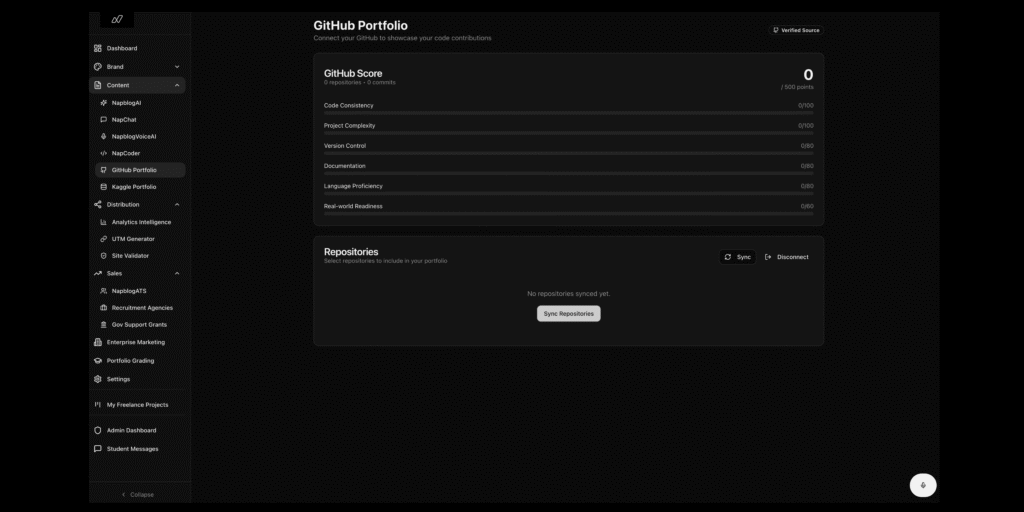
When a student or professional connects their GitHub Portfolio inside NapblogOS, the platform analyzes repositories across seven execution dimensions, producing a GitHub Score out of 500 points.
The GitHub Score Dimensions
- Code Consistency (0–100)
- Commit frequency
- Commit hygiene
- Refactoring behavior
- Logical progression over time
- Project Complexity (0–100)
- Single-file demos vs multi-module systems
- Use of frameworks
- Architectural thinking
- Separation of concerns
- Version Control Discipline (0–80)
- Meaningful commit messages
- Branch usage
- Pull request structure
- Change traceability
- Documentation Quality (0–80)
- README clarity
- Setup instructions
- Problem statements
- Decision explanations
- Language Proficiency (0–80)
- Depth vs surface usage
- Idiomatic patterns
- Tooling maturity
- Stack coherence
- Real-World Readiness (0–60)
- Production mindset
- Environment configuration
- Error handling
- Scalability awareness
Total: 500 points
This score is not cosmetic.
It directly feeds into the NapblogOS Portfolio Grading Engine.
Why This Matters More Than Ever in the AI Era
AI has changed how we learn — but it has also broken how we evaluate.
The world is now divided into two groups:
- Those who use AI to build systems
- Those who use AI to generate outputs
NapblogOS is designed for the first group.
By integrating GitHub Portfolio evaluation:
- We separate builders from prompt-copyists
- We reward execution over explanation
- We measure thinking, not typing
This is especially critical for students.
Degrees alone no longer differentiate.
Certifications are becoming noise.
Content creation is commoditized.
Execution is the new currency.
From Content Creators to Full-Stack Marketers
NapblogOS was built with a clear thesis:
The future marketer is a system builder, not just a content producer.
A full-stack marketer must be able to:
- Source data
- Clean data
- Model data
- Build pipelines
- Define KPIs
- Feed algorithms
- Interpret dashboards
- Deploy systems
GitHub is where these capabilities live.
Inside NapblogOS, GitHub Portfolio connects with:
- Analytics Intelligence
- Data Modeling
- Algorithm Scoring
- Portfolio Grading
- Recruiter Access
- Enterprise Evaluation
This transforms GitHub from a developer-only signal into a cross-functional execution record.
How Students Use GitHub Portfolio in NapblogOS
For students, this changes everything.
Instead of saying:
“I learned Python.”
“I know SQL.”
“I built a project.”
They can show:
- Repository architecture
- Commit history
- Data pipelines
- Marketing experiments
- Automation scripts
- Analytics workflows
NapblogOS then:
- Scores the work
- Contextualizes it
- Aligns it to market expectations
- Makes it recruiter-readable
This is how students outcompete traditional profiles.
Not by shouting louder — but by showing better systems.
For Recruiters: From Guesswork to Signal
Recruiters do not have time to audit GitHub manually.
NapblogOS solves this by:
- Normalizing GitHub signals
- Translating technical depth into readable scores
- Mapping execution to role readiness
A recruiter can now answer:
- Is this candidate junior, mid, or production-ready?
- Can they work in real environments?
- Do they understand systems, not just syntax?
This reduces:
- Bad hires
- Long interviews
- Trial-and-error recruitment
And increases:
- Signal clarity
- Confidence
- Speed
For Enterprises: Portfolio as Due Diligence
For enterprises, GitHub Portfolio inside NapblogOS becomes:
- A technical due-diligence layer
- A risk reduction mechanism
- A skills validation engine
Whether evaluating:
- Interns
- Graduates
- Contractors
- Freelancers
- Entry-level engineers
- Marketing technologists
NapblogOS provides objective execution data, not subjective claims.
Why This Is Bigger Than GitHub
GitHub Portfolio is not a standalone feature.
It is a foundation layer.
Inside NapblogOS, it connects with:
- Kaggle Portfolio (data science validation)
- Analytics Intelligence (real traffic proof)
- Freelance Projects (commercial execution)
- Algorithm Scoring (market readiness)
- ATS integration (hiring pipelines)
Together, they form a living portfolio OS.
One that evolves daily as users build, commit, ship, and learn.
The Philosophy Behind NapblogOS
NapblogOS was built on one belief:
The market does not reward learning.
The market rewards execution.
GitHub Portfolio adoption is a direct expression of that belief.
It forces honesty.
It rewards discipline.
It exposes gaps.
It builds confidence through proof.
And most importantly — it prepares students and professionals for the real world, not just academic validation.
Final Thought
We are entering an era where:
- Portfolios replace resumes
- Systems replace certificates
- Execution replaces explanation
GitHub Portfolio inside NapblogOS is not a feature.
It is a shift in how capability is measured.
If you are a student — build systems.
If you are a marketer — think like an engineer.
If you are a recruiter — demand proof.
If you are an enterprise — reduce risk.
If you are an educator — update the model.
NapblogOS is here to make portfolios credible again.
—
Pugazheanthi Palani
Founder, NapblogOS
Building execution-first portfolios for the AI economy