Last updated: February 17, 2026
5 min read
From Execution to Outreach: Introducing the NapblogOS AI-Powered Code Editor for Institutional Email Automation
When we started building NapblogOS™, our goal was never to create “another platform.”
We set out to build an operating system — one that replaces fragmented tools, mentor dependency, and inconsistent execution with system logic.
Over time, one insight kept surfacing across universities, incubators, and innovation teams:
Execution does not fail because people lack ideas.
Execution fails because systems stop at evaluation — and never extend into outreach, distribution, or real institutional engagement.
Today, we are introducing a feature that directly addresses that gap.
This edition of the NapblogOS newsletter highlights a major product capability now available inside the platform:
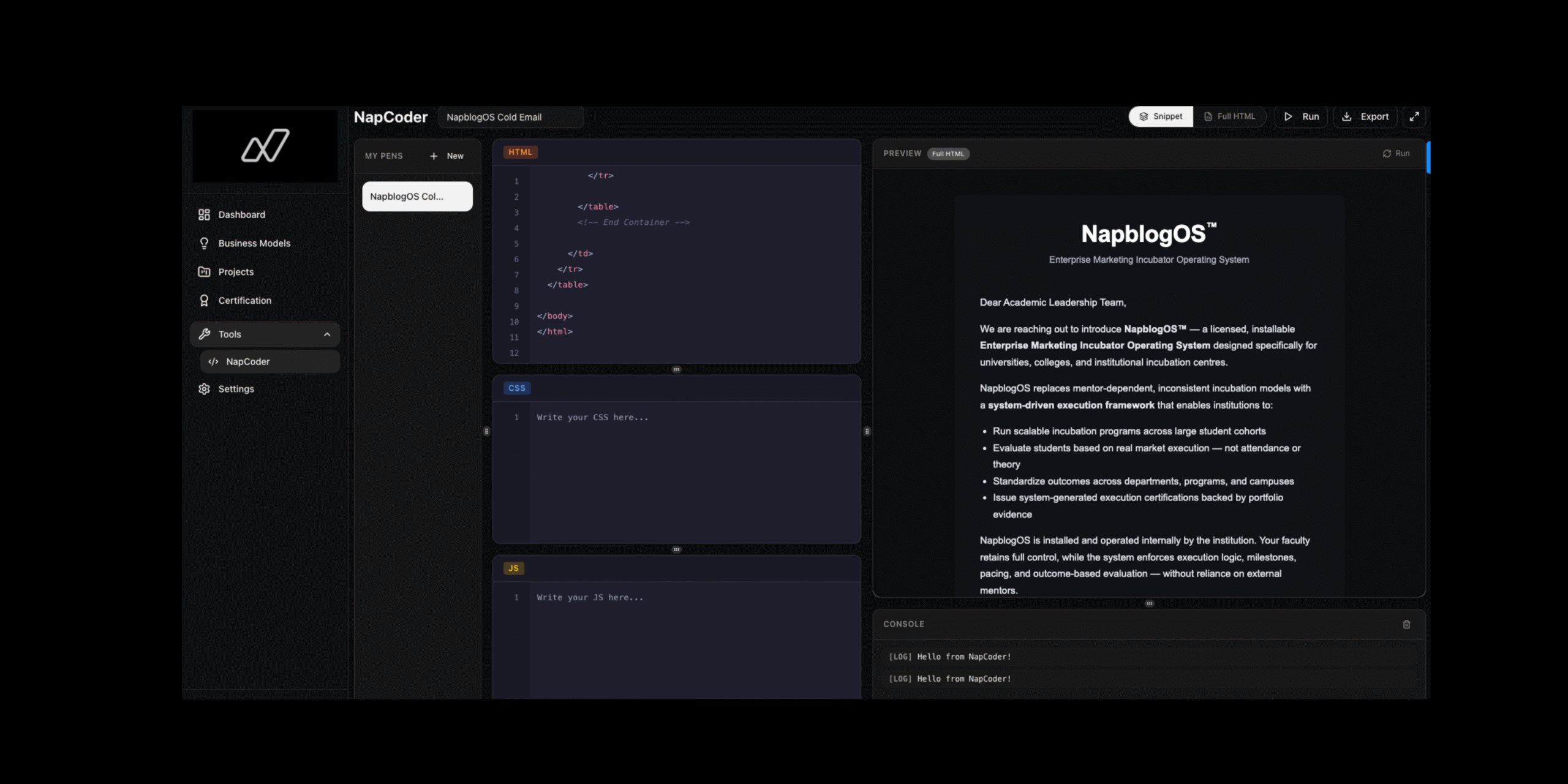
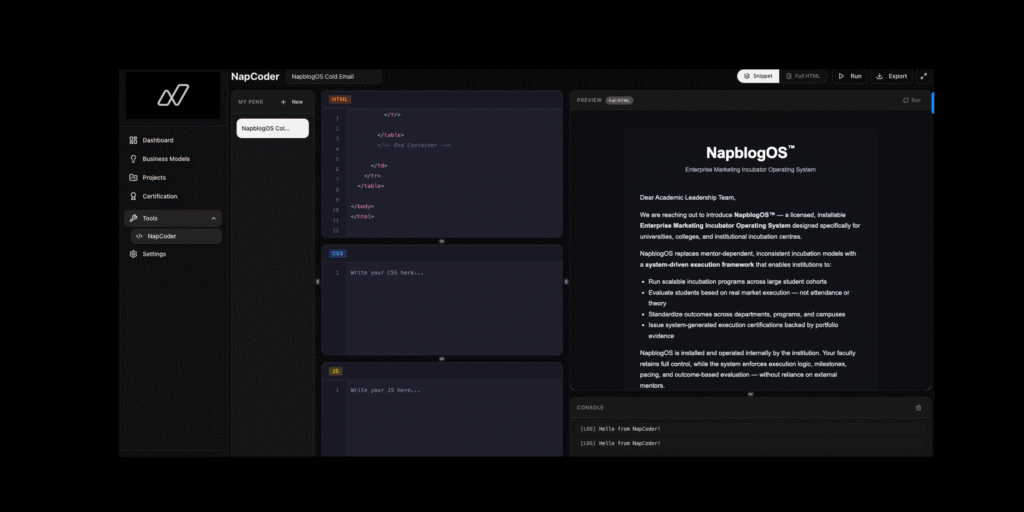
The NapblogOS AI-Powered Code Editor for Email Automation — a built-in environment that generates HTML, CSS, and JavaScript to create, customize, and send institutional-grade emails at scale.
This is not a coding playground.
It is a system-level outreach engine, purpose-built to help NapblogOS reach universities, colleges, and decision-makers — and, importantly, to demonstrate how execution actually scales when logic is embedded into software.
Why Outreach Had to Become a First-Class Feature
In most incubation and education systems, outreach lives outside the core product.
Emails are written manually.
Design is outsourced or improvised.
Campaigns depend on individual effort rather than repeatable logic.
That creates three problems:
- Inconsistency – Messaging changes depending on who writes it
- Inefficiency – Every outreach effort starts from scratch
- Non-scalability – Growth depends on human bandwidth, not systems
NapblogOS was designed to eliminate these patterns.
If NapblogOS evaluates students based on execution,
then the platform itself must operate the same way.
That meant one thing:
Outreach, communication, and acquisition had to be system-generated — not manually produced.
Introducing the NapblogOS Code Editor
Inside NapblogOS, users now have access to an integrated Code Editor that allows the system to generate:
- HTML email templates
- Inline and embedded CSS for email compatibility
- JavaScript logic for automation, previews, and triggers
This editor is not aimed at developers alone.
It is designed for operators — founders, program leads, institutional sales teams, and platform administrators who need outcomes, not syntax perfection.
The system uses AI to translate intent into execution.
You describe who you want to reach and why.
NapblogOS generates the outreach artifact.
What Makes This Editor Different from “Just Another Tool”
There are countless editors in the world.
There are countless AI writing tools.
NapblogOS deliberately does not compete in that category.
Instead, the Code Editor is deeply tied to the operating system itself.
Here is what makes it fundamentally different:
1. System-Aware Generation
The editor understands:
- NapblogOS positioning
- Institutional language norms
- Academic decision-making contexts
- Enterprise-grade tone and structure
This ensures emails generated inside NapblogOS are not “marketing copy” — they are institutionally credible communications.
When the system generates an outreach email to a university, it already knows:
- The product architecture
- The licensing model
- The operational framing
- The value proposition for academia
That context is embedded.
2. HTML, CSS, and JS — Not Just Text
Most AI email tools stop at words.
NapblogOS goes further.
The Code Editor generates:
- Fully structured HTML layouts
- Dark-theme enterprise-grade design
- Email-safe CSS
- JavaScript logic for previewing, personalization, or sequencing
This means the output is not a draft — it is deployable infrastructure.
The same system that evaluates execution portfolios can now generate institutional-grade outbound communication without external tools.
3. Built for Automation, Not One-Off Emails
NapblogOS does not treat emails as messages.
It treats them as system artifacts.
Each generated email can be:
- Versioned
- Reused
- Modified programmatically
- Automated across cohorts of institutions
Outreach becomes repeatable logic, not manual effort.
A Real Use Case: Reaching Universities for Acquisition Conversations
One of the first internal uses of the NapblogOS Code Editor was direct.
We asked a simple question:
If NapblogOS were to reach 100 universities globally, how would it do so without relying on manual sales effort?
The answer was not “hire more people.”
The answer was encode the outreach logic into the product itself.
Using the Code Editor, NapblogOS now generates:
- Cold introduction emails to academic leadership
- Follow-up sequences tailored to incubation programs
- Faculty-focused variants
- Administrative and procurement-friendly versions
Each version is structurally consistent, branded, and system-aligned.
The editor ensures:
- Message clarity
- Professional tone
- Design consistency
- Institutional credibility
This is what it means for the product to reach out on its own behalf.
Why This Matters for Universities
For universities evaluating NapblogOS, this feature sends a clear signal:
NapblogOS does not teach execution —
NapblogOS executes.
If a system can:
- Run incubation programs
- Evaluate outcomes
- Certify execution
- Generate enterprise-grade outreach artifacts
Then it is not a platform.
It is operational infrastructure.
Universities adopting NapblogOS are not just installing curriculum logic.
They are installing a self-contained execution environment.
Why This Matters for Students and Programs
From a student and program perspective, this feature models a critical lesson:
Execution is not complete until communication reaches the market.
By exposing structured, system-generated outreach inside the OS, NapblogOS reinforces that:
- Code is a means, not the goal
- Communication is an execution artifact
- Distribution is part of execution depth
Students and teams operating inside NapblogOS can see how:
- Ideas translate into assets
- Assets translate into outreach
- Outreach translates into institutional engagement
This closes the loop that most educational systems never address.
AI as an Operator, Not a Toy
It is important to clarify what role AI plays here.
NapblogOS does not use AI to “sound smart.”
It uses AI to remove friction from execution.
Inside the Code Editor, AI:
- Converts intent into structure
- Applies system tone automatically
- Enforces consistency across outputs
- Reduces dependence on manual skill variation
This aligns with the core NapblogOS philosophy:
Systems should absorb complexity so humans can focus on decisions.
Product-Led Acquisition, Not Sales-Led Noise
The long-term implication of this feature is strategic.
NapblogOS is moving toward product-led institutional acquisition.
Instead of:
- Aggressive outbound sales
- Manual pitch decks
- Disconnected campaigns
NapblogOS allows the product itself to:
- Generate outreach
- Initiate conversations
- Present itself coherently
This is especially important in academic environments, where trust, clarity, and structure matter more than hype.
What This Signals About the Direction of NapblogOS
This Code Editor feature is not isolated.
It signals where NapblogOS is heading:
- Deeper system autonomy
- Less reliance on external tools
- More execution logic embedded into software
- Clearer separation between “platforms” and “operating systems”
NapblogOS is not adding features for the sake of features.
Every capability must reinforce execution, scalability, and institutional credibility.
Closing Thoughts
NapblogOS started as a framework for evaluating execution.
It is now evolving into something more complete:
An operating system that executes, communicates, and scales on its own logic.
The AI-Powered Code Editor is a step in that direction.
It demonstrates that when systems are designed correctly:
- Outreach becomes infrastructure
- Communication becomes repeatable
- Growth becomes systematic
For universities, this means adopting NapblogOS is not just about improving student outcomes.
It is about installing a system that understands execution end-to-end — from idea to market, from portfolio to institutional conversation.
We look forward to sharing more as NapblogOS continues to evolve.
—
NapblogOS™ Team
Enterprise Marketing Incubator Operating System
NapCoder transforms how you write and share code on NapblogOS. Connect with us on LinkedIn.