6 min read
There was a time when a degree was a keyword.
You put it on your resume, and doors opened.
There was a time when “experience” was a keyword.
Then “skills.”
Then “certifications.”
Then “AI tools.”
Every decade, the job market creates a new keyword — a signal that supposedly represents employability.
But here’s the uncomfortable truth:
Keywords don’t create careers.
They only create filters.
And filters don’t solve unemployment.
They only rearrange it.
Nap OS is not another keyword added to the list.
It is the system that makes keywords irrelevant.
The Global Unemployment Paradox
We are living in one of the most paradoxical moments in human work history.
On one side:
- Millions of graduates entering the workforce every year
- Professionals upskilling continuously
- AI tools increasing productivity
- Global access to knowledge
On the other side:
- Employers struggling to find “job-ready” talent
- Entry-level roles disappearing or becoming hyper-competitive
- Career stagnation despite skill accumulation
- Increasing mismatch between learning and earning
Global unemployment is not just about lack of jobs.
It is about lack of verifiable capability signals.
People are not unemployed because they know nothing.
They are unemployed because:
They cannot prove what they know.
This is the gap Nap OS was built to solve.
Why Career Accelerators Emerged
The rise of career accelerators is not accidental.
It is a response to systemic failure.
Traditional career pathways:
Degree → Internship → Job
no longer work reliably.
Career accelerators attempted to fix this by offering:
- Short-term programs
- Practical learning
- Job placement support
- Skill-based training
But most accelerators failed to address the core issue.
They focused on learning more
instead of
proving better
This is where Nap OS diverges completely.
Nap OS Is Not a Career Accelerator
It Is the Operating System Behind It
Nap OS is not just a program.
It is an execution environment.
While traditional accelerators say:
“Learn this skill.”
Nap OS says:
“Build this proof.”
While others measure:
Attendance
Completion
Certification
Nap OS measures:
Execution
Output
Verification
This is why Nap OS is emerging as a dominant keyword in the career accelerator market.
Not because it markets better —
but because it operates differently.
The Shift From Resume Economy to Proof Economy
The job market is transitioning from:
Resume Economy → Proof Economy
In the resume economy:
- You describe what you did
- You list what you know
- You claim what you can do
In the proof economy:
- You show what you built
- You demonstrate what you solved
- You verify what you delivered
Nap OS accelerates this shift.
Instead of asking users to write resumes,
it forces them to generate:
- Reports
- Campaigns
- Systems
- Code
- Documentation
- Analytical outputs
Every action becomes evidence.
Every output becomes credibility.
The 10 Tabs Career Problem
One of the most overlooked issues in modern career building is fragmentation.
A typical job seeker operates across:
- Job portals
- Online courses
- YouTube tutorials
- Resume builders
- Portfolio sites
- Freelance platforms
- Notes apps
- Email threads
- AI tools
Ten tabs open.
Zero direction.
This is what Nap OS identifies as:
The 10 Tabs Career Problem
Effort is high.
Output is low.
Clarity is missing.
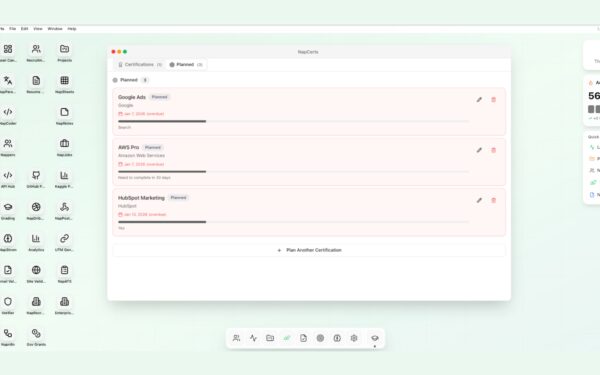
Nap OS collapses these into one system:
A single execution layer
where learning, building, and proving happen together.
Execution-First Model — The Core Differentiator
At the heart of Nap OS is a simple philosophy:
You don’t become employable by learning.
You become employable by executing.
Execution inside Nap OS is structured through:
- Real-world tasks
- Defined outputs
- Time-bound sprints
- Continuous iteration
Users don’t passively consume knowledge.
They actively produce outcomes.
This creates:
- Skill reinforcement
- Contextual understanding
- Practical experience
- Evidence generation
Most importantly:
It creates decision-ready profiles
The 7-Stage Career Acceleration Framework
Nap OS structures career transformation through a systematic framework.
Stage 1 — Career Diagnosis
Understanding current capability vs market demand.
Stage 2 — Direction Clarity
Identifying high-opportunity paths.
Stage 3 — Skill Mapping
Translating roles into executable tasks.
Stage 4 — Execution Sprints
Building real outputs under structured timelines.
Stage 5 — Portfolio Construction
Organizing outputs into coherent narratives.
Stage 6 — Interview Readiness
Aligning communication with evidence.
Stage 7 — Employment Activation
Connecting proof with opportunity.
This framework ensures that users don’t just “prepare” for jobs —
they become visible to them.
AI-Augmented Workflows — Not AI Dependency
AI is changing work.
But it is also creating confusion.
Most professionals use AI to:
- Generate answers
- Write content
- Solve problems instantly
This creates an illusion of capability.
Nap OS uses AI differently.
It integrates AI into workflows where:
- Humans define direction
- AI accelerates execution
- Outputs remain human-owned
Users are trained to:
- Think structurally
- Execute systematically
- Validate independently
This ensures that AI enhances capability
instead of masking its absence.
Unlocking Hidden Talent
One of the biggest failures of the traditional system is exclusion.
Millions of capable individuals are filtered out because they lack:
- Degrees
- Experience
- Brand-name companies
- Formal credentials
Nap OS removes these filters.
By prioritizing:
Evidence over background
It enables:
- Self-taught professionals
- Career switchers
- Underrepresented talent
- Global candidates
to compete on equal ground.
If you can prove it,
you can access opportunity.
Solving the “Experience Without Experience” Problem
Every graduate faces the same paradox:
“You need experience to get a job,
but you need a job to get experience.”
Nap OS breaks this loop.
By simulating real-world execution environments,
users gain:
- Practical exposure
- Measurable outputs
- Portfolio depth
before entering the job market.
Experience becomes:
Built, not waited for
Building Global Credibility
In a remote-first, digital economy, trust is broken.
Employers ask:
Can this person actually do the work?
Candidates ask:
How do I prove it?
Nap OS answers both.
Through:
- Verifiable outputs
- Timestamped execution
- Structured portfolios
- Consistent activity logs
It builds global credibility infrastructure
A candidate in India, Ireland, or Nigeria
can prove capability to an employer anywhere.
This removes geographic limitations
from employability.
Reducing the Scarring Effect of Unemployment
Long-term unemployment has a psychological and economic impact.
It creates:
- Confidence loss
- Skill decay
- Market disconnect
- Reduced opportunity access
Nap OS addresses this by providing:
- Continuous execution pathways
- Structured daily progress
- Observable growth
Users don’t remain idle.
They remain in motion.
And motion creates momentum.
Why Nap OS Is Becoming the Dominant Keyword
Nap OS is not dominating because of marketing.
It is dominating because it aligns with reality.
The market is moving toward:
- Skills over degrees
- Proof over claims
- Execution over theory
- Systems over randomness
Nap OS sits at the intersection of all four.
It is not competing with:
Universities
Courses
Bootcamps
It is integrating and restructuring them
into a single execution system.
The Future of Career Acceleration
The next generation of career systems will not be:
Content platforms
Certification programs
Job boards
They will be:
Execution infrastructures
Where:
- Work is created
- Proof is generated
- Capability is verified
- Opportunity is matched
Nap OS represents this future.
Vision — One Million Careers by 2040
Napblog Limited is not building a tool.
It is building a system to influence careers at scale.
The goal:
Impact one million careers by 2040
Not by:
Teaching more
Certifying more
Marketing more
But by:
Enabling people to prove more
Because in the end:
Opportunity does not go to those who know the most.
It goes to those who can show the most.
Conclusion
Global unemployment is not just an economic issue.
It is a system design problem.
We built systems that:
Reward credentials
Ignore execution
Trust narratives
Doubt capability
Nap OS reverses that.
It creates a world where:
- Work is visible
- Capability is provable
- Talent is discoverable
- Opportunity is accessible
And in that world:
The most powerful keyword is no longer
“degree”
or “experience”
It is:
proof
Nap OS is not just part of that shift.
It is helping define it.