5 min read
Universities produce knowledge.
Industries demand execution.
Between these two lies one of the most critical gaps in the modern world:
The translation gap between learning and doing.
Students spend years working on:
- Assignments
- University projects
- Thesis research
- Group work
- Case studies
Yet when they graduate, they face a single question:
“Do you have experience?”
This is not a failure of students.
It is a failure of systems.
Because the work already exists.
It just isn’t structured, validated, or visible in a way that decision makers can trust.
Nap OS was built to solve this exact problem.
The Broken Bridge Between Academia and Industry
Let’s break down the reality.
University Projects
Students complete multiple academic projects across semesters.
But these projects often:
- Stay inside classrooms
- Lack real-world context
- Are not standardized for evaluation beyond grades
- Never reach employers
Thesis Work
Final-year research and thesis projects involve:
- Deep analysis
- Problem-solving
- Structured thinking
Yet most theses:
- Sit in PDF format
- Are never translated into practical outputs
- Fail to communicate industry relevance
Placement Programs
Universities attempt to bridge the gap through placements.
But placements often:
- Depend on limited company partnerships
- Are inconsistent in quality
- Provide observational experience rather than execution ownership
- Are inaccessible to many students
Career Simulation
Students are told to “prepare” through:
- Mock interviews
- Practice assignments
- Theoretical exercises
But simulations without consequences do not build real capability.
The Core Problem
All these systems share a common limitation:
They generate activity, but not employability.
Because employability requires:
- Execution
- Evidence
- Verification
- Visibility
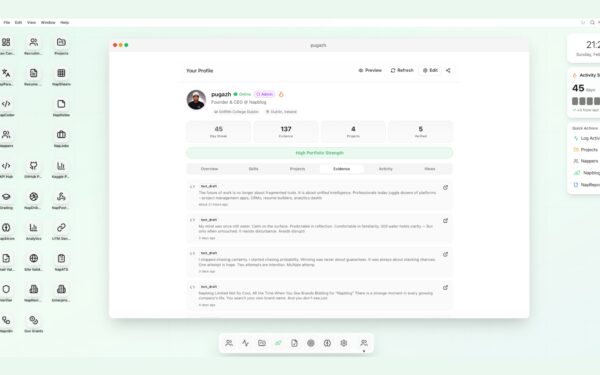
Nap OS introduces these missing layers.
Nap OS — The Execution Layer for Academic Systems
Nap OS is not a replacement for universities.
It is an execution infrastructure layered on top of them.
It transforms:
Academic Activity → Verified Employability Signals
Instead of asking institutions to redesign curriculum,
Nap OS restructures how outcomes are captured and validated.
Supporting University Projects — From Grades to Proof
In traditional systems, university projects are evaluated through:
- Internal grading
- Faculty feedback
- Limited peer review
Once graded, they lose value.
Nap OS changes this by converting projects into:
Execution Artifacts
Students working on projects within Nap OS:
- Document their process
- Track iterations
- Produce structured outputs
- Link work to real-world applications
Each project becomes:
- Observable
- Shareable
- Verifiable
Instead of saying:
“I completed a marketing project.”
A student can show:
- Strategy document
- Campaign simulation
- Data analysis
- Performance assumptions
This shifts projects from academic exercises to professional evidence.
Thesis-Backed Projects — From Research to Application
A thesis represents one of the highest forms of structured thinking a student produces.
Yet its value is underutilized.
Nap OS transforms thesis work into:
Industry-Ready Execution Outputs
For example:
A thesis in marketing becomes:
- Market research frameworks
- Customer segmentation models
- Campaign strategies
A thesis in technology becomes:
- Functional prototypes
- System architectures
- Code repositories
A thesis in business becomes:
- Financial models
- Growth strategies
- Operational workflows
Nap OS ensures that:
Research is not just submitted
It is translated into action
This enables students to present their thesis not as a document,
but as a portfolio of execution.
Placement Programs — From Opportunity Scarcity to System Abundance
Traditional placement programs are limited by:
- Number of companies
- Available roles
- Geographic constraints
- Selection processes
Nap OS removes these limitations by creating:
Execution-Based Placement Infrastructure
Instead of waiting for placement opportunities:
Students enter execution environments where they:
- Work on real-world problems
- Contribute to ongoing projects
- Build outputs aligned with industry needs
This creates:
Placement through participation
rather than
placement through selection
Every student gets the opportunity to:
- Execute
- Contribute
- Prove
Employers evaluating such candidates don’t ask:
“Did you get placed?”
They ask:
“What have you built?”
Career Simulation — From Practice to Reality
Most career simulations fail because they lack:
- Accountability
- Real consequences
- Output expectations
Nap OS introduces:
Execution Sprints
These are structured, time-bound work cycles where participants must:
- Complete real tasks
- Deliver measurable outputs
- Iterate based on feedback
There is no passive learning.
There is only:
Work → Feedback → Improvement → Output
This creates:
- Pressure
- Clarity
- Ownership
Which are essential elements of real-world environments.
Nap OS doesn’t simulate careers.
It initiates them.
Portfolio-First Approach — The Output of the System
Every component within Nap OS leads to one outcome:
A verifiable, structured portfolio
This portfolio includes:
- Projects
- Evidence
- Documentation
- Execution history
- Verified outputs
Unlike traditional portfolios:
- It is not manually curated
- It is system-generated
- It reflects real activity
This becomes the primary interface between:
Talent
and
Opportunity
Solving the Employability Visibility Problem
One of the biggest barriers in hiring is visibility.
Employers cannot see:
- How someone works
- How consistently they perform
- How they approach problems
Nap OS solves this through:
- Activity tracking
- Evidence logging
- Execution timelines
- Verification layers
This creates:
Transparent professional identities
Decision makers don’t rely on assumptions.
They rely on observable patterns.
Institutional Impact — Universities as Outcome Engines
Nap OS enables universities to evolve from:
Knowledge Providers
to
Outcome Systems
With Nap OS integration, institutions can:
- Track student execution
- Measure employability outcomes
- Validate project impact
- Improve curriculum relevance
This creates accountability not just for students,
but for the entire system.
Student Impact — From Confusion to Clarity
Students entering Nap OS experience a shift:
From:
“What should I do?”
To:
“What should I build next?”
This reduces:
- Career anxiety
- Decision paralysis
- Skill confusion
Because progress becomes:
Action-driven
Employer Impact — From Screening to Selection
Employers using Nap OS data can:
- Skip resume filtering
- Observe real work
- Identify high performers
- Reduce hiring risk
Hiring becomes:
Faster
More accurate
More evidence-based
The Larger Vision — System-Level Change
Nap OS is not solving individual problems in isolation.
It is restructuring the relationship between:
Education
Work
Opportunity
By introducing:
- Execution infrastructure
- Evidence systems
- Verification layers
It creates a new standard for employability.
Conclusion
University projects exist.
Thesis work exists.
Placement programs exist.
Career simulations exist.
But they operate in silos.
Nap OS connects them.
It transforms:
Learning into execution
Execution into evidence
Evidence into employability
This is not an incremental improvement.
It is a structural shift.
In a world where:
Degrees are abundant
Skills are evolving
Jobs are competitive
The only sustainable advantage is:
Proven capability
Nap OS ensures that capability is not hidden.
It is built, tracked, and made visible.
And in doing so, it doesn’t just prepare students for jobs.
It prepares them to be chosen.