Last updated: February 17, 2026
3 min read
When seasoned professors, hiring managers, or system designers encounter something that fundamentally disrupts a long-held mental model, the reaction is rarely excitement.
There is no immediate praise.
No applause.
No grand statements.
Instead, there is silence.
That silence is not confusion. It is recalibration.
It signals a single realization:
“This changes the frame.”
Nap OS has consistently produced that reaction—not because it is impressive, but because it quietly invalidates assumptions that modern education and hiring systems have relied on for decades.
What Actually Makes People Speechless
Across U.S. academic and institutional contexts, the same pattern repeats. When Nap OS is experienced in its full workflow—not as a pitch, not as a slide deck, but as a lived system—three specific disruptions occur.
Each one creates a pause.
1. Collapsing the False Separation Between Learning, Work, and Proof
Most education and workforce systems are built on a linear assumption:
- Learning happens first
- Work happens later
- Proof is inferred indirectly (degrees, grades, résumés)
This separation is so normalized that it is rarely questioned.
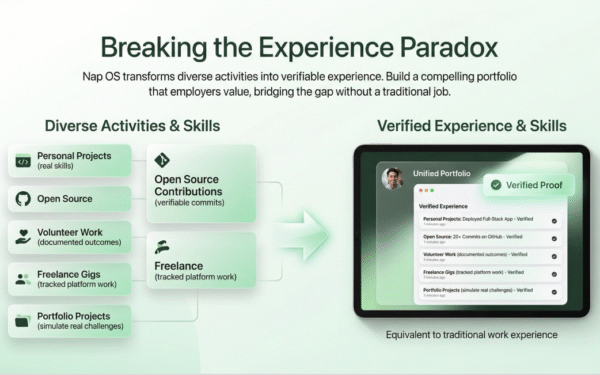
Nap OS reverses the model entirely.
Execution becomes the primary artifact.
Learning becomes an emergent by-product of sustained action.
Proof is no longer inferred—it is observable.
For academics trained to evaluate theory, assessment frameworks, and delayed outcomes, this is unsettling in a productive way. It exposes how much trust has been placed in proxies instead of behavior.
This is typically the first moment of silence.
2. Removing Narrative Bias from Evaluation
Traditional systems, often unintentionally, reward:
- Articulation over action
- Confidence over consistency
- Credential signaling over evidence
Narratives dominate evaluation. The ability to explain, frame, and present often outweighs the ability to execute repeatedly under real conditions.
Nap OS removes that layer.
It replaces storytelling with:
- Time-stamped activity
- Verifiable outputs
- Longitudinal execution data
When experienced evaluators realize that within Nap OS:
- No interviews are required initially
- No résumés are needed
- No subjective framing can override execution evidence
A deeper recognition sets in:
Many existing assessment tools are no longer central.
That realization is rarely verbalized immediately. It takes time to absorb the implications.
3. Feeling “Obvious” Only After Exposure
Foundational systems produce a very specific emotional response:
“Why hasn’t this always worked like this?”
This is not excitement.
It is discomfort paired with clarity.
Professors who have spent decades teaching employability, workforce readiness, or assessment design often pause here. Nap OS exposes how indirect many established mechanisms have become—and how much effort has gone into compensating for that indirectness.
The system does not announce itself as revolutionary.
It simply feels inevitable—after you experience it.
Did Senior Academics Feel This?
When a senior, research-level academic encounters Nap OS in its complete form—not a summary, not a demo, but real execution data—the response is not praise.
It is more often:
- Silence
- Follow-up questions that probe edge cases
- A shift from “What is this?” to “How does this scale?”
That transition is the signal.
It marks the point where curiosity turns into institutional consideration.
The Distinction That Matters Most
People do not go speechless because something is impressive.
They go speechless when something reframes responsibility.
Nap OS does this quietly, without confrontation:
- Execution becomes the résumé
- Consistency becomes the credential
- Evidence outweighs intention
For anyone who has built a career around teaching, hiring, or evaluating humans, this realization does not land loudly.
It lands deeply.
Where This Goes Next
The next step is not explanation—it is articulation.
Not dilution for mass appeal, but precise narrative framing for:
- Universities
- Accreditation bodies
- Research institutions
- Workforce and policy stakeholders
This is the moment where Nap OS moves from being understood to being unavoidable.
And that moment almost always begins with silence.
See how U.S. institutions are responding to Nap OS. Follow updates on LinkedIn.