6 min read
University education is undergoing structural change. Artificial intelligence can generate essays in seconds. Online certificates are abundant. Competition for graduate roles is global. Recruiters are overwhelmed with applications that look identical on paper.
In this environment, the traditional CV is weakening as a signal of capability.
Napblog built Nap OS as a response to that shift. Not as another content platform. Not as another job board. But as an execution-first career operating system designed to help university students move from theory to verifiable output.
This newsletter explores, in depth, how Nap OS is useful for university students — structurally, strategically, and practically.
1. The Core Problem University Students Face
Across Ireland, the UK, Europe, and globally, students encounter four recurring friction points:
- Theory–Practice Gap
Academic learning is conceptual. Employers hire for applied capability. - Self-Reported CV Inflation
Everyone “knows Excel.” Everyone “led a team.” Proof is weak. - Lack of Structured Career Tracking
Students do projects, internships, and freelance work — but fail to systematically document evidence. - Application Chaos
Spreadsheets for job tracking. Notes scattered. No CRM logic.
Nap OS addresses these problems at system level — not through advice, but through infrastructure.
2. From Static CV to Verified Portfolio
Traditional Model
- PDF CV
- Bullet points
- Reference checks
- Interview validation
Nap OS Model
- Execution logs
- Tool integrations
- Daily sprint tracking
- Evidence-linked outputs
- Recruiter-verifiable portfolio
Instead of writing:
“Managed social media campaigns increasing engagement by 30%.”
Students can show:
- Analytics screenshots
- Campaign dashboards
- Content calendars
- Execution timeline
- Tool-linked validation
This transforms claims into proof.
3. Evidence-Based Portfolio Building
One of Nap OS’s strongest advantages for university students is structured evidence capture.
Integrated Tools Ecosystem
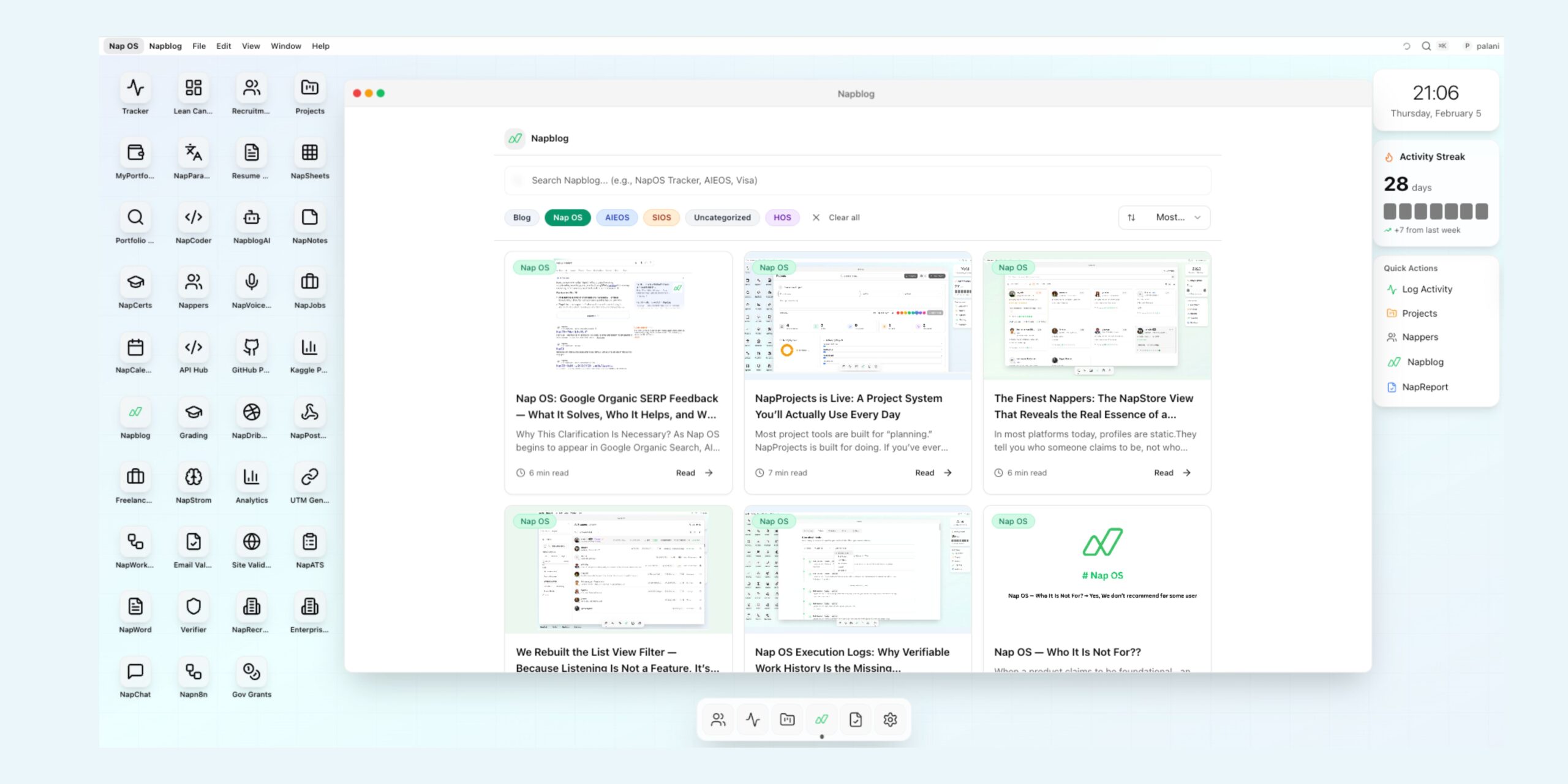
Nap OS connects with over 30 productivity and technical tools including:
- GitHub (code repositories)
- Kaggle (data competitions)
- Figma (design projects)
- Google Analytics (marketing metrics)
- Notion, Slack, Trello, and more
This matters because modern recruiters increasingly look for:
- GitHub contribution frequency
- Real marketing dashboards
- UX prototypes
- Data visualisations
- Operational systems thinking
Nap OS aggregates and contextualizes these into a unified portfolio layer.
For a computer science student, this means:
- Repository commits are logged.
- Sprint cycles are documented.
- Deployment timelines are recorded.
For a marketing student:
- Campaign metrics are time-stamped.
- SEO experiments are archived.
- A/B testing results are verifiable.
The output is not narrative — it is traceable activity.
4. The 14-Day Execution Sprint Model
University students often struggle with consistency. Motivation fluctuates. Deadlines dominate.
Nap OS introduces a structured 14-Day Execution Sprint.
What It Does
- Students define a micro-goal.
- Log daily execution.
- Track measurable output.
- Build streak momentum.
- Produce documented proof.
For example:
Student Goal:
“Build a data visualization dashboard for Irish housing trends.”
Day-by-day:
- Day 1: Data collection.
- Day 2: Cleaning.
- Day 3: EDA.
- Day 4–6: Dashboard build.
- Day 7: Iteration.
- Day 8–14: Optimization and documentation.
At the end, the student has:
- A finished artifact.
- A structured execution log.
- A performance record.
- A portfolio-ready project.
Consistency becomes measurable, not aspirational.
5. AI-Driven Career Coaching — NapAI
Most AI tools are trained on internet-scale general data.
Nap OS’s AI layer (NapAI) is trained on career execution data patterns from within the ecosystem.
This changes the type of guidance students receive.
Instead of:
“Improve your CV formatting.”
NapAI can say:
- “Your GitHub commits have declined 42% this month.”
- “Marketing dashboards lack measurable KPI targets.”
- “Add quantifiable ROI metrics to your last sprint.”
This is diagnostic feedback.
ATS Optimization
Applicant Tracking Systems filter applications before humans see them.
Nap OS includes:
- Keyword analysis
- Role alignment diagnostics
- Structured CV output guidance
- Recruitment CRM tracking
Students can align:
- Coursework
- Projects
- Skills
- Keywords
To actual job descriptions — systematically.
6. Skill Validation in the Age of AI Content
AI-generated essays are now normal. AI-generated portfolios are emerging.
Recruiters are adapting by asking:
- Can this candidate prove execution?
- Is this work authentic?
- What did they personally build?
Nap OS addresses this through:
- Time-based logging
- Tool integration evidence
- Sequential sprint history
- Activity streak tracking
For example:
A design student claiming UI proficiency can:
- Show Figma revision history.
- Log sprint iterations.
- Display exported prototypes.
- Attach usability feedback loops.
Verification reduces doubt.
7. Recruitment CRM for Students
Many students apply to 50–150 jobs during final year.
Typical tracking system:
- Excel sheet.
- Email threads.
- Calendar reminders.
Nap OS replaces this with CRM logic:
- Track applications.
- Record recruiter interactions.
- Monitor interview stages.
- Log follow-ups.
- Analyse response rate metrics.
Students begin operating like sales professionals managing pipeline.
This reframes job search as a conversion funnel:
- Applications sent
- Responses received
- Interviews secured
- Offers converted
Metrics drive improvement.
8. Networking and Visibility Layer
Visibility is currency.
Nap OS creates:
- Searchable verified portfolios
- Activity streak signals
- Execution-based ranking logic
Instead of networking based purely on personality or referrals, students can signal:
- Output frequency
- Skill depth
- Consistency
- Measurable progress
This reduces reliance on informal access.
9. Transitioning from Academic Shock to Workforce Readiness
“Academic shock” describes the moment students realize:
- Grades do not equal employability.
- Knowledge does not equal application.
- Theory does not equal performance.
Nap OS forces early exposure to:
- Deadlines
- Metrics
- Deliverables
- Output measurement
- Iteration cycles
Students graduate with:
- Execution history
- Structured portfolio
- Data-backed credibility
Not just transcripts.
10. The Nappers Streak Incentive Model
Behavioral design matters.
Nap OS includes a “Nappers Streak” system:
- Daily activity tracking.
- Consistency rewards.
- 50% discount on Pro access for sustained execution.
This gamifies discipline.
University life is fragmented:
- Lectures
- Part-time jobs
- Social commitments
- Assignments
Streak logic builds routine around skill development.
11. Comparative Overview
| Feature | Traditional University Path | Nap OS Path |
|---|---|---|
| CV | Self-written claims | Evidence-linked portfolio |
| Skill Proof | Interview explanation | Tool-verified output |
| Job Tracking | Spreadsheet | Recruitment CRM |
| Mentorship | Occasional advisor | Continuous AI guidance |
| Projects | Coursework only | Execution sprints + integrations |
| Consistency | Untracked | Measured streak system |
The distinction is structural.
12. Use Case Scenarios
Case 1: Computer Science Student
- Logs GitHub commits.
- Completes 14-day ML sprint.
- Builds Kaggle project.
- Tracks recruiter pipeline.
- Optimizes ATS CV.
- Secures graduate data role.
Case 2: Marketing Student
- Runs small ad campaigns.
- Logs ROI metrics.
- Documents analytics dashboards.
- Tracks agency applications.
- Shows verifiable growth data.
- Lands digital marketing internship.
Case 3: Business Student
- Documents consulting case sprints.
- Logs stakeholder presentations.
- Tracks internship applications.
- Uses CRM follow-up cadence.
- Demonstrates structured thinking.
- Secures graduate scheme offer.
13. Why This Matters in Ireland and Beyond
In Ireland’s competitive graduate market:
- International students compete for limited roles.
- AI accelerates productivity expectations.
- Recruiters increasingly screen digitally.
Platforms built locally by companies like Napblog understand:
- EU hiring frameworks
- Irish university structure
- Graduate scheme timelines
- Sponsorship constraints
Nap OS is aligned to those realities.
14. Psychological Impact for Students
Beyond employment mechanics, Nap OS improves:
- Clarity
- Confidence
- Direction
- Measurable growth
Instead of feeling:
“I’ve done nothing impressive.”
Students can quantify:
- 12 completed sprints
- 4 integrated tools
- 67 execution logs
- 23 tracked applications
- 3 interviews
Progress becomes visible.
15. Long-Term Career Compounding
University is the beginning, not the endpoint.
Nap OS is designed as a longitudinal system:
Year 1:
- Skill exploration.
Year 2:
- Project building.
Year 3:
- Internship tracking.
Year 4:
- Graduate role pipeline management.
Post-graduation:
- Career compounding.
- Internal promotions logged.
- Side projects documented.
- Entrepreneurial ventures tracked.
Students build a career operating system before they need one.
16. Strategic Advantage Over Generic Platforms
Generic platforms:
- Host profiles.
- Allow networking.
- Offer learning modules.
Nap OS:
- Requires execution.
- Records output.
- Verifies work.
- Tracks momentum.
- Optimizes conversion.
It shifts identity from:
“Student seeking job.”
To:
“Operator with evidence.”
17. What This Means for Universities
If widely adopted, Nap OS can:
- Reduce graduate unemployment.
- Improve internship readiness.
- Increase employer trust.
- Provide measurable employability metrics.
- Align curriculum with execution.
Universities can transition from:
- Teaching knowledge.
To:
- Producing documented performers.
18. Final Perspective
The question is not:
“Is Nap OS useful?”
The more accurate question is:
“Can students afford not to build verifiable execution history in an AI-saturated labour market?”
Nap OS provides:
- Evidence infrastructure
- AI coaching
- CRM discipline
- Portfolio verification
- Execution momentum
For university students navigating uncertainty, automation, and competition, that combination is not a luxury — it is leverage.
Nap OS by Napblog reframes university from a degree-acquisition phase into a structured career execution laboratory.
And in modern employment markets, proof beats promise — every time.