11 min read
From Classroom to Career: Why Nap OS Belongs in Every Student Success Conversation
Reflections from my guest lecture at National College of Ireland on Portfolio Management for placements and start-up incubations—and an open invitation to institutions ready to deliver real student outcomes
A Moment That Mattered
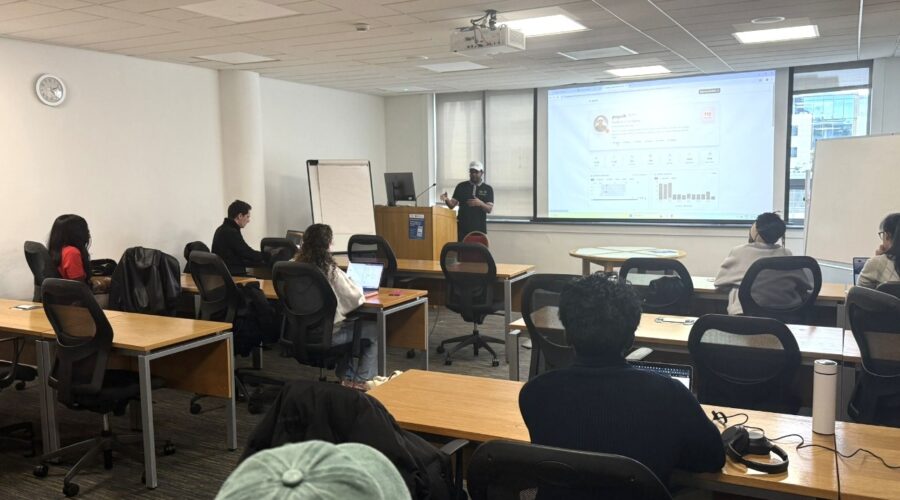
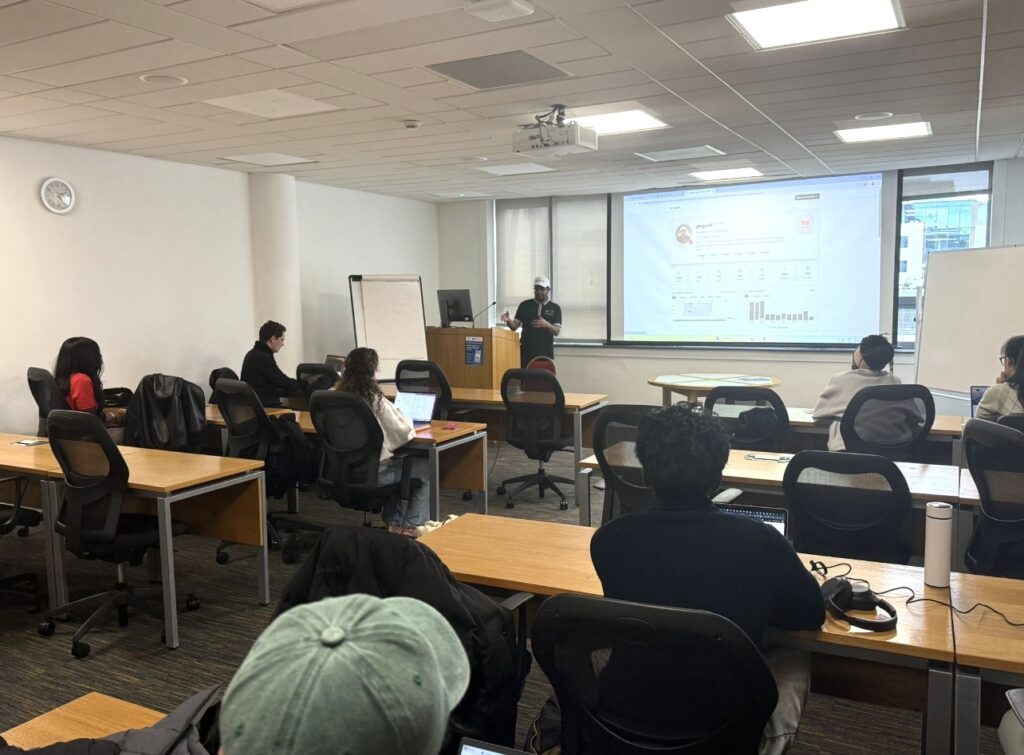
Today, I had the privilege of delivering a guest lecture at National College of Ireland (NCI) on Portfolio Management for placement and start-up incubations. Standing in front of students who are actively navigating the bridge between academic learning and professional reality, I was reminded exactly why we built Nap OS in the first place.
This opportunity happened because Professor Muslim Jameel, PhD—Associate Director of the JANUS Research Centre and a dedicated advocate for responsible AI and student success—shared his genuine passion for connecting students with practical, execution-focused career infrastructure. Professor Jameel’s commitment to bridging academic rigor with real-world application is exactly the mindset institutions need to prepare students for the employment and entrepreneurship challenges of 2026 and beyond. I’m deeply grateful for his trust and for the platform to share Nap OS with NCI’s community.
What struck me most wasn’t the lecture itself. It was the questions afterward. The conversations with students who wanted to understand how to build portfolios that actually mattered. The career changers asking how to convert scattered experience into verifiable credentials.
The aspiring founders wondering how to translate ideas into evidence of execution capability. Every question confirmed what we’ve been building Nap OS to address—and why more institutions need this conversation in their classrooms.
The Gap Between What Students Learn and What Employers Need
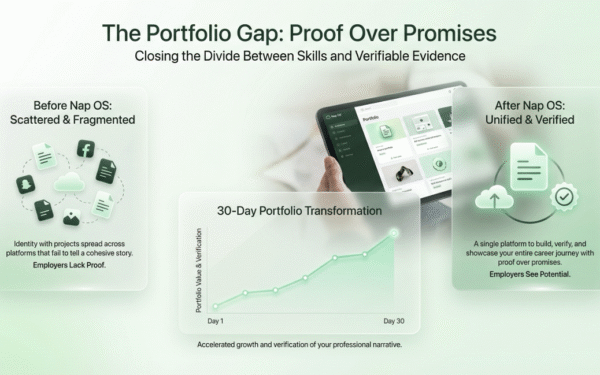
Every honest conversation with students reveals the same pattern: they’ve worked hard, learned valuable concepts, and completed meaningful coursework—but they struggle to translate that effort into something employers can actually evaluate. The portfolio sits in a folder. The projects exist on a laptop. The skills are claimed on a resume but can’t be verified by anyone.
This isn’t a failure of students. It’s a failure of the infrastructure around them. Traditional career services weren’t built for skills-based hiring. Academic transcripts weren’t designed to demonstrate capability. Resume templates can’t convey process, iteration, or real-world impact. Students are graduating with genuine capability that remains invisible to the employers who most need it.
During my NCI lecture, I walked students through how Nap OS approaches this problem. Not with another resume builder. Not with another job board. But with an execution-driven career operating system that converts real work into verifiable, industry-standard evidence. The reaction in the room told me everything I needed to know: students are hungry for this. They don’t need more theory. They need infrastructure that makes their actual work count.
What Portfolio Management Actually Means for Placements
Most students hear “portfolio” and think of a collection of finished projects. That’s the smallest, least valuable interpretation possible. Real portfolio management for placements is something much more sophisticated: strategic, progressive, measurable capability building that tells a coherent story about who you are as a professional.
During the lecture, I broke this down into concrete elements. First, portfolio strategy: understanding what types of projects actually signal capability for your target roles, rather than random collection of whatever you happened to work on. Second, portfolio progression: showing development over time rather than static snapshots, demonstrating learning velocity and skill evolution. Third, portfolio verification: connecting work to real data, GitHub commits, analytics metrics, deployment evidence—so claims become provable facts rather than marketing statements.
For placement purposes specifically, portfolio management needs to address a particular challenge: standing out among candidates who often have similar academic credentials. When dozens of students graduate with the same degree from the same institution, credentials alone don’t differentiate anyone. Portfolios do. But only if those portfolios demonstrate something employers actually evaluate—work quality, problem-solving approach, technical execution, measurable outcomes.
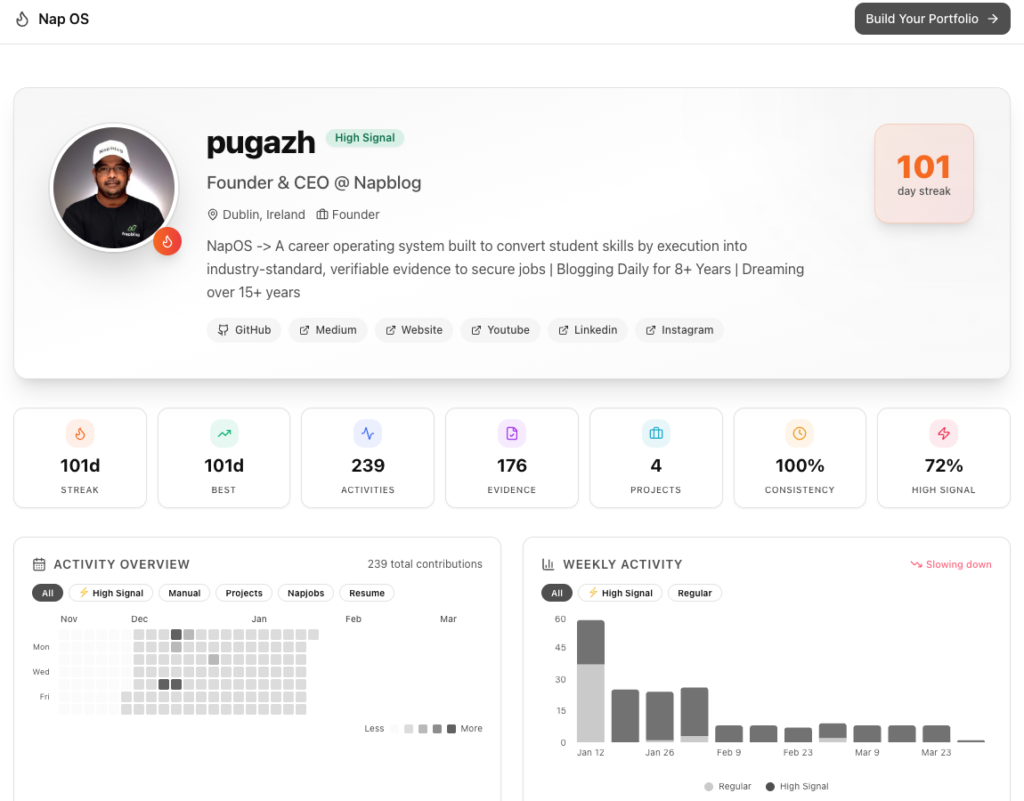
I shared examples from the 22+ Nap OS talents currently in verified roles. Students entering the workforce through Nap OS don’t compete on credentials—they compete on demonstrated capability. They walk into interviews with verified portfolios showing real deployed projects, analytics-backed impact metrics, and process documentation that proves they can actually do the work. The difference in interview outcomes is dramatic.
Start-up Incubation: Where Portfolio Management Becomes Critical
The second half of my NCI lecture focused on how portfolio management applies to start-up incubations—and here’s where the stakes get even higher. For placement candidates, a weak portfolio means missing job opportunities. For aspiring founders, a weak portfolio means missing funding, missing co-founders, missing early customers, missing everything that could make the difference between a business that launches and one that stays permanently hypothetical.
Investors don’t fund ideas. They fund evidence of execution. Customers don’t buy from people who claim capability. They buy from people who demonstrate it. Co-founders don’t join based on vision alone. They join based on proof that you can actually build things. In every dimension of startup success, portfolio management—the strategic documentation and verification of execution capability—determines outcomes.
I walked students through how Nap OS supports founders specifically. The execution scoring framework measures real progress against standardized criteria. The process documentation captures iteration and learning, which investors recognize as signals of founder capability. The verified metrics provide credible evidence of traction when most founders are still struggling to prove anything worked.
The student founders in the room asked sharp questions. How do you demonstrate execution when your product isn’t launched yet? How do you prove capability when you haven’t had paying customers? How do you show investor-grade evidence when you’re still in the idea-validation phase? These are exactly the questions Nap OS was designed to answer, and watching students engage with that framework gave me real hope about the next generation of Irish entrepreneurs.
Why Institutional Partnerships Matter
Guest lectures are valuable, but they’re fundamentally limited. An hour with students can open minds and plant seeds, but it can’t build the infrastructure those students need to actually succeed. For Nap OS to deliver on its promise of transforming student outcomes in employment and entrepreneurship, we need deeper institutional partnerships.
This is my open invitation to universities, colleges, and incubation centers across Ireland and beyond: let’s build programs together that deliver measurable student success. Not abstract career advice. Not generic workshops. But execution-driven, portfolio-building, evidence-based programs that graduate students into verified roles and funded startups.
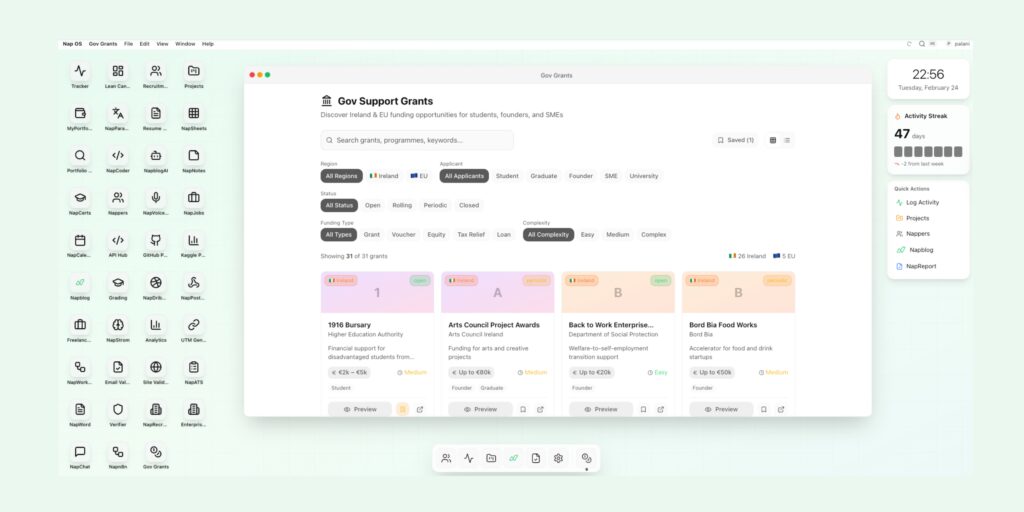
What I’m proposing isn’t hypothetical. Napblog Limited has spent 18+ months building and testing Nap OS with 100+ contributors globally. The 1,000-point execution scoring framework exists. The verified portfolio infrastructure exists. The AI assistant trained on real student execution data exists. The recruitment CRM exists. The 7-stage Career Accelerator program exists. Everything is ready for institutional deployment.
What we need is institutional commitment. Partner with us to run structured programs using Nap OS infrastructure. Integrate portfolio management into your curriculum using evidence-based frameworks. Give your students access to career acceleration tools that actually work in skills-based hiring markets. Let us help you demonstrate measurable graduate outcomes in an era when students and parents increasingly demand ROI proof from educational institutions.
The Programs I Want to Run with Institutions
Let me be specific about the types of programs I’m hoping to deliver across more institutions, because specificity matters when you’re inviting collaboration.
Portfolio Management Masterclasses: Multi-session workshops where students learn strategic portfolio building, not just project collection. Students leave with actual verified portfolios, not theoretical understanding. Measured outcome: every participant has a live, verified portfolio ready for employer evaluation within four weeks.
Career Accelerator Cohorts: The full 7-stage Nap OS Career Accelerator program delivered to institutional cohorts. Students progress through access and clarity, situational context, experience mapping, cross-domain learning, skills and portfolio building, interview preparation, and employment clearance. Measured outcome: placement rates for participating cohorts, time-to-offer metrics, verified role quality assessments.
Start-up Incubation Programs: Execution-driven incubation using Nap OS infrastructure to support student founders through systematic portfolio building, traction documentation, and investor-ready evidence development. Measured outcome: startup formation rates, funding secured, customer acquisition, and demonstrated execution milestones.
Faculty Development Sessions: Workshops for academic staff on how to integrate portfolio management, verified execution, and skills-based hiring concepts into existing curricula. Measured outcome: curriculum updates, new assessment methodologies, and improved graduate employability metrics.
Industry Connection Events: Curated meetings between Nap OS talent pool (with verified portfolios) and recruiting companies. This solves a real problem for both sides—companies get pre-verified candidates, students get direct access to opportunities that match their demonstrated capabilities. Measured outcome: placement rates, time-to-hire, employer satisfaction with candidate quality.
The Organic and Direct Marketing Philosophy
I want to be transparent about how Napblog Limited approaches growth, because it matters for institutional partners considering collaboration. We don’t do aggressive advertising. We don’t buy student leads. We don’t run generic marketing campaigns designed to capture anyone who clicks.
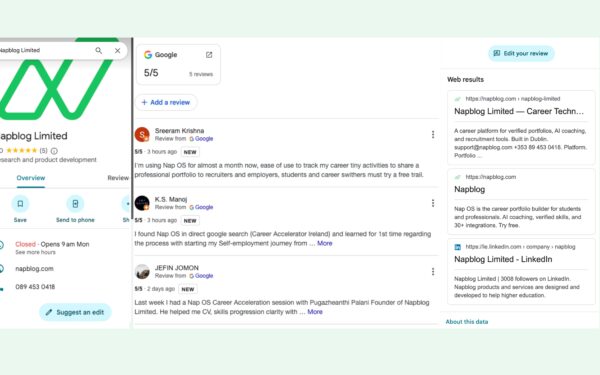
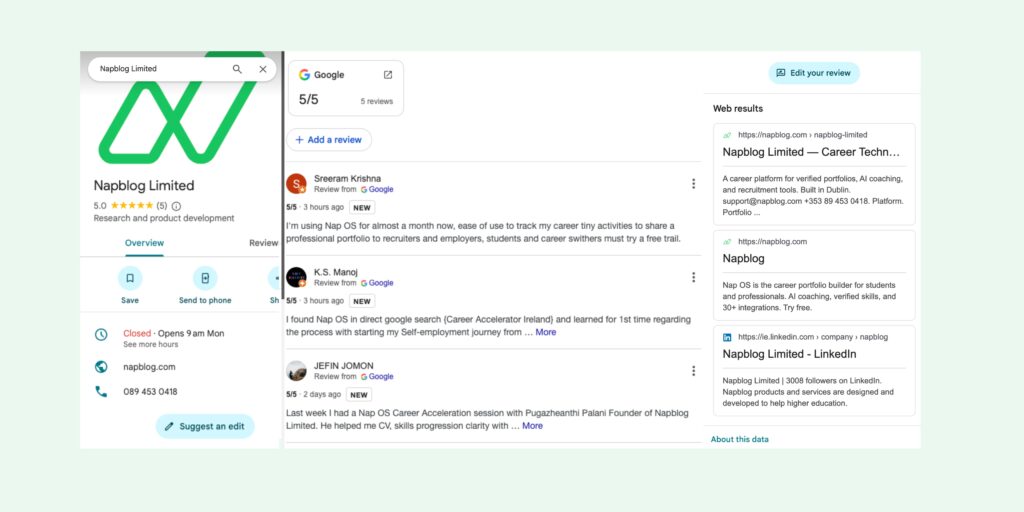
Our entire approach is built on organic growth and direct marketing—reaching students through value-first engagement. Guest lectures like the one at NCI. Published research and insights (1,000+ pieces publicly validated). Newsletter content that actually helps career navigators. Google reviews from real students with verifiable outcomes. Direct conversations with people who need what we’ve built.
This philosophy isn’t just marketing strategy—it’s product strategy. Nap OS only works when users genuinely commit to execution. We don’t want students who were pressured into signing up. We want students who understood the value, chose to engage, and showed up with the motivation required for real portfolio building. The organic acquisition model self-selects for this.

For institutional partners, this means something important: partnerships with Nap OS aren’t transactional customer acquisition plays. They’re value-delivery collaborations focused on student success. We measure ourselves on outcomes—verified placements, funded startups, measurable skill development—not enrollment numbers. When we partner with an institution, both sides have skin in the game for actual student success.
Why Ireland, Why Now
Napblog Limited is headquartered in Dublin, and Ireland occupies a unique position that makes it the ideal proving ground for Nap OS as an institutional solution. Ireland hosts major European operations for nearly every significant tech company. It’s home to some of Europe’s most ambitious universities and colleges. It attracts international students from across the globe who face the specific challenge of translating foreign experience into local opportunities.
The Irish context creates exactly the conditions where Nap OS delivers maximum value. Students here need to compete in one of the most sophisticated job markets in Europe. They need to demonstrate capability rapidly to employers who have global talent pipelines. They need portfolio infrastructure that bridges local and international opportunities. They need career acceleration frameworks that work for immigrants, career changers, and freshers alike.
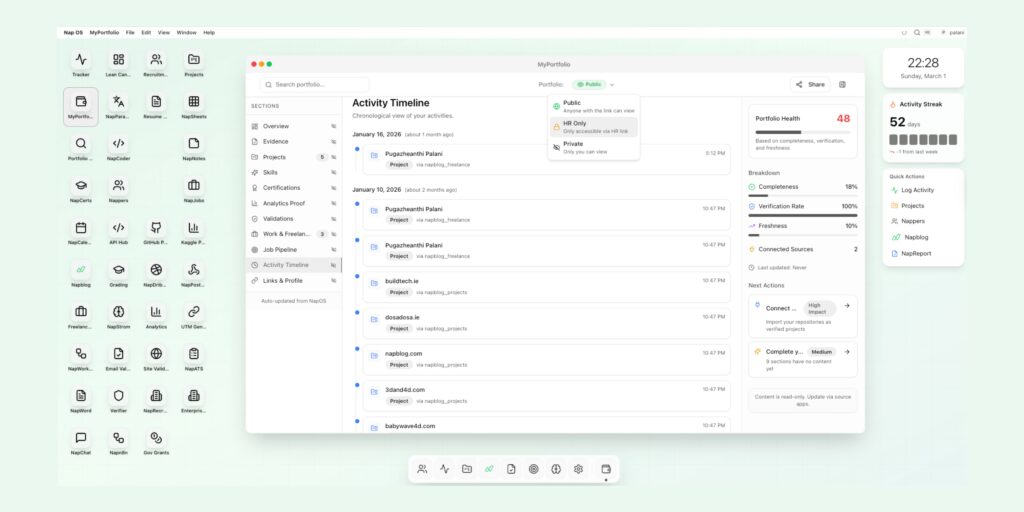
We’ve already proven this model with 22+ talents placed in verified roles at companies like ServiceNow, Accenture, Amazon, Eir, ESB, Energia, and others. These aren’t hypothetical success stories. They’re real students who went through Nap OS programs and secured real positions at recognizable employers. The infrastructure works. The framework works. The results are measurable.
But 22+ placements is just the beginning. With institutional partnerships, that number scales dramatically. Imagine if every third-year student at a partner institution completed the Nap OS Career Accelerator before graduation. Imagine if every student founder in an incubator used Nap OS infrastructure to document execution. Imagine if every placement office integrated verified portfolios into their graduate support systems. The compound effect on student outcomes would be transformational.
A Direct Invitation
If you’re reading this as a faculty member, career services professional, incubation program manager, or institutional leader, I’m directly inviting you to have a conversation with me about what Nap OS could deliver for your students.
I’m not asking for commitment. I’m asking for a conversation. Thirty minutes to walk through your specific institutional context, understand what challenges your students face, and explore whether a Nap OS-powered program could address those challenges. If there’s a fit, we can design collaboration specific to your needs. If there’s not, you’ll still walk away with fresh perspectives on portfolio management, skills-based hiring, and student success infrastructure.
What I’m most interested in is institutions ready to move beyond abstract career advice into concrete outcome delivery. Universities tired of measuring success through enrollment numbers who want to measure it through graduate outcomes. Colleges frustrated with generic placement support who want specialized execution-focused programs. Incubators ready to equip student founders with real evidence-of-execution infrastructure rather than just mentorship sessions.
Professor Muslim Jameel took a chance on bringing Nap OS to NCI because he saw something valuable for his students. I’m asking more academic leaders to take similar chances. The students need this. The infrastructure exists. The results are proven. What’s missing is the institutional commitment to deliver these programs at scale.
What Happens Next
My goal over the coming months is to deliver more guest lectures, more workshops, more institutional programs across Ireland and beyond. The NCI lecture was a beginning, not an endpoint. I want to build on that momentum with universities and colleges ready to engage seriously with student outcomes.
If you’re interested in exploring a potential collaboration—guest lecture, workshop, full program integration, or institutional deployment—please reach out directly. You can contact me through Napblog Limited at palani@napblog.com or through my LinkedIn profile. Every conversation starts with understanding your context, so please share what student success challenges your institution is trying to solve.
To the students at NCI who attended my lecture and asked such thoughtful questions: thank you for your engagement and energy. You reminded me why this work matters. To Professor Muslim Jameel: thank you for the opportunity and for your continued advocacy for student-focused innovation. To faculty and administrators at institutions considering similar collaborations: I’m ready when you are.
The career landscape is shifting rapidly. Traditional credentials are losing ground to verified execution. Skills-based hiring is replacing degree-based gatekeeping.
Students who graduate with portfolios that prove themselves will thrive, while those who rely solely on academic credentials will struggle. The question for institutions is simple: will you prepare your students for this new reality, or will you leave them to figure it out alone after graduation?
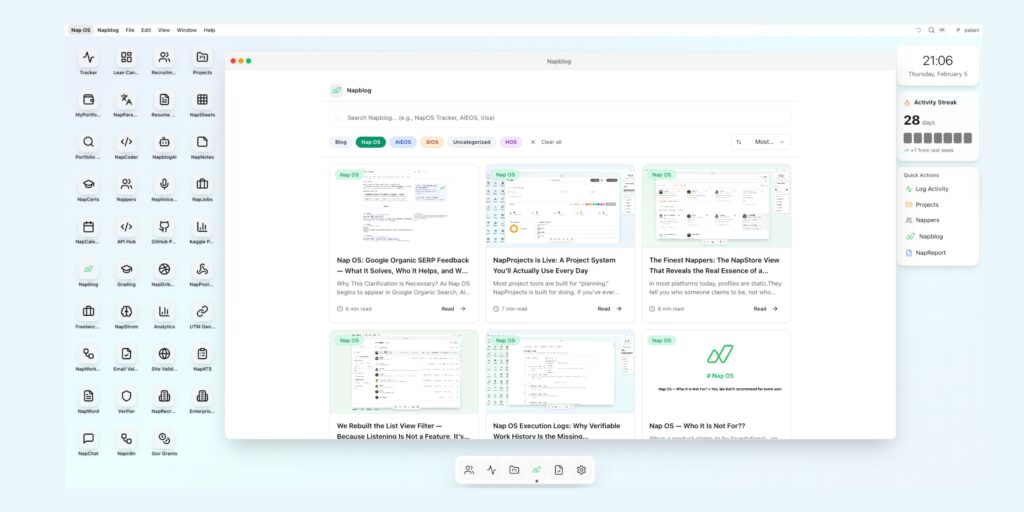
Nap OS was built to make preparation possible. My commitment is to bring this infrastructure to as many students as possible through partnerships with institutions genuinely invested in graduate success. The NCI guest lecture was one step in that direction. I’m ready for the next one—and the one after that, and the one after that, until every student who needs this has access to it.
This is how we deliver real student success in employment and entrepreneurship. Not through more generic advice. Not through more motivational speeches. But through execution-driven infrastructure, verified portfolios, and institutional commitment to measurable outcomes. If your institution is ready to be part of this, let’s talk.
— Pugazheanthi Palani Founder & CEO, Napblog Limited Creator of Nap OS — The Career Accelerator & Recruitment Operating System palani@napblog.com | napblog.com | Dublin, Ireland