Last updated: March 9, 2026
4 min read
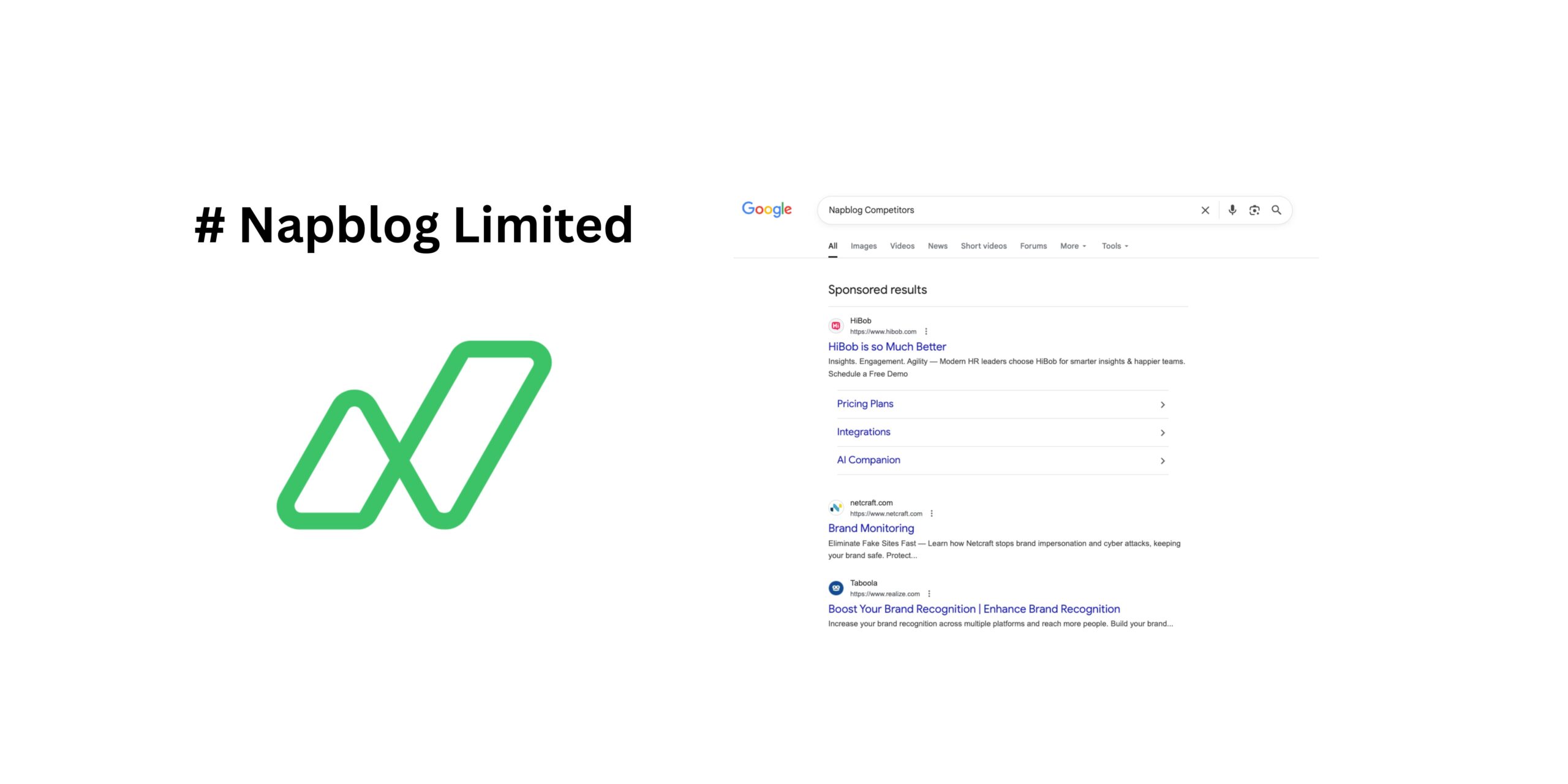
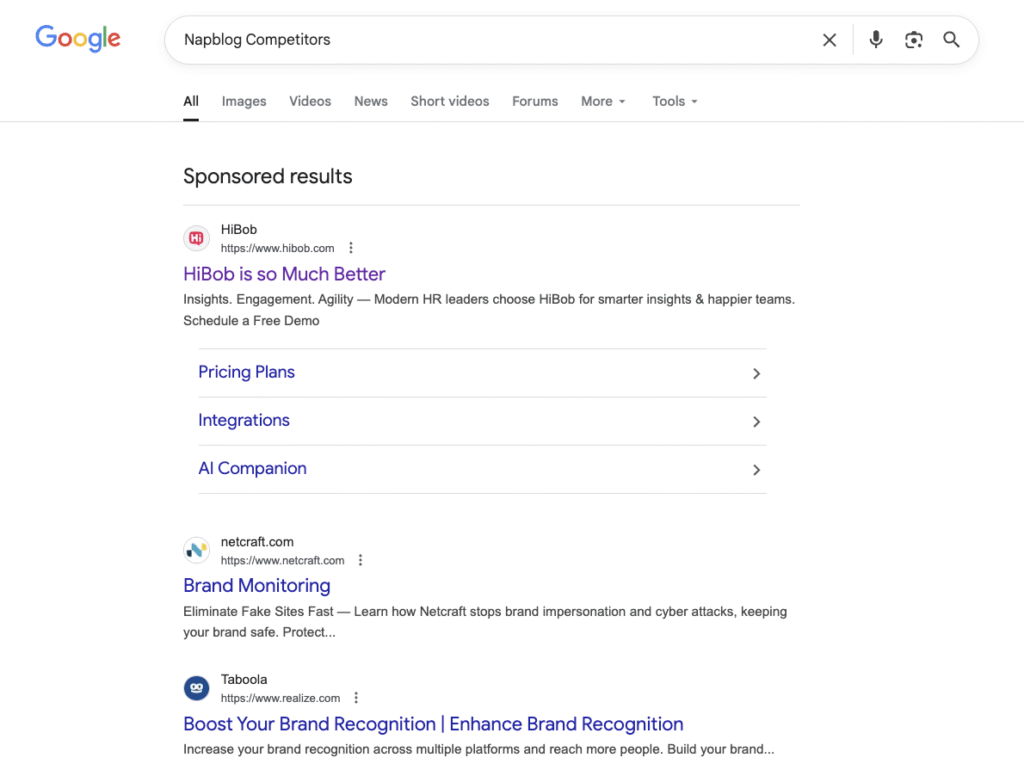
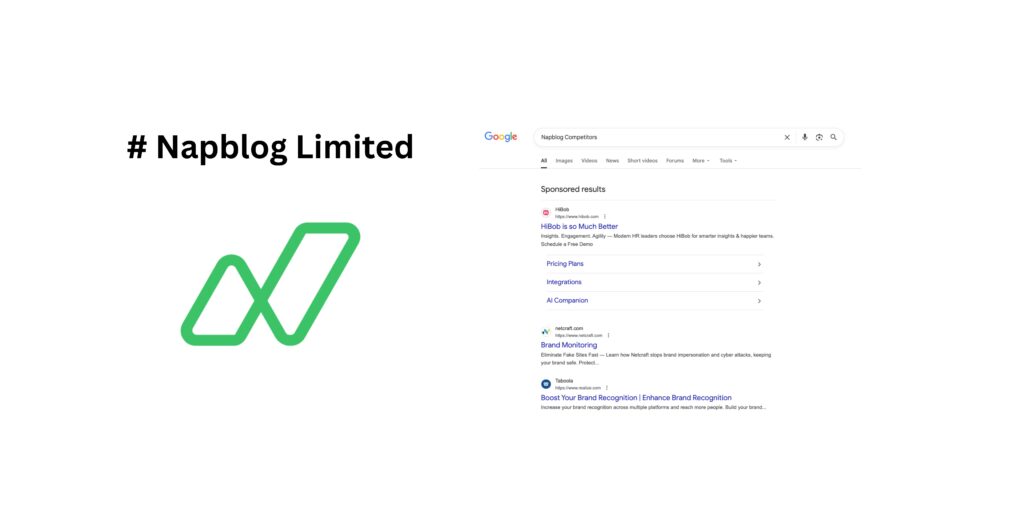
When you search for Napblog competitors or related terms on Google, you may notice sponsored results from platforms that appear, at first glance, unrelated to Napblog’s core mission. One such example is HiBob, a modern HR software platform that frequently appears in sponsored listings.
This article explains why that happens, what it means, and why it’s not a problem—nor a threat to Napblog Limited or its long-term vision.
This is not a takedown.
This is not a comparison war.
This is a clarity piece.
Understanding Google Ads: Intent, Not Identity
Google Ads does not work on brand loyalty.
It works on search intent.
When someone types a query like:
- “Napblog competitors”
- “NapOS alternatives”
- “Career OS platforms”
- “Work execution platforms”
Google interprets this as commercial investigation intent, not brand allegiance.
That tells advertisers:
“This user is exploring solutions, not defending one.”
As a result, platforms operating in adjacent problem spaces—HR, productivity, workforce systems, talent management—can appear, even if they do not directly compete with Napblog.
This is how the ad auction is designed.
Why Platforms Like HiBob Appear
Let’s be precise.
HiBob is positioned as:
- An HR management platform
- Built for scaling companies
- Focused on employee lifecycle, analytics, and engagement
Napblog, by contrast, is building:
- An execution-first career operating system
- Focused on individual proof of work
- Designed for students, job seekers, and early professionals
- Anchored around portfolio, attribution, and real output
These are different layers of the ecosystem.
However, Google Ads does not fully understand philosophical differences. It understands:
- Keywords
- Click-through probability
- Bid competitiveness
If a company bids on:
- “career platform”
- “work system”
- “people operations”
- “productivity software”
It may appear next to Napblog-related searches.
That’s not competition.
That’s overlapping vocabulary.
The Important Distinction: Platform Layer vs Operating Layer
One helpful way to understand this is to think in layers.
HiBob and Similar Platforms Operate at the Organization Layer
They answer questions like:
- How do we manage employees?
- How do we track performance?
- How do we centralize HR data?
- How do we scale people operations?
They are company-centric systems.
Napblog Operates at the Individual Execution Layer
Napblog answers different questions:
- What proof can I show for my skills?
- How do I execute consistently?
- How do I build trust before credentials?
- How do I convert learning into outcomes?
Napblog is person-centric, not organization-centric.
That distinction matters.
Why Google Still Groups Them Together
Because Google Ads works on intent clusters, not mission statements.
If someone searches:
“career execution system”
Google may associate:
- HR software
- Talent platforms
- Workforce tools
- Productivity suites
From Google’s perspective, they all live in the same commercial neighborhood, even if they are on different streets.
This is why seeing competitor ads does not mean Napblog is being targeted unfairly.
It means Napblog is being recognized as commercially relevant.
That is actually a signal of progress.
Sponsored Results Are Not Search Results
It’s critical to separate two things:
- Organic search results → relevance, authority, content
- Sponsored ads → bidding strategy, keyword economics
Sponsored listings:
- Do not imply endorsement
- Do not imply superiority
- Do not define category ownership
They simply indicate:
“This company paid to be visible for this query.”
That’s all.
Why Napblog Does Not Need to Imitate This Strategy
Napblog’s growth thesis is different.
Napblog is not built to:
- Capture generic HR demand
- Replace enterprise platforms
- Compete on feature breadth
Napblog is built to:
- Create execution streaks
- Build public proof
- Establish longitudinal trust
- Turn work into verifiable signals
That kind of adoption is driven by:
- Community
- Proof visibility
- Consistency loops
- Reputation systems
Not ad saturation.
A Note on “Competitor” as a Word
The word competitor is often misleading.
In reality:
- Most platforms compete for attention, not users
- Many tools coexist in the same workflow
- A student could use NapOS and later join a company using HiBob
That is not conflict.
That is ecosystem layering.
Napblog does not need others to fail to succeed.
Why This Is Actually a Healthy Signal for Napblog
If Napblog were invisible, no ads would appear around it.
The fact that:
- Google recognizes Napblog-related searches as commercial
- Other platforms bid on adjacent intent
- Users explore “Napblog competitors”
Means one thing:
Napblog is entering the consideration phase of the market.
That is a necessary step before category creation.
The Long Game: Category Creation vs Keyword Capture
Many companies fight for keywords.
Napblog is building for category creation.
That means:
- Redefining what a “career platform” means
- Moving from resumes to execution logs
- Shifting from credentials to proof
- Replacing passive profiles with active systems
When a category is new, Google struggles to classify it.
That’s normal.
Every new category goes through this phase.
What Users Should Do When They See These Ads
If you’re exploring Napblog and see sponsored ads from other platforms:
- Use them as context, not comparison
- Ask: What problem am I actually trying to solve?
- Decide whether you need:
- Company-level HR tooling
- Or individual-level execution proof
They are different needs.
Napblog’s Position Remains Clear
Napblog is not trying to be:
- An HR department
- A payroll system
- A corporate analytics dashboard
Napblog is building:
- A The Career Accelerator
- For people who want to show, not tell
- For those who want proof before permission
That clarity matters more than ad placements.
Final Thought: Ads Are Noise, Systems Are Signal
Google Ads come and go.
Bids change.
Budgets shift.
Campaigns pause.
What remains is:
- Product clarity
- User outcomes
- Trust built over time
Napblog is focused on the signal.
Everything else is background noise.
Napblog Limited
Building systems for execution, not impressions.
Competitor ads are common in digital marketing but organic growth wins long term. Follow Napblog on LinkedIn.