6 min read
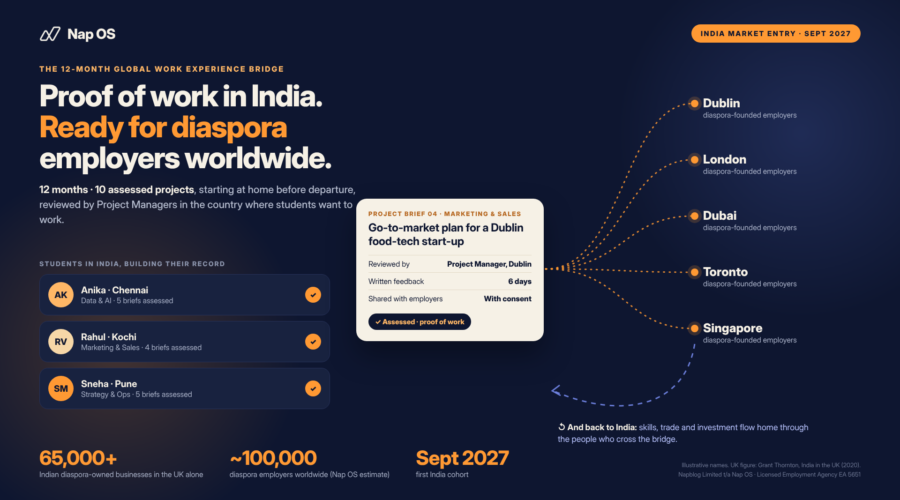
Every year, hundreds of thousands of Indian students borrow heavily to study abroad, then land in a job market that asks for local work experience they have no way to get. At the same time, tens of thousands of businesses built by the Indian diaspora in Ireland, the UK and beyond are looking for capable graduates. Nap OS is building the bridge between the two: a 12-month programme that starts in India, five months before a student flies, and ends with a record of real, assessed work that employers can hire from.
This article explains the opportunity, how the bridge works, and how Indian universities and institutions can join us as we enter India.
Contents
- The far end of the bridge: around 100,000 diaspora employers
- Why India, why now
- How the 12 months work
- How Indian universities and institutions plug in
- What we don’t claim
- Join the first cohort
- Sources
1. The far end of the bridge: around 100,000 diaspora employers
In the UK alone, Grant Thornton’s research for the High Commission of India estimated more than 65,000 Indian diaspora-owned businesses. The 654 largest of them, each with turnover above £100,000, employed just over 174,000 people and generated £36.84 billion in combined revenue. Separately, Grant Thornton’s 2025 India meets Britain tracker counted 1,197 Indian-owned companies in the UK, employing 126,720 people.
Add the diaspora-founded businesses in Ireland, the Gulf, Europe and North America, and we estimate the reachable pool at around 100,000 established employers. That figure is our estimate, not an official count, and we will refine it as we map each market.
Why start with these employers? Many of their founders made the same journey our students are about to make. They know what an Indian degree means, they understand the family behind a student loan, and they often run fast-growing businesses short of people who can do the work from day one. Many also trade with India, which means a graduate they hire in Dublin or London can later carry that business back home.
That is how a work-experience bridge feeds the Indian economy, not just the destination country: skills, contacts and trade flow back through the people who cross it.
One principle stays fixed. Every employer we work with hires on merit and on the work in front of them, open to every candidate. Diaspora employers are where we start the conversation, not a closed club.
2. Why India, why now
The students are already moving, the risks for them are rising, and degrees alone are no longer enough.
- The flow is large and growing. India is Ireland’s largest source of international students: 9,175 were enrolled in Irish higher education in 2024/25, up 30% in a year. The UK issued more than 95,000 study visas to Indian nationals in 2025.
- The stakes are rising. Irish study visa refusals reached 64% in the first five months of 2026, up from 22% in 2023. Families are asking harder questions before they borrow.
- The degree is not the proof. Mercer-Mettl’s India Graduate Skill Index 2025 rated 42.6% of Indian graduates as employable. Employers abroad know this, and filter for local experience instead.
- The clock is short. A one-year master’s in Ireland typically costs €30,000 to €40,000 with living costs, mostly borrowed. To stay and work, a graduate then needs a job that meets the employment-permit salary floor, from €34,009 in Ireland.
Put together, an Indian student today carries more debt, more uncertainty and less time than ever. What they lack is not ambition or intelligence. It is evidence: work that someone in their target market has examined and is willing to stand behind.
3. How the 12 months work
The bridge starts in India, crosses with the student, and stays open after graduation.
| When | Where | What happens |
|---|---|---|
| Months 1–5 | At home in India | Onboarding, a briefing on which sectors are hiring in the destination, a career plan, and five assessed project briefs |
| Month 6 | Arrival | Induction in Ireland or the UK, alongside the start of study |
| Months 7–11 | In the destination | Five more briefs or an industry project, and mock interviews built on the student’s own work |
| Month 12 | Final review | A complete record of assessed work |
| After graduation | Anywhere | Every project stays in Nap OS as proof of work for project-based hiring |
Each brief is set in one of five domains: Startup and Entrepreneurship, Strategy and Operations, Marketing and Sales, Product and Research, or Data and AI. A named Project Manager working in the destination market reviews every submission in writing within seven days, against criteria published in advance.
The result is not a certificate. It is a portfolio of real work, judged by someone who knows what employers in that country expect. A diaspora founder in Dublin can open it and see what the student can do before the first interview.
If a visa is refused, the student can continue the programme remotely, switch destination, pause, or take a refund for the part not yet delivered. The work they have already done stays theirs.
4. How Indian universities and institutions plug in
We are entering India through the institutions students already trust, and we are inviting the first partners now.
The bridge needs strong foundations on the Indian side. Students first hear about studying abroad from their university, a training institute, a study-abroad adviser or an education lender. Those are the moments where Nap OS can start the conversation about work, not just admission.
| Partner | What they gain | What we ask |
|---|---|---|
| Universities and colleges | Employability evidence for outgoing students and better outcomes to report | Introduce the programme to final-year and postgraduate students |
| Training institutes and academies | Real project briefs reviewed by practitioners abroad | Host sessions and bootcamps on campus |
| Education lenders | A career-led conversation at loan counselling, and borrowers better prepared to repay | Offer the programme as an optional complement to the loan |
| Study-abroad advisers | A stronger answer to “what happens after the degree?” | Refer students who want work experience before they fly |
Our track record so far is in Europe. We have delivered a 30-credit capstone for University College Dublin’s MSc in Communication and Media, and hosted a credit-bearing MSc placement for Grenoble École de Management. In India we are in conversation with institutions and an education lender about pilots for the September 2027 intake; we will name partners when agreements are signed.
The same model works for students who stay in India. A reviewed record of real work is valued by employers at home too, and diaspora businesses that trade with India are often hiring on both sides.
5. What we don’t claim
Trust is the whole point of a bridge, so here are its limits.
- No guaranteed job. Fees cover project briefs, Project Manager review and career support, not recruitment or job placement. Employment is not guaranteed, and no student is ever charged to apply for or be interviewed for a role.
- No immigration advice. We cannot influence a visa decision. Our refund and remote options exist because refusals happen.
- Not an accredited award. Academic credit stays with the university.
- Licensed in Ireland. Napblog Limited holds Irish employment agency licence EA 5651. In the UK we will offer assessment only until we have the right legal route or a licensed partner in place.
- Estimates are labelled. The figure of around 100,000 diaspora employers is our estimate, built on published UK research; we will update it as we map each market.
6. Join the first cohort
The first India cohort starts its home phase in April 2027, ahead of the September 2027 intake.
- Universities, colleges and institutes in India: talk to us about bringing the programme to your outgoing students, or hosting a Students × Project Manager bootcamp on campus.
- Diaspora founders and employers: tell us what you are hiring for. Review a student’s record, set a brief, or join our Project Manager network.
- Students with an offer for September 2027: apply at napblog.com and start building your record before you fly.
I came to Ireland from India on an education loan, and I know how much a family puts on the table when a child leaves to study. Nap OS exists so the next student arrives with more than a degree.
Pugazheanthi Palani, Founder & CEO, Nap OS palani@napblog.com · +353 89 453 0418
Napblog Limited t/a Nap OS · CRO 812006 · Licensed Employment Agency EA 5651 · Dublin
Sources
- Grant Thornton, India in the UK: the diaspora effect (Feb 2020): 65,000+ diaspora-owned businesses; 654 with turnover above £100,000, employing 174,000+
- Consultancy.uk on Grant Thornton’s India meets Britain tracker (June 2025): 1,197 Indian-owned companies, 126,720 employees
- Business Today: Indians top UK visas in 2025
- Indian enrolments in Ireland 2024/25: ApplyBoard data reported by The PIE News, January 2026
- Irish study visa refusals: Department of Justice figures in a parliamentary answer, reported by the Irish Examiner, June 2026
- Mercer-Mettl, India Graduate Skill Index 2025
- Diaspora employer estimate and per-student costs: Nap OS estimates