4 min read
By Pugazheanthi Palani, Founder & CEO, Napblog Limited (trading as Nap OS)
1. The Paradox of “Degree Inflation” in the World’s Youngest Nation
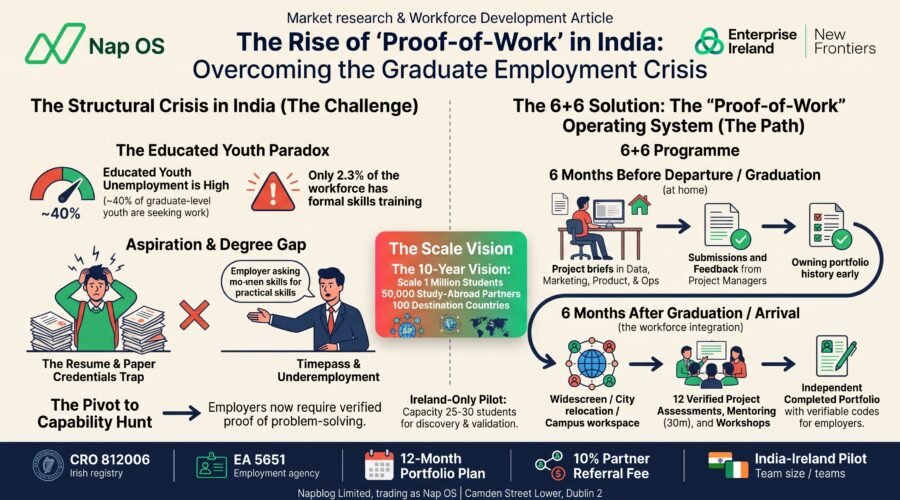
India is home to the largest youth and working-age population on earth, with over 65% of its 1.4 billion people under the age of 35. This demographic dividend is widely hailed as the country’s ultimate competitive advantage. Yet, beneath the macroeconomic optimism lies a stark, structural challenge: educated youth unemployment.
Recent data reveals a troubling paradox—the higher an individual climbs on the academic ladder, the more likely they are to experience prolonged periods of unemployment. Graduating from a university, once a guaranteed ticket to social mobility, has increasingly become a bottleneck of unverified credentials. Over-education, “degree inflation,” and the intense focus on competitive exams have created a holding pattern where millions of ambitious, educated youth struggle to find productive roles, often falling into the trap of insecure or informal underemployment.
This isn’t a problem of talent; it is a mismatch in verification. In a fast-evolving global and domestic market, a certificate alone no longer proves readiness. Employers, from local startups to global enterprises, are increasingly bypassing resume screening in favor of practical capability. They are actively hunting for people who can solve problems from day one.
The result is a silent, massive transition: The Billion-Person search for “Proof-of-Work.”
2. Why a Billion People Need a Workforce Operating System
Traditional hiring and education models in India were built for a different era—one that valued standardized testing over project delivery. But the 21st-century economy is skills-first, project-based, and increasingly digitized.
India’s youth, micro-entrepreneurs, and gig workers (set to reach 23.5 million by 2030) are beginning to realize that the only true currency in the modern job market is demonstrable, reviewable output. “Proof-of-Work”—building, revising, and pointing to real projects—is replacing the paper CV.
To bridge this massive scale, India requires more than just traditional skilling schemes. It requires a decentralized, structured “Operating System” for workforce development:
- The Transition: From memorized theory to continuous project execution.
- The Need: A repeatable lifecycle of receiving briefs, submitting independent work, receiving structured review, revising, and owning a verifiable digital record.
- The Deliverable: A living, checkable portfolio that is legally independent of any one institution, verifying actual competency for employers and investors alike.
3. Nap OS’s Ambition: Scaling the Infrastructure of “Prove-It”
Our long-term, 10-year scale ambition is to support this historic transition by reaching one million students annually through a global network of 50,000 education, training, and study-abroad partners spanning 100 destination countries.
This scale cannot be built on marketing promises. It must be proven on the ground, starting small with rigorously monitored pilots.
Our initial “6+6 Programme” is designed specifically to capture and document student outputs before they exit education or migrate for further studies, splitting the journey into two practical blocks:
- Months 1–6 (Preparation at Home): Students in India use their waiting and transitional hours to execute simulated professional tasks in Data & AI, Marketing, Product, and Strategy. Every submission is read and judged by experienced, industry-tested Project Managers, training students to explain assumptions, manage deadlines, and build portfolio history before graduation or relocation.
- Months 7–12 (Support and Portfolio Expansion): Developing these skills alongside academic workloads, adding to a verifiable, employer-checkable digital record that holds reviewed work—dated and authenticated under Nap OS’s licensed framework.
This does not guarantee employment—no legal entity can or should sell placement promises. Instead, it converts potential into structured evidence.
4. Moving Beyond the Credentials Trap
The transition from credential verification to “capability hunting” is not a temporary trend; it is a permanent shift in how human capital is valued.
For the Indian youth and its burgeoning workforce, having a practical “Proof-of-Work” system isn’t just about applying for jobs—it is also about entrepreneurship. Small and medium enterprises (MSMEs) and startups need founders and early employees who have already validated their problem-solving ability in the real world.
Nap OS proposes to partner with forward-thinking education consultancies and training organizations across India (from hubs like Kochi, Hyderabad, and Thiruvananthapuram to Lagos and beyond) to embed this Layer-2 of career readiness directly into existing curricula and study journeys.
We would rather be checked than believed. As the market demands transparent, evidence-based workforce development, we invite partners to step beyond the credentials trap and start building proof.
For partnership inquiries, pilot discovery, and service mapping, contact Pugazheanthi Palani at palani@napblog.com.