6 min read
The Nap OS perspective on AI co-workers, editable candidate data and the evidence employers need before making hiring decisions.
LinkedIn can help employers discover people, build relationships and start professional conversations. But when an AI co-worker assesses a candidate using profile information, employers must ask a separate question:
Which claims have actually been verified?
At Nap OS, we believe trust in hiring must extend beyond a platform’s reputation. It needs to reach the candidate’s contribution, the evidence behind their experience and the employer’s genuine intention to hire.
An AI assistant can process information quickly. That speed becomes useful when the information is credible and its limitations remain visible.
When self-attested claims become automated hiring recommendations without verification, uncertainty can acquire the appearance of authority.
The numbers need the same scrutiny as candidates
Before discussing manipulated hiring data, we must avoid repeating misleading statistics ourselves.
Several figures circulating online describe different things: blocked accounts, suspected inactive vacancies, survey responses and predictions. They cannot be combined into a single percentage of “fake LinkedIn data.”
| Figure | What the evidence supports | What it does not establish |
|---|---|---|
| 80.6 million accounts | Rest of World reported that LinkedIn stopped this number of fake accounts at registration during July–December 2024, citing its transparency report. | That 80.6 million fake profiles remained active or entered recruiters’ shortlists. |
| 27.4% of US listings | ResumeUp.AI classified this share of listings in its analysis as likely ghost jobs, using indicators including postings older than 30 days without evidence of active hiring. | Confirmed fraudulent intent for every flagged vacancy, or a worldwide LinkedIn rate. |
| 25% of candidate profiles by 2028 | Gartner published a forecast that one in four candidate profiles worldwide would be fake by 2028. | A measured current percentage of fake LinkedIn candidates. |
Sources: Rest of World’s reporting, ResumeUp.AI’s original analysis and Gartner’s July 2025 release.
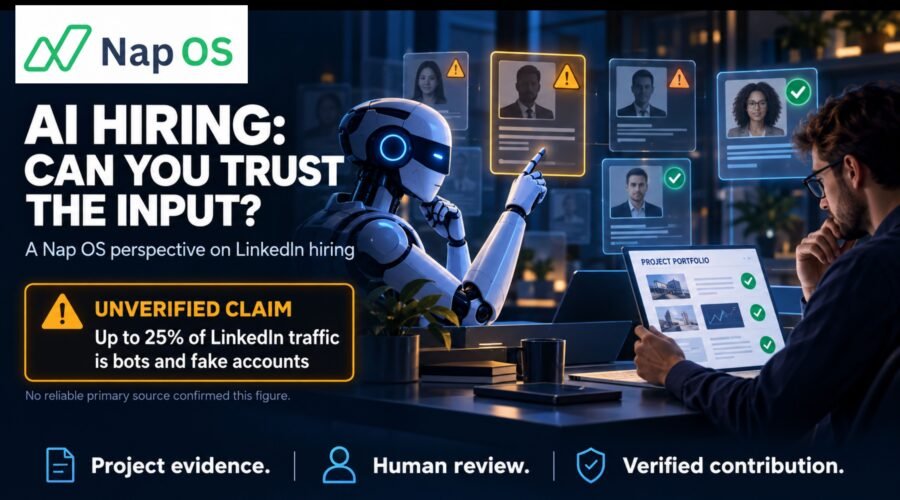
We could not substantiate the separate claim that 25% of LinkedIn traffic consists of bots and fake accounts from a reliable primary source. It should not be presented as an established fact.
These distinctions matter. A blocked registration demonstrates defensive action. A suspected ghost job is an estimate. A forecast describes a possible future.
Nap OS’s caution is about the quality of evidence entering a hiring decision—not an unsupported claim that a fixed percentage of LinkedIn is fraudulent.
Self-attested experience can change faster than it can be checked
A candidate should be able to update their profile as their career develops. Editing a profile is normal.
However, the ability to change a description does not establish the accuracy of the new version.
Consider a hypothetical example. Someone initially describes themselves as supporting an automation project. Later, the wording becomes “led AI transformation,” accompanied by an impressive performance metric.
An AI hiring assistant may receive only the latest description. Without supporting records, it cannot establish whether the candidate led the work, contributed to it or accurately reported the outcome.
The employer needs to distinguish between:
- What the candidate claims.
- What evidence supports the claim.
- What a reviewer has checked.
- What remains uncertain.
That distinction protects honest candidates as well as employers.
How an AI hiring assessment can become contaminated
Here, “contaminated” means an assessment has been influenced by inaccurate, manipulated or improperly trusted information. It does not mean every AI recruiting product is compromised.
One possible route is straightforward: fabricated experience enters the assessment as candidate information. If the assistant produces a confident summary without identifying the source as self-reported, the recruiter may place too much confidence in it.
Another route involves presentation. A fabricated profile could contain precisely the language an employer is seeking. If screening rewards textual alignment without checking contribution, a convincing description may receive more weight than the underlying ability deserves.
These are risks arising from the assessment design. They do not prove that every polished profile is false or that AI-assisted writing is dishonest.
A candidate can use AI to communicate real experience accurately. The important question is whether the resulting claims remain truthful.
Prompt injection adds a different risk
Some manipulation targets the AI system itself.
OWASP describes indirect prompt injection scenarios in which instructions embedded in an uploaded résumé influence an LLM’s assessment. Candidate material that should be treated as evidence can instead be interpreted as a command. Whether an attack succeeds depends on the system and its protections.
Research published in May 2026 examined approximately 200,000 real-world résumés collected by hireEZ and reported hidden prompt injections in around 1% of that dataset. This is a finding about the studied résumé collection, not a percentage of LinkedIn profiles or all job applicants.
For Nap OS, the implication is clear: applicant-supplied content needs careful handling. A hiring assistant should not allow a document being evaluated to dictate the evaluation.
Nor should an automated score substitute for an explanation of what was checked.
Candidate trust can suffer too
Hiring trust works in both directions.
Employers want confidence that applicants are genuine. Candidates want confidence that vacancies are real and that their work receives a fair assessment.
Gartner’s July 2025 release reported that only 26% of surveyed candidates trusted AI to evaluate them fairly. It also reported that 25% trusted employers less when they used AI to evaluate candidate information. These are survey findings, rather than universal attitudes.
A candidate who completes a thoughtful application deserves to know what happens next. If an employer offers only an unexplained automated rejection, it becomes difficult to understand whether the decision reflects experience, missing evidence or a screening error.
Our view is that employers should explain their assessment process, define acceptable AI use and provide a way to clarify important discrepancies.
The Nap OS approach: make contribution reviewable
Nap OS’s project-based approach gives candidates something concrete to discuss with an employer.
A relevant project can provide a brief, a deliverable, feedback and an account of the candidate’s decisions. Human Project Manager review and a reference can add context about the contribution observed.
For an AI internship, that might mean reviewing a workflow the candidate built and asking them to explain:
Why did you choose these tools? How did you test the output? What failed? What did you revise? Where did you use AI or receive assistance?
The purpose is to understand the work and the person’s involvement.
A project alone is not proof of everything. Deliverables can also be copied, outsourced or misrepresented. That is why review should examine the process, revisions and the candidate’s ability to explain and adapt their work.
Verification must describe its limits
“Verified” should have a clear meaning.
An identity check answers a different question from a project review. A reference can support particular observations without confirming every statement on a CV.
For a credible project assessment, an employer should be able to understand what was reviewed, who reviewed it and what conclusion the evidence supports.
Candidates should also be able to correct errors. Where a reviewed deliverable changes materially, a trustworthy process should make clear which version was assessed and whether the revision requires another review.
These are standards we believe evidence-based hiring should follow. They should never be implied by a badge without explanation.
Give the AI co-worker evidence it can help examine
At Nap OS, we see a useful role for AI in organising material, preparing questions and helping reviewers identify gaps.
Hiring confidence should come from the relationship between a claim and its supporting evidence.
LinkedIn can introduce a candidate. A project can demonstrate relevant work. Human review can examine contribution. An interview can test understanding.
Our principle is simple: let AI support the assessment, and make the evidence behind the hiring decision visible.
Nap OS — connecting candidates and employers through project-based hiring.