Last updated: May 29, 2026
8 min read
Europe does not have a talent problem.
Europe does not have a university problem.
Europe does not even have an employability problem in isolation.
Europe has an infrastructure fragmentation problem.
Across the European higher education ecosystem, universities are academically strong, globally respected, and highly specialised. Yet behind the excellence of teaching and research sits a fragmented operational reality—one that students, institutions, employers, and governments experience every day.
A student in India applying to Ireland faces one compliance process.
A learner progressing from France to Germany enters another qualification structure.
A university attempting to internationalise into new markets faces different quality assurance systems, visa regulations, progression frameworks, employability expectations, and operational reporting requirements.
The challenge is not intelligence.
The challenge is orchestration.
And that is precisely where Nap OS by Napblog Limited believes a new category of infrastructure is emerging.
Not another university.
Not another recruitment agency.
Not another student CRM.
But a new operating layer for international education, employability, and career outcomes.
A system built to coordinate what Europe currently struggles to connect.
Europe’s Hidden Problem: Operational Fragmentation
The European Higher Education Area (EHEA) is one of the greatest educational achievements in modern history.
Through the Bologna Process, Europe has built strong alignment around qualifications, student mobility, and academic recognition. Systems such as:
- Ireland’s QQI and NFQ
- France’s quality frameworks
- Germany’s accreditation systems
- Netherlands and Flanders qualification structures
- Nordic quality assurance frameworks
- ECTS credit transfer systems
- EQF (European Qualifications Framework) alignment
have created academic legitimacy across borders.
Yet operationally, fragmentation remains deeply visible.
Universities often manage international delivery through disconnected systems.
Admissions happen in one workflow.
Visa management happens elsewhere.
Student onboarding is fragmented.
Compliance reporting becomes manual.
Career readiness exists separately from education.
Recruitment systems barely understand employability evidence.
And employers increasingly distrust static CVs.
The result?
Students move through education, but struggle to transition into economic outcomes.
Universities teach, but cannot always prove employability.
Employers hire, but struggle to validate capability.
Governments regulate, but face increasing complexity.
This creates a missing infrastructure layer.
Nap OS believes this layer matters.
The Shift: From Education Platforms to Education Infrastructure
Most EdTech companies optimise learning.
Few optimise systems.
There is an important distinction.
Learning platforms focus on:
- content delivery,
- assessments,
- classrooms,
- certifications.
But modern higher education increasingly requires something bigger.
An operational operating system.
One that coordinates:
- admissions,
- compliance,
- learner lifecycle,
- employability evidence,
- recruitment pathways,
- institutional workflows,
- international mobility,
- qualification interoperability.
This is where Nap OS is positioning itself.
Not merely as a student platform.
But as infrastructure.
Potentially becoming the operating system layer for compliant international education delivery.
That distinction matters.
Because infrastructure lasts.
Platforms change.
Universities evolve.
Policies shift.
But operational systems become deeply embedded.
Why Ireland Is the Strategic Starting Point
At Napblog Limited, we believe geography matters.
And Ireland is one of the smartest entry points into international education infrastructure.
Why?
Because Ireland sits at a unique intersection.
It is:
- English-speaking,
- globally trusted,
- internationally attractive,
- highly regulated,
- deeply connected to Europe,
- and integrated within European qualification structures.
Ireland already acts as a bridge between:
North America, Europe, Asia, and emerging global talent markets.
For international students, Ireland is often not just a destination.
It is a transition point.
A gateway into European careers.
A bridge toward global employability.
That makes Irish compliance systems incredibly important.
When institutions successfully operate within:
- QQI requirements
- NFQ standards
- Departmental compliance
- quality assurance frameworks
- international student operational expectations
they develop operational maturity.
That maturity becomes exportable.
At Nap OS, we view Ireland not as the final market.
But as the first regulatory wedge into broader Europe.
Beyond Recruitment: Why Traditional Hiring Systems Are Breaking
One of the most misunderstood realities in higher education is this:
Students are not struggling because they lack degrees.
They are struggling because degrees alone no longer guarantee trust.
The old hiring model worked when jobs evolved slowly.
A CV represented history.
Experience was stable.
Skills remained relevant for years.
That world no longer exists.
Today:
job descriptions evolve monthly,
AI reshapes entry-level roles,
skills become obsolete rapidly,
and recruiters increasingly struggle to evaluate capability.
The biggest issue?
Static information.
A CV is frozen in time.
A student may have evolved dramatically within thirty days.
Yet hiring systems still rely on self-declared summaries.
This creates enormous inefficiency.
Recruiters waste time.
Students remain invisible.
Potential goes undocumented.
Nap OS was designed to question this assumption.
Instead of asking:
“What experience do you claim?”
The better question becomes:
“What work can you prove?”
That shift fundamentally changes employability.
From Credentials to Executable Skills
Nap OS introduces a different philosophy.
Skills should be executable.
Not theoretical.
Not assumed.
Not self-declared.
But evidenced.
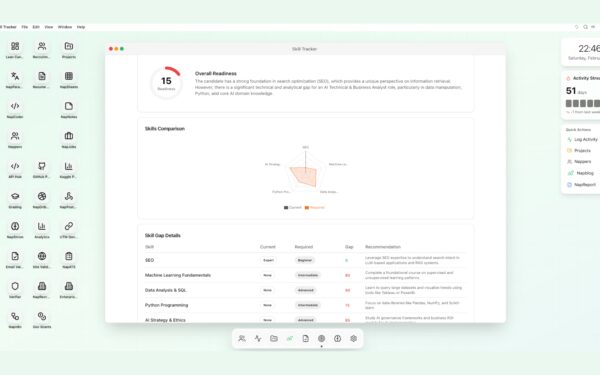
Inside Nap OS, learners build portfolios through real execution.
This means:
research outputs,
project documentation,
problem-solving workflows,
analytics,
content systems,
simulations,
technical deliverables,
case-based execution,
industry-relevant evidence.
Every activity leaves proof.
The future of hiring is unlikely to rely purely on trust.
It will increasingly rely on verification.
Europe already values compliance.
The next evolution is employability compliance.
Can capability be validated?
Can outcomes be evidenced?
Can skills be measured through execution?
Nap OS believes the answer is yes.
Building a European Employability Infrastructure
The long-term opportunity is not merely helping students find jobs.
The opportunity is building a European employability operating layer.
A system where:
universities understand career outcomes better,
students build verified evidence continuously,
recruiters reduce hiring uncertainty,
institutions strengthen employability metrics,
and governments improve talent retention.
Imagine a student ecosystem where:
a learner in Dublin builds execution evidence,
their qualifications align with European standards,
their portfolio becomes recruiter-readable,
their skills remain dynamically updated,
and employers can verify capability instantly.
This reduces friction everywhere.
For institutions.
For students.
For employers.
For regulators.
Infrastructure solves friction.
Qualification Interoperability: Europe’s Quiet Challenge
One of the biggest hidden inefficiencies in European education is qualification translation.
Students move across borders constantly.
Yet systems remain fragmented.
Questions repeatedly emerge:
How do qualifications compare?
What is equivalent?
How should credits transfer?
What progression routes exist?
This creates operational delays.
Nap OS sees long-term opportunity in building qualification interoperability systems.
Potentially supporting:
- NFQ ↔ EQF mapping
- ECTS recognition pathways
- admissions equivalency
- progression frameworks
- international academic comparability
As Europe becomes more mobile, interoperability becomes increasingly valuable.
The institutions that simplify movement will win.
The infrastructure providers that enable it may matter even more.
Why Compliance Is a Product, Not Paperwork
Most organisations treat compliance as administrative burden.
We disagree.
Compliance is infrastructure.
And infrastructure compounds.
Future-ready institutions increasingly require:
audit trails,
policy evidence,
student lifecycle visibility,
communication logging,
attendance systems,
quality assurance records,
escalation frameworks,
timestamped documentation.
These are not bureaucratic tasks.
They are trust systems.
Trust matters in education.
Trust matters in migration.
Trust matters in employability.
Trust matters in hiring.
Nap OS believes future education systems will increasingly become evidence systems.
Not assumption systems.
Multi-Institution Infrastructure: Thinking Beyond One University
Another important shift is scale.
Modern educational infrastructure cannot be designed for one institution alone.
It must become multi-tenant.
Meaning:
multiple universities,
multiple workflows,
multiple countries,
multiple compliance requirements,
multiple employability systems.
Each institution may operate differently.
Yet underneath, operational logic often overlaps.
Nap OS sees opportunity in configurable infrastructure.
Where workflows adapt to:
country regulations,
institutional policies,
programme structures,
student categories,
and compliance environments.
The future may not belong to institutions with the biggest campuses.
It may belong to systems with the strongest orchestration.
Why Human Connection Still Matters
Technology alone does not solve employability.
This is important.
Students do not only need systems.
They need confidence.
Context.
Mentorship.
Guidance.
Networks.
Belonging.
Nap OS believes the strongest infrastructure blends:
technology,
execution,
verification,
and human support.
Because careers remain deeply human.
Students rarely fail because of intelligence.
They fail because navigation is unclear.
Execution becomes inconsistent.
Feedback arrives too late.
Or opportunity feels invisible.
Technology helps.
But systems must remain human-centred.
The European Expansion Opportunity
If Europe increasingly values:
internationalisation,
cross-border learning,
mobility,
career outcomes,
quality assurance,
and digital infrastructure,
then a larger opportunity emerges.
A phased path becomes possible.
Phase 1: Ireland
Build operational proof.
Strengthen institutional collaboration.
Validate employability outcomes.
Improve compliance maturity.
Establish infrastructure reliability.
Phase 2: Multi-Institution Expansion
Expand partnerships.
Create reusable workflows.
Build stronger employability evidence systems.
Support broader institutional needs.
Phase 3: Europe
Target countries facing operational complexity:
France.
Germany.
Netherlands.
Spain.
Nordic countries.
Especially institutions seeking:
better international student systems,
career readiness infrastructure,
workflow automation,
and operational simplification.
The need already exists.
The question is who builds the layer.
The Biggest Strategic Mistake to Avoid
There is a dangerous trap many education companies fall into.
Becoming:
a consultancy with software.
That model rarely scales.
The stronger path?
Infrastructure with services attached.
This distinction changes everything.
Services support adoption.
Infrastructure creates longevity.
The companies remembered decades later are usually infrastructure companies.
They quietly become indispensable.
A 75-Year View of Education
At Napblog Limited, we think long-term.
Not quarterly.
Not annual.
But generationally.
The future of higher education will likely become:
more international,
more modular,
more evidence-based,
more interoperable,
more outcome-focused,
and more compliance-driven.
Students will increasingly expect:
career visibility,
verified capability,
cross-border portability,
real-world execution,
and measurable outcomes.
Universities will increasingly need:
better systems,
better orchestration,
better employability infrastructure,
and stronger operational transparency.
The opportunity is not merely to build software.
The opportunity is to help redesign how trust operates in education and careers.
Final Thought: Europe Does Not Need More Noise. It Needs Better Systems.
Education is not broken.
But the infrastructure surrounding education is evolving faster than institutions can adapt.
Students deserve more than uncertainty.
Universities deserve better operational systems.
Employers deserve more trustworthy signals.
Governments deserve stronger visibility.
Europe already has world-class education.
What it may still be missing is the operating layer that helps everything work together.
Nap OS is not claiming to have solved the entire system.
But we believe the question is worth asking:
What if education, employability, compliance, and execution could finally operate inside one connected system?
That future may arrive sooner than many expect.
And if it does, Europe will not simply need better universities.
It will need better infrastructure.