Last updated: May 29, 2026
6 min read
The conversation around artificial intelligence has shifted rapidly over the past few years.
At first, AI was viewed as a productivity tool.
Then it became an automation layer.
Today, it is increasingly becoming a replacement layer.
Tasks once assigned to interns, graduates, and junior employees can now be completed by advanced AI systems within seconds.
Reports can be generated instantly.
Marketing copy can be produced automatically.
Code can be written through prompts.
Research summaries can be completed without human effort.
This has created a growing fear among students and early-career professionals:
“What happens if AI takes away entry-level jobs before we even get started?”
At Napblog Limited, we believe this fear is valid—but incomplete.
AI is not simply replacing jobs.
It is replacing low-signal work.
The future does not belong to individuals who only consume information.
It belongs to individuals who can execute, adapt, validate, and integrate human judgment into systems powered by AI.
This is exactly why Nap OS was built.
Nap OS is not designed to compete against AI.
It is designed to position students beyond the layer AI can easily replace.
The Real Threat Is Not AI — It Is Invisible Capability
Most students assume the problem is AI automation.
But the deeper issue is this:
Traditional systems fail to prove real capability.
A resume cannot demonstrate execution.
A certificate cannot validate ownership.
A degree alone cannot show adaptability.
When employers cannot verify capability, they naturally move toward cheaper and faster alternatives—including AI systems.
This creates a dangerous cycle:
- Entry-level workers lack proof
- Employers reduce hiring risk using automation
- Students struggle to gain experience
- AI continues replacing repetitive tasks
Nap OS interrupts this cycle through a portfolio-based execution hiring system.
The Shift From Knowledge Economy to Execution Economy
For decades, education systems rewarded knowledge retention.
The future workforce rewards execution.
This is one of the most important transitions happening globally.
In the past:
- Knowing information created value
Today:
- Applying information creates value
And increasingly:
- Validating execution creates value
AI systems can generate information.
But they still struggle with:
- Long-term ownership
- Contextual judgment
- Human adaptability
- Relationship-driven execution
- Accountability
- Cross-domain synthesis
Nap OS trains students precisely in these areas.
Why Entry-Level Jobs Are Vulnerable
Entry-level jobs are often built around repetitive operational tasks.
These include:
- Basic reporting
- Data entry
- Content drafting
- Scheduling
- Administrative coordination
- Initial research
- Simple analysis
AI systems are becoming highly effective at these functions.
This means companies are beginning to ask:
“Why hire someone for predictable tasks when AI can perform them instantly?”
This does not mean humans become irrelevant.
It means the value threshold increases.
Students now need to demonstrate:
- Initiative
- Workflow thinking
- Tool integration
- Problem-solving ability
- Evidence-backed execution
Nap OS prepares students for this shift.
Nap OS: Building Human-AI Employability
Nap OS operates on a core belief:
The future employee is not anti-AI.
The future employee is AI-augmented.
Students using Nap OS learn how to:
- Work with AI tools
- Validate AI-generated outputs
- Structure workflows
- Create measurable outcomes
- Document execution processes
This transforms AI from a threat into a leverage layer.
The student becomes:
- Faster
- More organised
- More analytical
- More execution-focused
But most importantly, still human.
Portfolio-Based Skill Execution Hiring
Traditional hiring systems rely heavily on static indicators:
- Degrees
- CVs
- Certifications
- Self-written skill claims
Nap OS introduces a different model:
Portfolio-based execution hiring.
In this system, candidates are evaluated through:
- Real outputs
- Live execution evidence
- Documented workflows
- Consistency patterns
- Traceable project work
This changes hiring from:
“Tell us what you know.”
To:
“Show us what you have done.”
This distinction is critical in the AI era.
Because AI can generate answers.
But sustained execution still requires human ownership.
How Nap OS Creates Execution Evidence
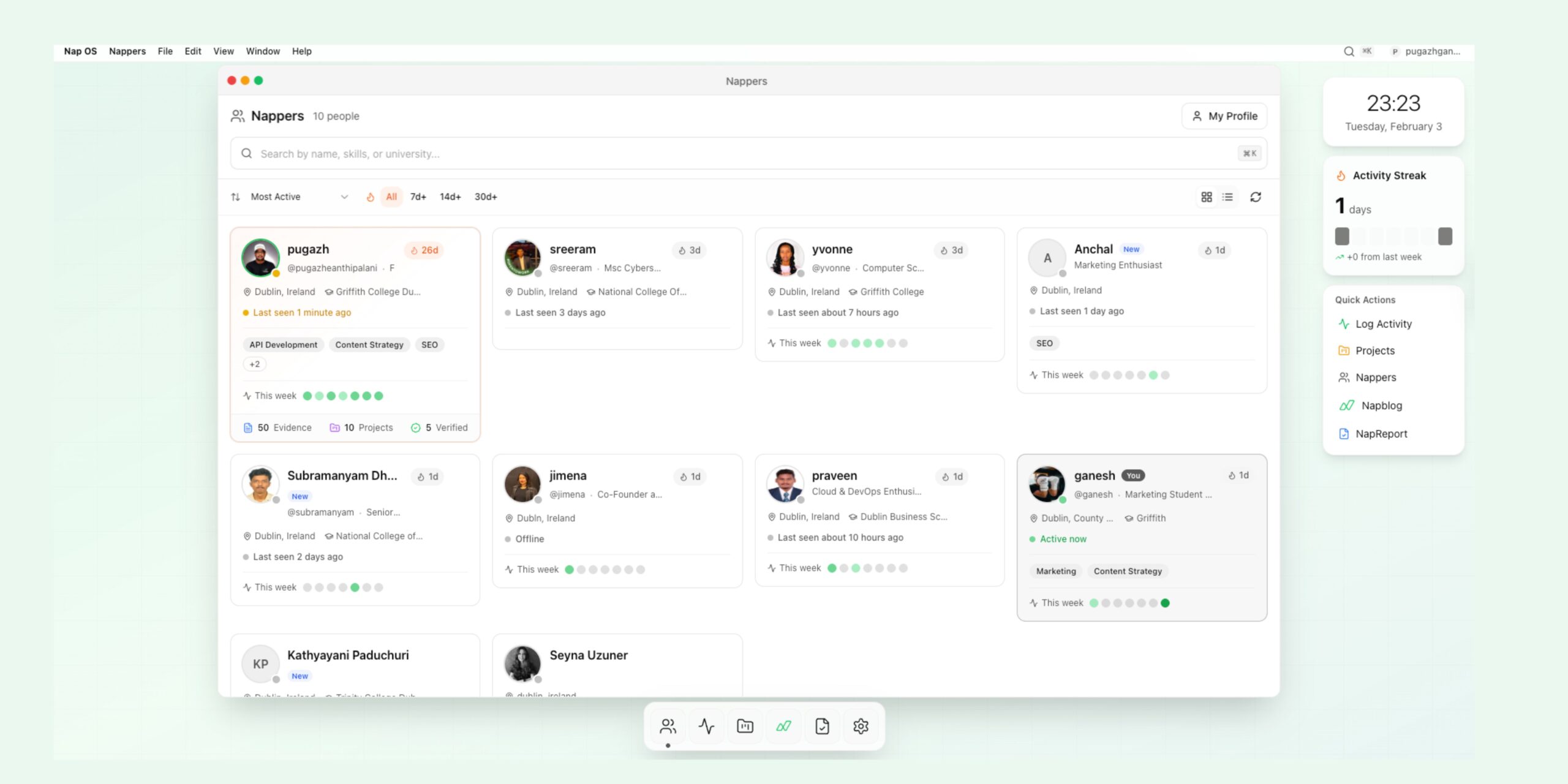
Inside Nap OS, students perform structured tasks that simulate real work environments.
These tasks produce outputs such as:
- Marketing campaigns
- Research documents
- Workflow systems
- Dashboards
- Content assets
- Strategic analyses
- Automation setups
Each output becomes part of a live portfolio.
The system tracks:
- What was completed
- Which tools were used
- How decisions were made
- How consistently work was delivered
This creates employability evidence that is difficult to fake.
Why Portfolios Matter More in the AI Era
In an AI-driven economy, resumes become weaker signals.
Why?
Because AI can help anyone optimise a resume.
But portfolios expose depth.
A strong portfolio reveals:
- Thinking patterns
- Execution quality
- Problem-solving ability
- Communication style
- Initiative
- Consistency
These are much harder to automate convincingly.
Nap OS positions students around these stronger signals.
Simulated Work Environments Create Real Readiness
One of the biggest challenges students face is lack of experience.
Employers ask for experience.
Students need jobs to gain experience.
Nap OS solves this through reverse-engineered work simulation.
Students execute role-based tasks using real tools in structured environments.
This creates:
- Workflow familiarity
- Operational understanding
- Practical confidence
By the time students apply for jobs, they are no longer approaching employers as purely academic candidates.
They already have operational exposure.
AI Alone Cannot Replace Human Trust
A critical misconception is that companies only care about output speed.
In reality, companies also care about:
- Reliability
- Accountability
- Communication
- Ownership
- Adaptability
AI systems can generate outputs.
But businesses still rely heavily on human trust.
Nap OS strengthens this human trust layer through:
- Verified execution tracking
- Consistency systems
- Evidence-backed portfolios
- Identity-linked work validation
This makes candidates more trustworthy.
The Importance of Human Context
AI lacks lived experience.
It lacks emotional understanding.
It lacks long-term relational memory.
It lacks situational awareness beyond its training.
Students trained through Nap OS develop contextual intelligence by:
- Working across projects
- Managing ambiguity
- Iterating on feedback
- Reflecting on execution outcomes
This creates practical intelligence that extends beyond AI-generated outputs.
The Rise of Hybrid Workers
The future workforce will likely divide into three groups:
1. AI-Replaced Workers
Individuals performing repetitive, low-context tasks without adaptability.
2. AI-Dependent Workers
Individuals relying entirely on AI without developing core thinking or execution capabilities.
3. Hybrid Execution Workers
Individuals who combine:
- Human judgment
- AI leverage
- Workflow execution
- Strategic thinking
- Real-world adaptability
Nap OS is designed to create the third category.
Nap OS and Continuous Skill Evolution
The problem with static education is that industries evolve faster than curricula.
AI accelerates this gap even further.
Nap OS solves this through continuous execution.
Students constantly:
- Update workflows
- Learn new tools
- Adapt to market trends
- Expand their execution capabilities
This creates dynamic employability rather than static qualification.
Why Human Relationships Still Matter
One area AI cannot easily replace is meaningful human connection.
Opportunities often emerge through:
- Trust
- Reputation
- Collaboration
- Communication
- Reliability
Nap OS encourages students to build:
- Public execution histories
- Transparent workflows
- Collaborative projects
- Professional visibility
This increases real human opportunities.
Because careers are not built only through skills.
They are built through relationships backed by evidence.
The Psychological Impact of Execution
Many students today experience anxiety around AI.
They fear becoming irrelevant before they even begin their careers.
Nap OS addresses this psychologically as well.
Execution creates confidence.
When students consistently:
- Build
- Ship
- Document
- Improve
They stop feeling powerless.
They begin seeing themselves as contributors rather than victims of technological change.
Why Companies Still Need Humans
Despite rapid AI advancement, companies still require humans to:
- Interpret complexity
- Manage stakeholders
- Build culture
- Navigate uncertainty
- Make ethical decisions
- Create trust
AI enhances systems.
Humans align systems with purpose.
Nap OS trains students to operate within this higher-value layer.
The Long-Term Vision of Nap OS
Nap OS is not just preparing students for current jobs.
It is preparing them for a continuously evolving economy.
This includes:
- AI-integrated workflows
- Portfolio-first hiring
- Evidence-based employability
- Continuous learning systems
- Execution-driven career development
Over time, the system aims to create a generation of professionals who are:
- Adaptable
- Technically fluent
- Operationally capable
- Human-centered
Conclusion
AI is changing the structure of entry-level work.
This change is real.
But the solution is not fear.
And it is not resistance.
The solution is adaptation through execution.
Nap OS helps students move beyond fragile career signals like static resumes and generic certifications by creating a portfolio-based execution hiring system built for the AI era.
Through:
- Real work simulation
- Verified portfolios
- Continuous execution
- Human-AI collaboration
- Evidence-backed employability
Students become more than applicants.
They become provable contributors.
The future will not belong to those who simply know information.
Nor to those who rely entirely on automation.
It will belong to individuals who can combine:
Human judgment,
AI leverage,
and consistent execution.
That is the future Nap OS is building toward.