Last updated: May 29, 2026
7 min read
At Napblog Limited, we believe in radical transparency when it comes to digital growth. Instead of presenting polished success stories without context, we prefer to share real data, real outcomes, and real lessons. Q1 2026 marked an important phase in our development: not because everything worked perfectly, but because the analytics revealed exactly what is working, what is not working yet, and where the biggest strategic opportunities lie.
This article breaks down Napblog Limited’s LinkedIn-driven performance during Q1 2026 using Google Analytics data, and more importantly, explains what other startups can learn from it. The goal is not simply to present numbers, but to interpret them in a way that helps founders, early-stage marketers, and product-driven companies understand how real traction develops.
1. The Core Numbers: What Actually Happened in Q1 2026
Let’s start with the raw results.
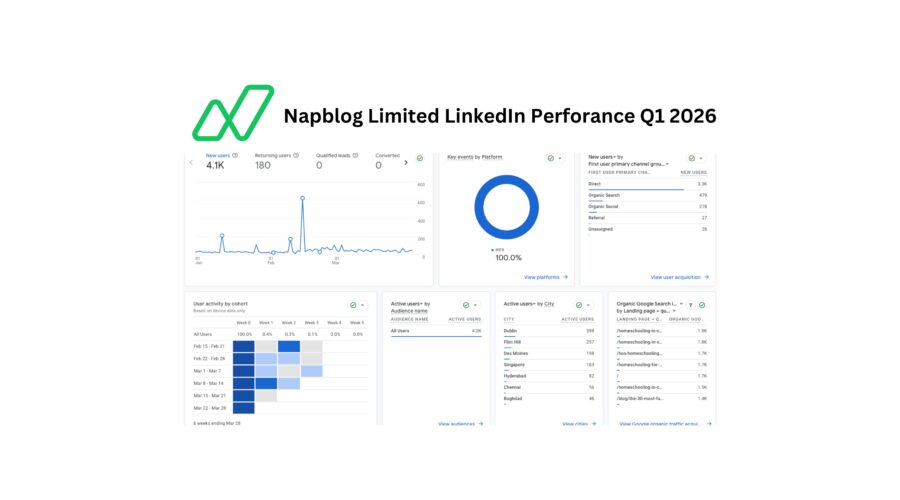
During Q1 2026, Napblog Limited recorded:
- 4.1K new users
- 180 returning users
- 0 qualified leads
- 0 converted leads
- 4.2K total active users
- LinkedIn generated 380 sessions
- Organic search generated 644 sessions
- Direct traffic dominated at over 80% of total users
At first glance, many startups would consider this disappointing because there are no converted leads. However, this would be a misunderstanding of how early-stage content-driven growth actually works. The key insight is not the lack of conversions. The key insight is that attention is growing faster than conversion infrastructure.
This is extremely common in the first serious growth phase of a startup.
2. LinkedIn Was Not the Largest Traffic Source — But It Was One of the Most Strategic
LinkedIn contributed:
- 204 users from linkedin.com referral
- Additional sessions from shortened LinkedIn links and campaign-based posts
- A total impact of roughly 10% of all non-direct traffic
This is significant for one reason: LinkedIn traffic is usually higher-intent traffic than most other social platforms.
While platforms like Instagram or Snapchat may generate views quickly, LinkedIn users are far more likely to:
- Read long-form articles
- Click through to strategy-based content
- Spend more time per session
- Return later
In fact, the analytics show that LinkedIn users had longer engagement times than direct traffic users, which suggests that the platform is not just sending random visitors. It is sending people who are genuinely interested in what Napblog Limited is building.
For startups, this is a critical insight: quality of traffic matters more than quantity of traffic in the early stage.
3. Organic Search and LinkedIn Are Starting to Reinforce Each Other
One of the most interesting patterns in the data is the relationship between LinkedIn posts and organic search growth.
The most viewed pages during Q1 2026 were not generic marketing articles. Instead, they were highly specific, strategic long-form articles such as:
- Homeschooling in China
- Homeschooling in Switzerland
- Homeschooling in California 2026
- Homeschooling in Ireland
- Long-form strategic education content
These pages generated between 1.4K and 1.9K search impressions each.
This tells us something important: LinkedIn is not just a traffic source. It is acting as a content amplifier that helps search visibility grow faster.
When articles are shared on LinkedIn:
- They receive initial attention.
- That attention increases engagement signals.
- Google notices stronger engagement patterns.
- The articles gain more impressions in search.
- Organic traffic begins to grow without additional promotion.
This is one of the most powerful early-stage growth loops available to startups today.
4. The Biggest Problem: Traffic Without Conversion Is Still Just Traffic
Although user growth is strong, the data clearly shows:
- 0 qualified leads
- 0 converted leads
- Very low engagement per session for direct users
- Limited returning users (only 180)
This is not a failure. It is a structural issue that almost every startup experiences during the early content-driven stage.
The problem is not that the audience is uninterested. The problem is that the conversion architecture is not yet aligned with the content strategy.
In simple terms:
People are discovering Napblog Limited
But they do not yet know what to do next
This is one of the most important lessons for early startups. Content alone does not generate leads. Content generates attention. Conversion systems generate leads.
5. What the Cohort Data Tells Us About Audience Behaviour
The user cohort table reveals another key insight: retention drops almost immediately after the first visit.
Week-to-week retention looks roughly like this:
- Week 0: 100%
- Week 1: 0.4%
- Week 2: 0.3%
- Week 3: 0.1%
- Week 4: 0.0%
This means users are discovering the content, reading it once, and not returning.
Why is this happening?
Because Napblog Limited is currently positioned as a content discovery brand, not yet as a community brand.
To improve retention, startups must do one of the following:
- Build a newsletter
- Build a repeat content series
- Create a recognizable product ecosystem
- Create content that connects to a long-term mission
Retention is not about traffic. It is about identity. When users feel that a brand stands for something meaningful, they return.
6. The Geography of Growth: Why Global Reach Matters Early
The active users by city show a very interesting distribution:
- Dublin
- Flint Hill
- Des Moines
- Singapore
- Hyderabad
- Chennai
- Baghdad
This is not a typical startup traffic pattern. Most early startups receive almost all of their traffic from one country. Napblog Limited is already showing global audience diversity.
This matters because it validates the strategic direction of the company. Instead of building content that is limited to one national audience, Napblog Limited is building content that works across:
- Europe
- The United States
- Asia
- Emerging digital markets
For new startups, this is a powerful lesson: global relevance increases growth speed.
A startup that builds only for one region grows slowly. A startup that builds content that works globally can scale much faster, even without advertising.
7. The Direct Traffic Problem — and Why It Is Not Actually a Problem
More than 80% of users came from direct traffic.
Many people misunderstand this metric. They assume direct traffic means people are typing the website into the browser manually. That is rarely true.
Direct traffic often includes:
- Links shared privately
- Links opened from mobile apps
- Links opened from LinkedIn without proper tracking
- Links opened from email
- Links opened from AI tools like ChatGPT
In fact, the data already shows that users are arriving from platforms like:
- ChatGPT
- Google AI tools
- Various search engines
- Referral platforms
This means Napblog Limited is starting to gain attention outside traditional marketing channels.
For startups, this is one of the most important developments in 2026: traffic is no longer only coming from Google or social media. It is coming from AI discovery platforms.
8. LinkedIn Is Working — But It Needs a More Focused Strategy
The LinkedIn traffic shows promise, but it also reveals a clear opportunity for improvement.
At the moment, LinkedIn is:
- Generating visibility
- Generating clicks
- Generating awareness
But it is not yet generating:
- Leads
- Product sign-ups
- Strategic partnerships
- Community growth
This means the problem is not the platform. The problem is the content structure on the platform.
To improve results, LinkedIn posts should focus more on:
- Clear positioning (what Napblog Limited actually builds)
- Clear problem statements (what problems are being solved)
- Clear call-to-action posts (what users should do next)
- More storytelling content (how the company is evolving)
LinkedIn rewards clarity more than frequency. Posting more content is not the solution. Posting more strategic content is the solution.
9. What This Means for New Startups in 2026
The biggest lesson from the Q1 2026 data is this:
Growth in 2026 is not about paid ads first.
Growth is about strategic attention first.
Napblog Limited has already achieved something that many startups struggle with:
- Thousands of users
- Global visibility
- Organic search traction
- Recognition across multiple platforms
What is missing is not attention. What is missing is conversion structure and positioning clarity.
For new startups, the lesson is simple:
Do not focus on conversions too early
Focus on building strategic attention first
Once attention exists, conversion systems can be built much more effectively.
10. The Most Important Lesson: Momentum Is Already Visible
Even though Q1 2026 did not produce leads yet, the data shows something more valuable: momentum.
Momentum can be seen in:
- Rising organic impressions
- Multiple articles ranking in search
- Growing direct traffic
- International audience growth
- LinkedIn traffic that is slowly increasing month by month
Startups do not fail because they grow slowly. They fail because they grow inconsistently. Napblog Limited is showing consistent growth patterns, and consistency is the most powerful signal in early-stage analytics.
11. What Napblog Limited Will Improve Going Forward
Based on the Q1 2026 analytics, the next phase of growth will focus on:
1. Converting attention into leads
This means introducing:
- Strategic landing pages
- Clear product explanations
- Email capture systems
- Call-to-action content
2. Strengthening the LinkedIn strategy
This means focusing on:
- High-value posts instead of frequent posts
- Founder-driven storytelling
- Thought leadership positioning
- Clear audience targeting
3. Improving retention
This means:
- Building repeat content themes
- Creating stronger brand identity
- Connecting all content to long-term strategic goals
12. Final Thoughts: Why Transparency Matters
Many companies only share success stories. Very few companies share real data when the results are still developing. Napblog Limited believes that transparency builds trust, and trust builds long-term growth.
Q1 2026 was not about conversions.
It was about building visibility.
It was about building momentum.
It was about building a global audience.
For new startups, the lesson is clear:
You do not need perfect results in the beginning.
You only need consistent progress.
The analytics show that Napblog Limited is moving in the right direction. LinkedIn is contributing real traffic. Organic search is growing. Global attention is increasing. The next stage is simply turning that attention into structured growth.