Last updated: May 29, 2026
5 min read
There is a moment every student waits for.
Graduation day.
A stage.
A name being called.
A certificate handed over.
A photograph captured.
For years of effort, this becomes the symbol of completion.
The degree certificate represents:
- Time invested
- Exams passed
- Curriculum completed
But here is a question that is rarely asked:
Why is this certificate seen only once with pride, but rarely seen again with purpose?
Why does it not travel with the student into every opportunity?
Why does it not speak loudly in front of every employer?
And more importantly:
Why does something so significant become so invisible?
Nap OS exists to answer this question.
The Static Nature of a Degree
A degree certificate is static.
It is a snapshot of:
- Completion
- Qualification
- Eligibility
It tells the world:
“This person has finished something.”
But it does not tell:
- What the person can actually do
- How they think
- How they solve problems
- How they execute under pressure
It represents the past, not the present.
And certainly not the future.
This is the fundamental limitation.
Because the world of work does not operate on static validation.
It operates on:
Dynamic capability
Visibility vs Reality
Students believe their degree holds value.
And it does.
But only in specific contexts:
- Initial screening
- Eligibility checks
- Formal requirements
Beyond that, its influence fades.
Employers don’t repeatedly ask to see a certificate.
They ask questions like:
- “What have you worked on?”
- “Can you show me your experience?”
- “How do you approach problems?”
The degree becomes background noise.
Not because it lacks importance,
but because it lacks visibility of capability.
The One-Day Peak Problem
Graduation day is the peak moment of the degree.
It is celebrated.
Shared.
Recognized.
But after that day:
- It is stored in a folder
- Uploaded once to a profile
- Rarely revisited
This creates what we call:
The One-Day Peak Problem
Years of effort lead to a single moment of visibility.
After that, the signal weakens.
This is not efficient.
Because effort should compound visibility,
not collapse into a single event.
The Changing Nature of Work
Work has changed.
Careers are no longer linear.
Roles are evolving faster than curriculum.
Skills are becoming:
- Dynamic
- Interdisciplinary
- Execution-driven
In this environment:
A static certificate struggles to represent a moving individual.
What is needed is:
A system that evolves with the person
Why Employers Don’t Rely on Certificates
This is not about employers ignoring degrees.
It is about employers needing more.
A certificate answers:
“Did you complete something?”
But hiring decisions require answers to:
- “Can you perform?”
- “Can you adapt?”
- “Can you deliver?”
These cannot be inferred from a document.
They must be observed.
This is why employers shift their focus to:
- Projects
- Work samples
- Case studies
- Real outputs
They are not rejecting degrees.
They are compensating for their limitations.
The Rise of the Portfolio
A portfolio is fundamentally different from a degree.
It is:
- Dynamic
- Evidence-based
- Continuously evolving
It answers questions in real-time:
- What has this person done recently?
- How has their thinking improved?
- What kind of problems have they solved?
Unlike a certificate, a portfolio:
Does not expire in relevance
It grows.
But Traditional Portfolios Are Broken Too
Even portfolios, in their current form, have issues:
- They are manually curated
- Often incomplete
- Lack verification
- Focus on presentation over substance
This creates another problem:
Trust
Can employers trust what they see?
Is the work authentic?
Was it actually executed by the individual?
This is where most systems fail again.
Nap OS — Continuous Visibility of Capability
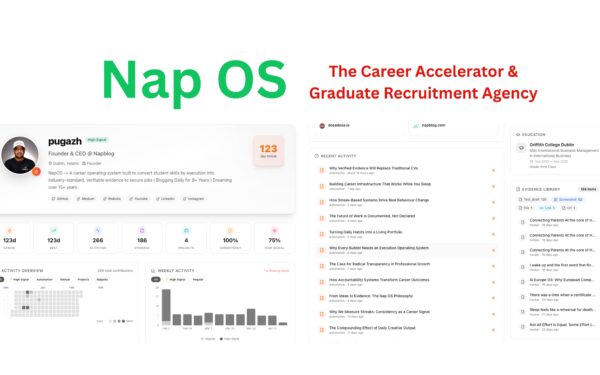
Nap OS solves this by transforming portfolios into:
Continuous, system-generated evidence streams
Instead of:
Manually adding work
It captures:
- Real execution
- Process
- Iterations
- Outputs
As they happen.
This creates a living portfolio.
Not something you build once.
But something that builds itself through action.
From Event-Based Recognition to Process-Based Visibility
A degree certificate is:
Event-based recognition
Nap OS introduces:
Process-based visibility
This means:
Every action contributes to identity.
Every project adds proof.
Every iteration improves credibility.
Instead of waiting for:
Graduation day
Students experience:
Daily validation through execution.
Continuous Improvement as Identity
One of the most powerful shifts Nap OS introduces is:
Identity through improvement
Students are no longer defined by:
- Their degree
- Their college
- Their final grade
They are defined by:
- Their consistency
- Their growth
- Their execution patterns
This creates a more accurate representation of capability.
Because real-world success is not about:
What you completed once
It is about:
What you can continuously do
Visibility That Travels
A degree certificate is location-bound.
It sits:
- In a folder
- On a wall
- In a PDF
A Nap OS portfolio is:
- Shareable
- Accessible
- Continuously updated
It travels with the individual across:
- Opportunities
- Applications
- Conversations
It doesn’t need to be requested.
It is already visible.
From Permission to Proof
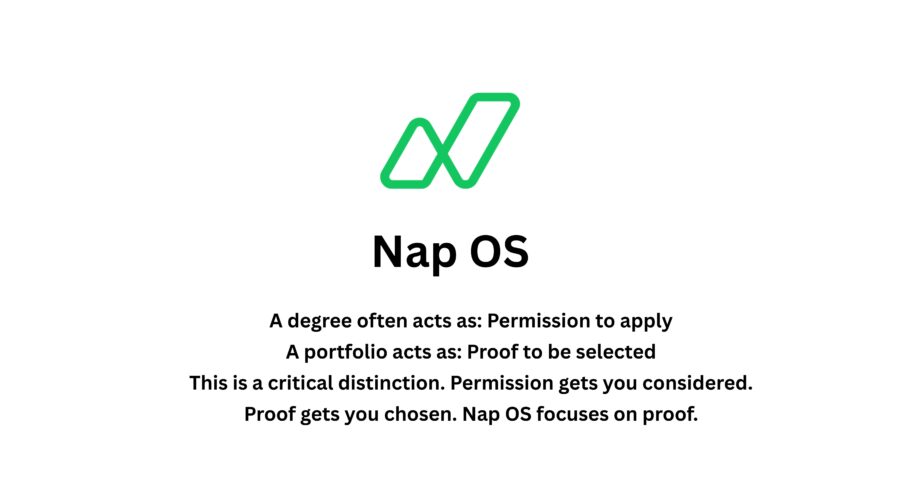
A degree often acts as:
Permission to apply
A portfolio acts as:
Proof to be selected
This is a critical distinction.
Permission gets you considered.
Proof gets you chosen.
Nap OS focuses on proof.
Reducing Career Anxiety
One of the biggest struggles students face is:
Uncertainty.
- “Am I good enough?”
- “What should I do next?”
- “Why am I not getting selected?”
This uncertainty exists because:
There is no continuous feedback loop.
Nap OS changes this.
Through:
- Execution tracking
- Output visibility
- Progress measurement
Students gain clarity.
They no longer guess their readiness.
They see it.
The Psychological Shift
This is not just a structural change.
It is a psychological one.
Students move from:
Waiting for validation
To:
Creating validation
From:
Fear of judgment
To:
Confidence through evidence
This shift is powerful.
Because it builds:
- Self-belief
- Ownership
- Direction
Long-Term Career Compounding
A degree stops growing after graduation.
A portfolio compounds.
Year after year, it accumulates:
- Experience
- Complexity
- Depth
This creates long-term advantage.
Because over time:
The difference between static and dynamic becomes exponential.
Institutional Evolution
Nap OS doesn’t eliminate degrees.
It complements them.
It allows institutions to move from:
Certification providers
To:
Capability enablers
By integrating continuous execution tracking,
universities can ensure that:
Students don’t just graduate.
They demonstrate readiness.
The Future of Professional Identity
In the future, professional identity will not be defined by:
- Where you studied
- What degree you hold
It will be defined by:
What you have consistently built
This requires:
- Systems
- Infrastructure
- Continuous validation
Nap OS is building that foundation.
Conclusion
A degree certificate is important.
It represents effort, discipline, and completion.
But it is not enough.
Because the world does not operate on completed effort.
It operates on visible capability.
The reason a degree is seen once
and a portfolio is seen repeatedly
is simple:
One represents the past.
The other represents the present.
Nap OS ensures that:
The present is always visible.
It transforms careers from:
One-day recognition
To:
Lifelong proof
And in doing so, it answers the most important question:
Not “What have you studied?”
But:
“What can you show?”