Last updated: May 29, 2026
6 min read
Across the European Union, billions in funding, policy shifts, and institutional programs are converging toward one clear outcome:
AI is no longer a function. It is becoming the foundation of how jobs are created, shaped, and scaled.
From the launch of the EU AI Skills Academy to Horizon Europe’s €14 billion allocation for research and innovation, the direction is clear — Europe is investing heavily in building a multi-disciplinary AI talent pool that goes beyond engineers.
But here’s the real question:
Who is going to translate this funding into real, usable, scalable talent?
This is where AI Europe OS by Napblog Limited steps in — not as a tool, but as an operating system for the future workforce.
The Shift: From AI Specialists to Multi-Disciplinary Builders
For the past decade, AI hiring was simple:
- Hire data scientists
- Hire machine learning engineers
- Build models
- Deploy
That model is now outdated.
The 2026 EU talent strategy clearly signals a shift:
From:
- Pure technical roles
To:
- AI-integrated professionals across domains
This includes:
- AI Product Managers
- AI-native Marketers
- AI-driven Healthcare Analysts
- AI Ethics & Governance Specialists
- AI-powered Operations Managers
The rise of “AI Generalists” — individuals who can apply AI in real-world domains — is now the most in-demand talent segment.
This is not a small change.
This is a complete redesign of how careers are built.
The Problem: Funding Exists, But Translation Is Broken
Europe has done something remarkable:
- €14 billion under Horizon Europe
- €100 million for interdisciplinary AI research (RAISE)
- €50 million under Marie Skłodowska-Curie Actions
- 15 AI Factories with shared compute infrastructure
- AI Skills Academy launching in 2026
On paper, this looks like a perfect system.
But in reality, there is a gap.
The gap is not funding.
The gap is translation.
Students don’t know how to:
- Position themselves in AI
- Build real-world projects
- Connect academic knowledge to industry needs
Companies don’t know how to:
- Identify multi-disciplinary AI talent
- Train non-technical teams effectively
- Integrate AI into existing workflows
This creates a paradox:
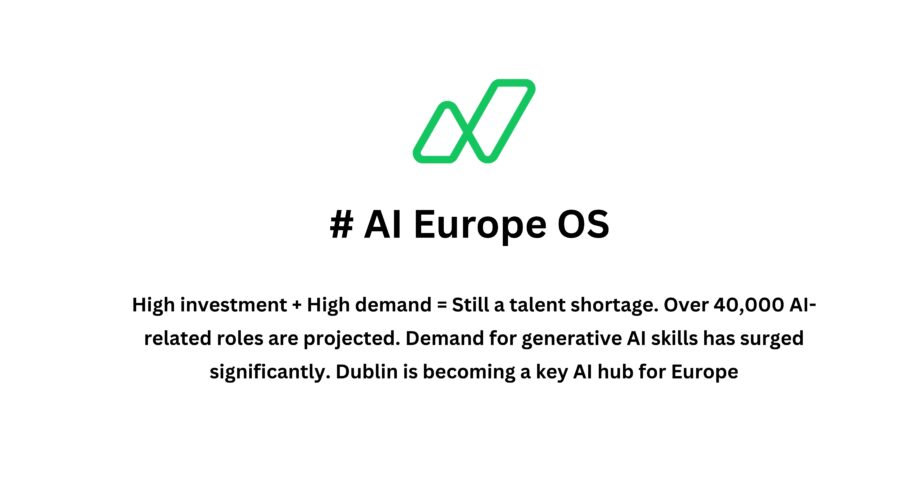
High investment + High demand = Still a talent shortage
Ireland: A Microcosm of Europe’s AI Opportunity
Take Ireland as an example.
By 2030:
- Over 40,000 AI-related roles are projected
- Demand for generative AI skills has surged significantly
- Dublin is becoming a key AI hub for Europe
Yet, most graduates are still:
- Degree-rich
- Skill-confused
- Directionless in AI positioning
This is not a talent problem.
This is a system design problem.
Introducing AI Europe OS: The Talent Operating System
AI Europe OS, developed by Napblog Limited, is designed to solve this exact gap.
It is not:
- A course
- A bootcamp
- A job board
It is an Operating System that sits between:
- Talent
- Industry
- AI tools
- Real-world problems
What AI Europe OS Actually Does
At its core, AI Europe OS transforms individuals into multi-disciplinary AI operators.
It does this through 5 layers:
1. Problem-First Learning
Instead of teaching tools, AI Europe OS starts with:
Real-world problems across industries
For example:
- How can AI improve patient diagnostics?
- How can AI optimize supply chains?
- How can AI increase marketing ROI?
This shifts thinking from:
“What tool should I learn?”
to
“What problem can I solve?”
2. AI-Native Skill Integration
Users learn to combine:
- Domain knowledge
- AI tools
- Decision-making frameworks
This creates hybrid intelligence, not just technical knowledge.
3. Real Project Execution
Every participant builds:
- Live use cases
- Portfolio-ready projects
- Industry-relevant solutions
This directly aligns with EU funding goals of:
Practical, deployable AI talent
4. Continuous Behavioural Tracking
Unlike traditional education systems, AI Europe OS tracks:
- Learning patterns
- Decision-making behaviour
- Problem-solving approach
This creates a data layer of human intelligence, which is critical for future AI systems.
5. Subscription-Based Growth Model
Instead of one-time learning:
- Users stay engaged
- Continuously evolve
- Adapt to new AI trends
This aligns with the reality that:
AI skills are not static — they are evolving assets
Why This Model Aligns with EU’s 2026 Vision
Let’s connect AI Europe OS directly to EU initiatives.
EU AI Skills Academy (2026)
Goal: Upskill professionals and create sectoral AI experts
AI Europe OS Role:
- Converts theoretical learning into real execution
- Bridges gap between training and application
Horizon Europe (€14 Billion)
Goal: Boost interdisciplinary research and careers
AI Europe OS Role:
- Prepares talent to participate in interdisciplinary projects
- Creates execution-ready individuals
EuroHPC AI Factories
Goal: Provide compute resources for AI innovation
AI Europe OS Role:
- Supplies trained individuals who can actually use this infrastructure
AI Governance & EU AI Act
By 2026:
- 60% of large companies will have AI governance roles
AI Europe OS Role:
- Develops professionals who understand both:
- AI systems
- Ethical & regulatory frameworks
The Bigger Vision: Job Creation Through Capability, Not Titles
Traditional job creation works like this:
- Create role
- Hire person
- Train them
AI Europe OS flips this:
- Build capability
- Let roles emerge
- Let industries adapt
This is crucial because:
AI is not replacing jobs — it is redefining them faster than institutions can react
Multi-Disciplinary Job Creation: The Real Outcome
The EU’s funding strategy is not just about jobs.
It’s about:
Creating a new category of professionals
AI Europe OS contributes by enabling:
New Hybrid Roles:
- AI + Marketing Strategist
- AI + Healthcare Analyst
- AI + Policy Advisor
- AI + Operations Architect
These are not traditional roles.
They are future roles being created in real-time.
Talent Retention: Solving Europe’s Brain Drain
One of Europe’s biggest challenges:
- Losing top talent to the US and other markets
EU’s response:
- Fellowships
- Funding
- Talent attraction programs
AI Europe OS adds a new layer:
Relevance
When individuals feel:
- Skilled
- Adaptable
- Future-proof
They are more likely to stay.
Gender Diversity and Inclusive Growth
Current statistics:
- Only ~23% of AI roles in Europe are held by women
AI Europe OS addresses this by:
- Removing technical barriers
- Focusing on problem-solving, not coding alone
- Enabling non-traditional entrants
This creates a more inclusive AI workforce.
The Rise of Agentic AI and What It Means
2026 is also marked by the rise of:
Agentic AI systems
(Multi-agent, autonomous decision-making systems)
This requires:
- Systems thinking
- Behaviour understanding
- Cross-domain knowledge
AI Europe OS is designed exactly for this shift.
Why Napblog Limited Is Building This
Napblog Limited has always operated differently.
Instead of chasing trends, it focuses on:
- Long-term value creation
- Behavioural understanding
- Founder-led narrative building
AI Europe OS is not just a product.
It is a model for future startup ecosystems.
What Startups and Founders Can Learn
1. Don’t follow the market — understand where it’s going
2. Build systems, not just products
3. Focus on capability creation, not job titles
4. Align with macro trends (like EU funding)
5. Think in ecosystems, not features
Conclusion: The Future Is Not AI vs Humans — It Is AI + Humans
Europe’s 2026 strategy is clear:
- AI will grow
- Jobs will evolve
- Skills will shift
- Systems will change
The winners will not be:
- The best coders
- The biggest companies
But:
Those who can integrate AI into real-world thinking
AI Europe OS by Napblog Limited is built for exactly that.
Not to teach AI.
But to create:
Humans who can think, act, and build with AI as a natural extension of themselves
Final Thought
The biggest opportunity in Europe right now is not funding.
It is:
Turning that funding into real, capable, adaptable human intelligence
That is the mission of AI Europe OS.
And 2026 is just the beginning.